 AI Chatbots
Do Small Businesses In Tanzania Need An AI Assistant?
Beatha Beichumila
Last Updated :
17th June 2026
By Fauzia Ibrahim
Product Specialist
Share this article with your friends
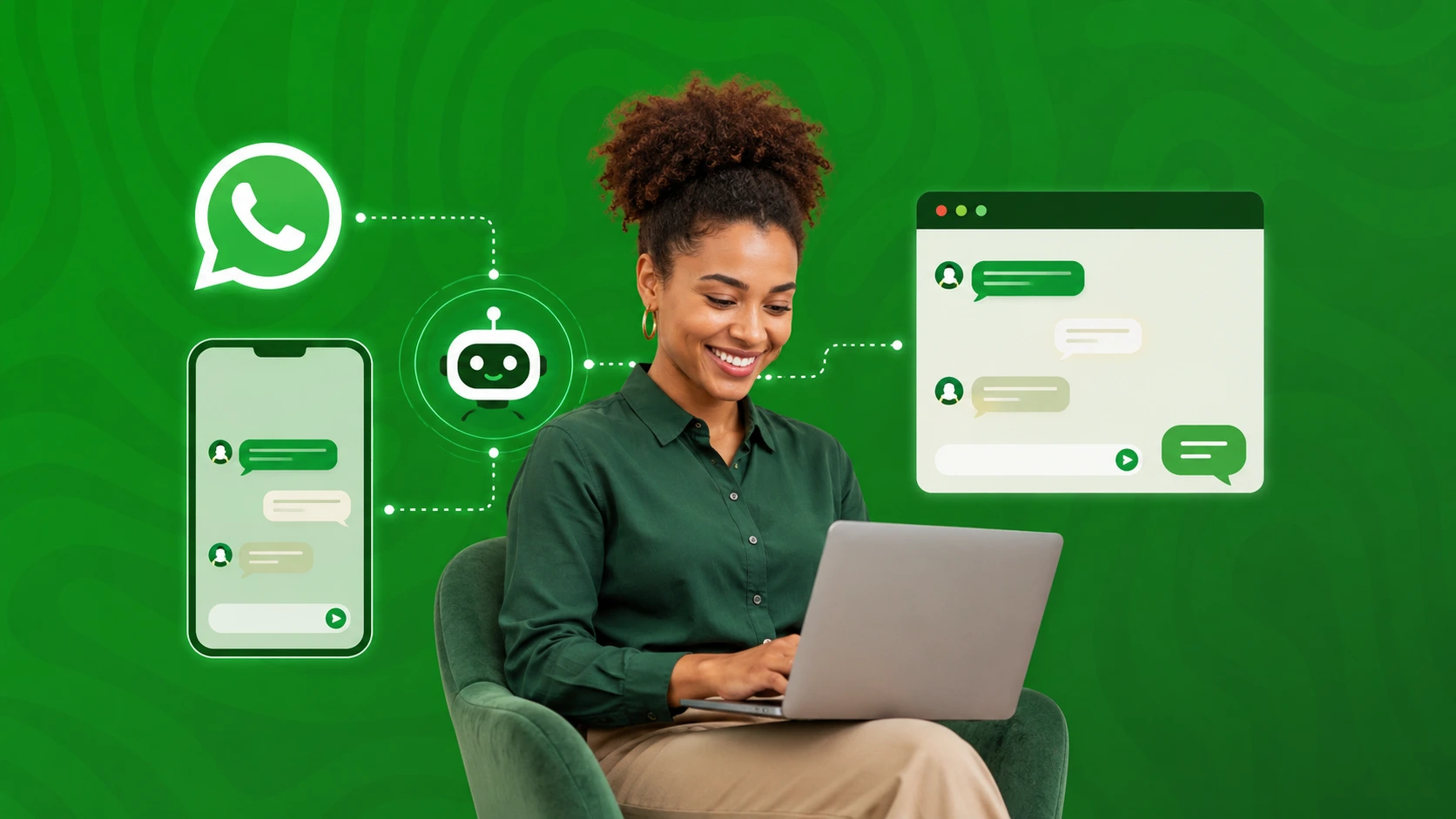
Combining WhatsApp and website chatbots means connecting your live chat widget and your WhatsApp Business number to the same AI assistant, knowledge base, and conversation history. The result is a single conversational layer where a customer can start a question on your website, continue on WhatsApp, and reach a human agent without ever repeating themselves.
Most businesses run two disconnected conversations. The website chatbot answers a visitor at 10 a.m., the WhatsApp number takes over at 8 p.m., and neither side knows what the other said. The customer ends up repeating their order number three times, the support team copies and pastes the same answers all day, and qualified leads quietly slip through the cracks because no one followed up on the after-hours questions.
Combining WhatsApp and website chatbots solves that. When the two channels share an AI assistant, a single inbox, and one customer profile, every conversation becomes continuous. The visitor who asked about pricing on your homepage gets a personalised follow-up on WhatsApp the next morning. The buyer who messaged you on WhatsApp finds the same order status when they open your website. Your team stops switching tabs and starts closing tickets.
This guide explains how a unified web-plus-WhatsApp chatbot works, what it should be able to do, where the handoff to a human should sit, and how Tanzanian and East African businesses can build the whole layer on Notify Africa without writing a single line of code.
Combining the two channels means putting one brain behind both interfaces. The website widget and the WhatsApp number stop being separate inboxes and become two doorways into the same conversational system. The AI assistant remembers the customer across both, agents see a single thread, and every message — whether typed into a chat bubble or sent from a phone — feeds the same analytics dashboard.
This is different from simply installing a WhatsApp click-to-chat button on your site. A click-to-chat button moves the customer from one tool to another and leaves the website conversation behind. A combined setup keeps the conversation alive in both places at once.
A website chatbot lives inside the browser. The customer is anonymous until they fill in a form, the conversation ends when they close the tab, and your business has no way to message them back unless they handed over an email address or phone number first. Web chat is excellent for capturing intent in the exact moment a visitor is exploring a product page, but it is fragile — refresh the page and the context is gone.
WhatsApp is the opposite. Every customer is identified by a phone number, conversations persist on their device forever, and businesses can re-engage them later using approved message templates. The trade-off is structure: outbound messages must follow Meta's template rules, businesses operate inside a 24-hour customer-service window after each user message, and every interaction must comply with WhatsApp's opt-in requirements set out in the WhatsApp Business Messaging Policy.
Each channel solves a problem the other cannot. Combining them gives you the immediacy of web chat and the permanence of WhatsApp.
When the two channels share a backend, three things happen automatically. The AI assistant answers consistently because both surfaces draw from the same knowledge base. The human agent picks up where the bot left off because the full transcript travels with the customer.
And the customer never has to explain themselves twice — a frustration that PwC's long-running customer experience research has repeatedly identified as one of the top reasons consumers abandon a brand after a single bad interaction.
A unified layer also simplifies measurement. Instead of comparing a web-chat dashboard to a separate WhatsApp report, you see one funnel: visitor → conversation → qualified lead → handoff → resolution. That single view is what makes combined chatbots a strategic upgrade and not just a convenience.
The honest answer is that customers no longer think in channels. They think in conversations. A buyer who saw your ad on Instagram, browsed your website on lunch break, and messaged your WhatsApp number from the bus expects all three touchpoints to feel like one continuous chat. Splitting them across disconnected tools is an internal problem your customer should never have to feel.
WhatsApp is the dominant messaging app across Tanzania and most of East Africa. For many SMEs, it is already the de facto customer support channel — informally run on a personal phone, with no automation, no analytics, and no continuity when the staff member who owns that phone goes on leave. Bringing WhatsApp into a proper WhatsApp marketing and customer engagement platform turns that messy reality into a structured channel without losing the familiarity customers prefer.
The website chatbot, meanwhile, captures visitors who are still in research mode and would never proactively open WhatsApp to talk to a brand they have not yet decided to trust. The bot can answer their questions, surface pricing, and — when the visitor is ready — offer to continue the conversation on WhatsApp so the relationship survives the browser closing.
Most small business inboxes go quiet from 6 p.m. to 8 a.m., which happens to be when a large share of buying decisions actually get made. A combined chatbot keeps the line open. The website widget answers the late-night browser, the AI assistant handles the WhatsApp message that arrives at 11 p.m., and any escalation gets queued for the human team in the morning with a full transcript ready to read.
This matters even more for industries where the buying journey is long — schools collecting enrolment enquiries, clinics scheduling appointments, fintechs onboarding new wallets. The AI assistant becomes the always-on receptionist, and the human team focuses on the conversations that genuinely need a person.
The same five questions account for a striking share of every support inbox: where is my order, what are your prices, are you open now, how do I pay, and can you ship to my area. A combined AI assistant answers all of these immediately on both channels, retrieves real account data when needed, and only escalates when it sees a question outside its training. Agents stop spending their day on copy-paste and start working on the conversations that actually move revenue.
Cut Your Support Backlog In Half
Let an AI assistant handle the repetitive questions on both your website and WhatsApp, while your team focuses on the conversations that close deals.
Talk To The Notify Africa TeamA combined setup has three moving parts: the website widget that sits on your pages, the WhatsApp Business API connection that handles your phone number, and the AI assistant that powers both. Done correctly, the customer experiences a single conversation. Done incorrectly, they experience two bots that contradict each other.
The website widget is usually the first point of contact. It greets visitors, answers product or service questions, captures lead details, and — critically — offers to continue the conversation on WhatsApp before the visitor leaves the page. That offer is what bridges the two channels. Once the visitor accepts and provides their number (or clicks a deep link that opens WhatsApp directly), the conversation moves into a persistent channel the business can return to later.
The website bot should be lightweight, fast to load, and styled to match the brand. It should not pretend to be human, but it should be polite enough that customers do not feel they are wasting their time talking to it.
WhatsApp picks up where the website left off. Because WhatsApp messages persist on the customer's phone, this is the channel where re-engagement happens — order confirmations, shipping updates, appointment reminders, payment receipts, and the occasional approved promotional message.
To send any outbound message outside the 24-hour customer service window, the business must use a pre-approved message template, as defined in the official WhatsApp Business Platform documentation. Template approval is not optional and not negotiable, but a good platform manages the submission process so you never have to think about it.
The AI assistant continues to answer on WhatsApp the same way it did on the website, drawing from the same knowledge base, so the customer notices no change in tone or accuracy.
The AI assistant is the part most businesses misunderstand. It is not a scripted chatbot with twenty pre-written buttons. A modern AI agent is trained on your product catalogue, your FAQ, your policies, and — if you connect it — your live order or CRM data. It understands intent in English and Swahili, holds context across messages, and knows when to escalate.
The assistant runs on both channels simultaneously. When a visitor asks about delivery on the website widget and then sends a follow-up on WhatsApp two hours later, the assistant remembers. When a customer asks about a specific order, it pulls the live status from your system instead of inventing an answer.
For businesses ready to explore that capability inside Notify Africa's ecosystem, the Notify Africa AI assistant is being built to sit precisely at this layer — handling intent, retrieving data, and escalating cleanly when needed.
A combined chatbot is only as good as what it can actually do. The minimum viable capability list looks like this:
Answer FAQs in English and Swahili with consistent accuracy on web and WhatsApp
Capture lead details — name, contact, intent — and push them into your CRM or sales pipeline
Retrieve real customer data such as order status, account balance, appointment time, or invoice status
Send and accept payment links via M-Pesa, Mixx by Yas, Airtel Money, card, or bank transfer
Trigger transactional notifications through approved WhatsApp templates or bulk SMS fallback when the customer is unreachable on WhatsApp
Escalate to a human agent with the full transcript attached
Operate inside the 24-hour WhatsApp customer service window without breaking compliance
Log every conversation, every handoff, and every resolution for analytics
A bot that ticks fewer than five of those boxes is a chat widget with extra steps. A bot that ticks all of them is a genuine customer operations layer.
Knowing when to step out of the way is the single most important skill a chatbot can have. Customers do not mind a bot. They mind a bot that traps them. The rule is simple: every conversation needs a visible, one-click path to a real person.
Good escalation triggers include explicit requests ("talk to an agent", "speak to a human"), repeated low-confidence responses from the AI, detected frustration in the customer's language, sensitive categories like refunds, complaints, or disputed charges, and any question that touches a regulated area such as medical advice or legal interpretation.
A well-designed handoff passes the full transcript, the customer's identity, and a summary of what they wanted so the human agent never has to ask the customer to repeat themselves.
The handoff also needs to work in both directions. When the human finishes, the AI should be able to pick up the conversation again for follow-up reminders, satisfaction surveys, or the next time the customer returns. A one-way handoff that abandons the customer to email purgatory is not a handoff — it is a dead end.
Combining WhatsApp and website chatbots brings every conversation under the same compliance umbrella, which is a good thing. In Tanzania, customer messaging is governed by the Personal Data Protection Act and supervised by the Personal Data Protection Commission. Electronic communications, including SMS and certain messaging activities, also fall within the remit of the Tanzania Communications Regulatory Authority. On the global side, WhatsApp messaging is subject to Meta's policy framework on opt-ins, template approvals, and acceptable use.
A serious combined setup gives you three things by default. Documented opt-in capture, so you can prove a customer agreed to be contacted on WhatsApp or SMS. Template management, so every outbound message complies with WhatsApp's approval rules. And conversation logs, so any compliance request can be answered with evidence rather than apology. Building those controls into the chatbot from day one is far cheaper than retrofitting them after a complaint.
Notify Africa is built as a single conversational layer for African businesses. As a Meta-approved WhatsApp Business Solution Provider, the platform connects directly to the official WhatsApp Business API, and the same backend powers the website widget, the AI assistant, the bulk SMS fallback, and the agent inbox.
What that looks like in practice:
One AI assistant that answers in English and Swahili across web chat and WhatsApp, trained on your own content and connected to your live data
A shared inbox where every conversation — web, WhatsApp, SMS — lands in the same place for your team
Local payment integrations with M-Pesa, Mixx by Yas, Airtel Money, card, and bank transfer so the bot can close a sale inside the chat
Bulk SMS fallback across Vodacom, Airtel, Mixx by Yas, and Halotel for customers who are unreachable on WhatsApp
A developer-friendly REST API and PHP SDK for teams that want to plug the conversation layer into custom systems
Enterprise-grade infrastructure with the platform's published 98.5% delivery rate, 99.9% uptime, and 24ms median latency
Marketing teams launch campaigns without raising a developer ticket. Support teams stop juggling phones. Developers get clean endpoints, webhooks, and signature verification instead of brittle workarounds. And the customer sees one brand having one conversation, regardless of where they started it.
For deeper technical and strategy content on each piece, the Notify Africa blog covers WhatsApp marketing, AI agents, SMS, and developer integration in detail.
Launch A Combined WhatsApp And Web Chatbot In Days, Not Months
Start free on Notify Africa, connect your WhatsApp number, drop the widget on your site, and let the AI assistant handle the rest.
Create Your Notify Africa AccountYes, when both are powered by the same backend. The website widget and the WhatsApp Business API connection feed into one AI assistant and one inbox, so the customer's identity, history, and current intent travel with them. The transition usually happens when the visitor accepts an in-chat offer to continue on WhatsApp, or when they later message the same business number from their phone. The bot recognises the customer by phone number or session ID and resumes the conversation with full context.
For anything beyond a personal phone, yes. The free WhatsApp Business app does not support automation, integrations, or multi-agent inboxes. A combined web-and-WhatsApp chatbot requires the WhatsApp Business API, which is accessed through a Meta-approved Business Solution Provider. Notify Africa is a BSP, so businesses connect through one provider rather than dealing with Meta directly. The API also unlocks template messages, webhooks, and the ability to scale messaging volumes.
No, and any vendor that promises this is selling fiction. A well-designed AI assistant handles repetitive questions, captures leads, retrieves data, and escalates anything outside its confidence range to a human. The result is fewer hours spent on low-value tasks and more capacity for the conversations that actually need human judgement — complaints, complex negotiations, retention calls. Most businesses see their team size stay flat while volume grows.
For a standard SME setup on a managed platform like Notify Africa, the technical work usually takes a few days. The bottleneck is rarely the technology — it is the content. The AI assistant needs your FAQ, your product catalogue, your pricing, your policies, and a clear list of what should be escalated. Businesses that arrive with that content ready tend to go live within a week. Businesses still drafting their FAQ should expect two or three weeks.
Combining WhatsApp and website chatbots is not about adding another tool — it is about removing the seams between the tools you already use. When the same AI assistant answers on your website, on WhatsApp, and through SMS fallback, the customer experiences one continuous conversation, your team works from one inbox, and your business sees one funnel from first touch to closed deal.
The key takeaways for any business considering this:
One backend powering both channels is what makes the setup actually unified
The AI assistant should retrieve real data, not just answer scripted FAQs
Every conversation needs a visible, one-click path to a human
Compliance with WhatsApp policy, the Personal Data Protection Act, and TCRA rules must be built in from the start
The right platform makes web, WhatsApp, and SMS feel like a single conversation to the customer
Notify Africa builds this layer for Tanzanian and East African businesses out of the box — Meta-approved, locally integrated, Swahili-ready. When you are ready to stop running two disconnected chats and start running one conversation, the platform is waiting.

A solution by iPF Softwares, an ISO 27001:2022 certified software development company.