 AI Chatbots
Do Small Businesses In Tanzania Need An AI Assistant?
Beatha Beichumila
Last Updated :
17th June 2026
By Fauzia Ibrahim
Product Specialist
Share this article with your friends
Lead generation automation using chatbots is the practice of deploying an AI-powered conversational agent on your website, WhatsApp, or messaging channels to greet visitors, ask qualifying questions, capture contact details, and route hot leads to your sales team in real time. A well-built chatbot replaces static forms, works around the clock, and typically converts visitors at three to five times the rate of traditional capture methods.
Your sales team is spending half their week chasing leads who were never going to buy, and the leads who actually wanted to buy got tired of waiting for a reply and went somewhere else.
That is the lead generation problem, and it is the problem an AI chatbot is built to solve. A conversational agent answers the first question within seconds, asks the four or five things your sales rep would have asked, and lands a qualified, scored lead in your CRM before the prospect closes the tab.
This guide walks through exactly how chatbot lead generation works, how to structure conversations that convert, which channels move the needle in the Tanzanian market, what to measure, and how to stay compliant with the Personal Data Protection Act 2022. It is written for marketing and growth leads who want to stop renting attention and start building a pipeline that runs while they sleep.
Lead generation automation using chatbots is the use of rule-based or AI-powered conversational software to engage website visitors and messaging-app users, capture their contact information, qualify their level of interest, and pass them to a human sales rep or directly into a CRM workflow without manual intervention.
The mechanics are straightforward. A visitor lands on a page, sees a chat widget or clicks an ad that opens a chat thread, and is greeted by an automated message. The chatbot asks a short series of questions designed to do three things: confirm the visitor is in your target market, collect a phone number or email, and surface the visitor's intent. Once qualified, the lead is scored, tagged, and either handed to a sales agent in real time or dropped into a nurture sequence.
The reason this model has displaced the contact form is friction. A traditional form requires the prospect to type out their full details, hit submit, and trust they will eventually be called back. A chatbot conversation feels like talking to a person, takes the information one micro-question at a time, and rewards the prospect with an immediate answer to their question.
A rule-based chatbot follows a fixed decision tree. If the visitor clicks "Pricing," the bot replies with a pricing message. These are fast to build, cheap to run, and perfect for high-volume FAQ deflection and simple capture flows.
An AI agent uses a large language model to understand free-text input, retrieve information from your knowledge base, and hold a contextual conversation. It can handle questions you never anticipated, switch topics mid-conversation, and recover gracefully when the visitor goes off-script. For lead generation in 2026, the winning approach is usually a hybrid: AI for the open conversation, structured flows for the qualification questions, and a clean handoff to a human when the lead is ready to close.
Chatbots used to be a customer-service tool. Today they sit across the entire funnel. At the top, they qualify cold traffic from paid ads. In the middle, they answer product questions and book demos. At the bottom, they recover abandoned checkouts and re-engage dormant leads. The bot does not replace your sales team. It removes the unqualified work from their calendar so the team only talks to people who are ready to buy.
Ready To Automate Your Lead Capture?
See how a Notify Africa AI agent turns your website and WhatsApp traffic into a qualified pipeline.
Talk To Our TeamChatbot lead generation works because three trends have converged: buyers expect instant answers, AI models can now hold credible conversations, and the cost of a static lead has doubled.
The conversion gap between forms and chat is no longer marginal. According to a 2026 analysis of conversational marketing performance, lead generation chatbots convert in the 10 to 20 percent range against the 2 to 5 percent that contact forms typically deliver, with response times collapsing from hours to instant. Industry benchmarks from chatbot performance studies put the average lead-to-meeting lift between two and four times when an AI agent replaces a form on the same traffic.
The infrastructure side has caught up too. A modern WhatsApp Business API account, paired with a chatbot platform, lets a business in Dar es Salaam run the same kind of conversational funnel that a Brazilian bank or a South African retailer uses to acquire customers at scale. The tools are no longer enterprise-only.
The single biggest change is patience. A prospect who lands on your site at 9pm is not going to wait until 8am for a callback. If your chatbot answers in under five seconds, you have a chance. If it does not, your competitor's bot will. Engaging a lead within five minutes of first contact makes them several times more likely to convert than one engaged after an hour, and only an automated system can guarantee that response time across thousands of conversations.
Paid ad costs continue to rise across every channel. The way to make paid acquisition work is to extract more revenue per click. A chatbot does this in two ways: it converts more of the clicks you already pay for, and it qualifies the conversions so your sales team spends time only on the deals worth closing. The marginal cost of an extra conversation handled by a bot is close to zero, so every percentage-point improvement in conversion drops straight to the bottom line.
Tanzania crossed a tipping point in digital adoption. According to TCRA, internet users in Tanzania reached 54.1 million by the end of the fourth quarter of the 2024/2025 financial year, up from 29 million in 2020. That is a market with the connectivity, the messaging habits, and the mobile-money infrastructure to support conversational commerce at scale. Businesses still relying on phone trees and email forms are leaving most of that audience untouched.
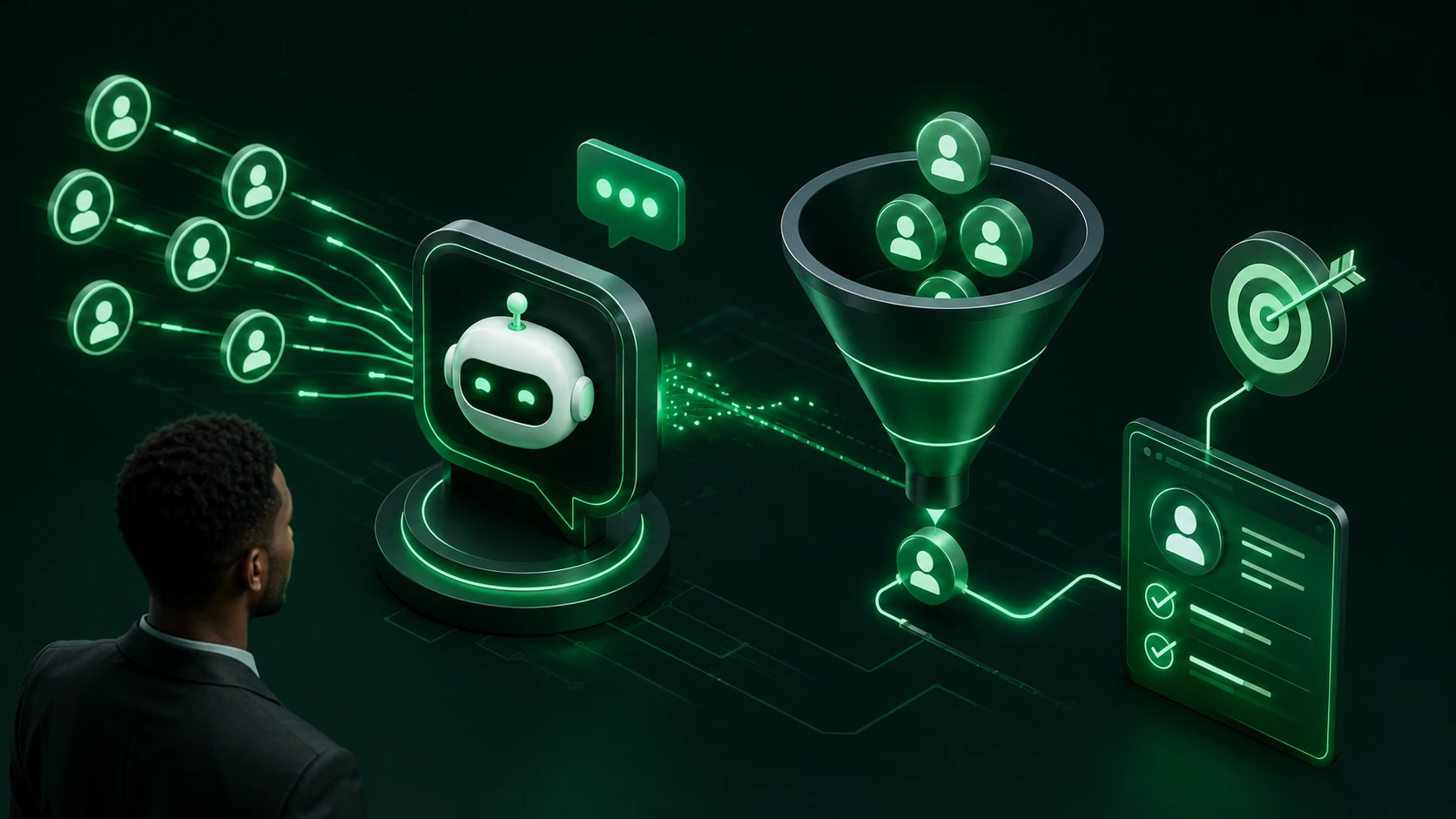
An AI chatbot captures and qualifies leads by holding a structured conversation that asks targeted questions, scores responses against your ideal customer profile, and routes the lead to the right next step based on the score.
The conversation has a deliberate shape. It opens with value, not interrogation. It asks the qualifying questions in a natural order. It captures contact details only after the visitor has received something useful. And it ends with a clear next action, whether that is a booked call, a delivered quote, or a follow-up message scheduled for later.
A high-converting lead generation flow follows five stages. The chatbot greets the visitor with a contextual opener, often tied to the page they are on. It offers value first, either an answer to their likely question or a useful resource. It then asks two or three qualifying questions, framed around the visitor's needs rather than your sales criteria. It captures contact details with a clear reason ("so we can send you the quote"). It closes with a defined next step and confirms what the visitor should expect.
Most B2B chatbots run a version of the BANT framework, asking about budget, authority, need, and timeline through conversational prompts.
For B2C and SME selling, a lighter version works better: confirm the use case, the urgency, and the decision maker. The chatbot does not need to ask all of these at once. Spreading the questions across the conversation, interleaved with helpful responses, keeps the visitor engaged and reduces abandonment.
Every answer the visitor gives is a scoring signal. A response that confirms budget over your minimum threshold gets a higher score than a vague answer. A timeline of "this month" outranks "researching."
Once the score crosses a threshold, the chatbot can do one of three things: open a live chat with a sales agent, drop a notification into the team's Slack or WhatsApp, or send the lead a calendar link to book a call. Lower-scored leads go into a nurture sequence and are followed up with educational content.
A lead generation chatbot in Tanzania needs to handle Swahili and English in the same conversation, often in the same message. Modern AI agents can detect the language of the input and reply in kind, which dramatically lifts engagement among Swahili-first audiences who would otherwise drop off when forced to switch into English.
Build A Chatbot That Qualifies While You Sleep
Notify Africa's AI agents handle Swahili and English, capture leads on WhatsApp and your website, and route hot prospects to your team in real time.
Create A Free AccountThe three highest-performing channels for chatbot lead generation in the Tanzanian market are WhatsApp, website chat widgets, and click-to-WhatsApp ads run through Meta. Each captures a different stage of buying intent, and the strongest pipelines combine all three.
WhatsApp is the messaging default for most Tanzanian consumers and businesses, which makes it the highest-leverage channel for chatbot-driven lead generation.
Running an AI agent on the WhatsApp Business API means leads can start a conversation from any of the channels they already use, including a click-to-WhatsApp ad, a QR code on a printed flyer, a button on your website, or a Google Business Profile link. The conversation happens inside an app the prospect checks dozens of times a day, with delivery rates and read rates that email cannot match.
A WhatsApp chatbot can send pricing, share a product catalogue, collect documents, take orders, and close a sale without ever bouncing the prospect to a website. For Tanzanian businesses, this is particularly powerful because it keeps the buyer inside the experience they trust, on a network they pay almost nothing to use.
Notify Africa's WhatsApp Business marketing platform is built specifically for this use case, with Meta-approved templates, broadcast tools, and built-in chatbot flows.
A chat widget on your website captures the visitor who has already shown intent by clicking through to your pricing or product page. The widget can be configured to trigger proactively based on behaviour, popping up when a visitor has spent more than thirty seconds on a pricing page or scrolled to the bottom of a service page. Proactive triggers convert significantly better than passive widgets because they catch the visitor at the moment of highest intent.
Meta's click-to-WhatsApp ad format opens a WhatsApp conversation when a user taps a Facebook or Instagram ad. This is the single most efficient paid-acquisition format for businesses in Tanzania and across Africa, because it removes every step between the ad and the first conversation.
The user taps the ad, the chat opens with a pre-filled message, and your chatbot takes over the qualification. The economics are striking. South African businesses using this format have reported lead-to-booking rates several times higher than the same traffic sent to a web form. For more detail on running this format effectively, Meta's WhatsApp Business documentation is the authoritative reference.
Not every lead has WhatsApp, and not every lead checks it regularly. SMS remains the most reliable broadcast channel in Tanzania because it reaches every phone number on every network, including Vodacom, Airtel, Mixx by Yas, and Halotel, without requiring an internet connection.
A chatbot-driven funnel should treat SMS as both a fallback channel and a reactivation layer, using the bulk SMS platform to re-engage cold leads with appointment reminders, payment links, and time-sensitive offers.
Chatbot lead automation delivers the strongest returns in industries with high customer volume, repetitive pre-sales questions, and a structured qualification process. In the Tanzanian market, that includes financial services, real estate, healthcare, education, e-commerce, logistics, and B2B SaaS.
Banks, microfinance institutions, and insurance providers field the same set of questions thousands of times a day: eligibility for a loan, required documents, interest rates, repayment terms.
A chatbot handles every one of these instantly, pre-qualifies the applicant against basic criteria, collects the required documents, and books the rest of the application with a human agent only when the prospect is qualified. This is the use case that turned WhatsApp into a serious lead channel for Latin American banks, and the same model translates directly to Tanzania's financial sector.
Property buyers want to see the photos, the price, the location, and the next available viewing slot. A chatbot delivers all four without making the prospect wait for an agent to be free. Qualification questions about budget, preferred area, and timeline filter serious buyers from window shoppers, and the booked viewing lands directly in the agent's calendar.
Clinics, dental practices, and wellness providers use chatbots to handle appointment booking, pre-consultation triage, and post-visit follow-ups. The qualification questions double as intake questions, which means by the time the patient arrives, the practitioner already has the relevant history.
Notice that healthcare data is sensitive personal data under the Personal Data Protection Act 2022, which means consent capture and data-handling procedures need to be designed into the chatbot from the start.
Universities, training colleges, and online course providers use chatbots to handle programme enquiries, eligibility checks, fee questions, and application starts. The chatbot can guide a prospect from "Tell me about this course" to a submitted application without a human touching the conversation, which dramatically lifts conversion among after-hours enquiries that traditional admissions offices miss entirely.
Retailers use chatbots for product discovery, cart recovery, order tracking, and post-purchase support. The lead generation angle is largely about repeat purchase: a chatbot remembers what the customer bought, suggests complementary products, and pings them when the item they were looking at goes on sale.
Sell Your Product Where Your Customers Already Are
Deploy a WhatsApp chatbot that qualifies leads, takes orders, and books appointments in Swahili and English.
Explore WhatsApp MarketingYou build a high-converting lead generation chatbot by starting with the conversation, not the technology. Map the questions your best salesperson asks, design a flow that asks them in a natural order, deliver value at every step, and only ask for contact details once the visitor has received something useful in return.
Sit with your top salesperson for an hour. Write down every question they ask a new prospect, in the order they ask it. Note the questions the prospect almost always asks first. The chatbot script is built from this transcript, not from a generic template.
The opening message decides whether the visitor engages or closes the tab. It should reference the page or ad the visitor came from, offer something specific, and ask a single low-commitment question. "Hi, looking for help with bulk SMS pricing? I can send you our rate card in 30 seconds, what type of business are you in?" outperforms "Hello, how can I help you today?" by a wide margin.
Translate the salesperson's questions into chatbot prompts, ordered from least to most committing. Start with use case and need. Move to scale and budget. End with decision authority and timeline. Use quick-reply buttons for closed questions and free text only when the answer matters. Every closed answer should map to a scoring rule.
Ask for the phone number or email only when you have something to deliver in return. "Send me your number and I'll WhatsApp you the quote" gets a higher response rate than a standalone "What is your phone number?" because the visitor sees the value of giving it up.
A booked call, a sent quote, or a routed conversation to a live agent are all valid endpoints. What matters is that the visitor knows what happens next and when. "A member of our team will WhatsApp you within the next hour" is a contract; the bot's job is to make sure that contract is kept.
Every captured lead, every score, every conversation transcript should land in your CRM in real time. This is where the developer story matters. Notify Africa's developer API and PHP SDK let your engineering team push chatbot leads, scores, and conversation context into HubSpot, Salesforce, Pipedrive, or any custom system you run.
The first version of your chatbot will not be the best version. Run weekly reviews of the conversations the bot lost, identify the question that caused the drop-off, and rewrite that prompt. A chatbot that improves by one percentage point of conversion per month doubles its output in under six years and pays for itself in weeks.
Measure six metrics: conversation start rate, completion rate, lead capture rate, qualified-lead rate, cost per qualified lead, and lead-to-customer conversion. Together these tell you whether the chatbot is engaging visitors, holding their attention, capturing data, qualifying intent, and ultimately producing revenue.
Conversation start rate is the percentage of visitors who exchange at least one message with the bot. Below 5 percent, your opening message is the problem. Completion rate measures the share of started conversations that reach the end of the flow. A drop in completion at a specific question points directly at the prompt that needs rewriting.
Lead capture rate is the percentage of completed conversations that yield contact details. Qualified-lead rate is the share of captured leads that meet your scoring threshold. Cost per qualified lead divides total chatbot spend (platform fees, ad spend driving traffic to the bot, message costs) by the number of qualified leads, and is the single metric that tells finance whether the chatbot is paying for itself. Lead-to-customer conversion closes the loop, showing whether the leads the bot is qualifying actually buy.
The benchmarks worth using as a starting point: contact forms typically convert 2 to 5 percent of visitors, while well-designed AI chatbots convert in the 10 to 20 percent range on the same traffic. Track your own numbers against these and beat them.
Track Every Lead, Every Conversation, Every Conversion
Get real-time analytics on your chatbot performance and connect the data straight into your CRM through the Notify Africa API.
See Developer DocsChatbot lead generation in Tanzania is governed by the Personal Data Protection Act 2022, enforced by the Personal Data Protection Commission, with messaging activity additionally regulated by the Tanzania Communications Regulatory Authority. Compliance means three things in practice: lawful collection of contact details, transparent processing, and respect for the data subject's rights.
Before a chatbot can store a visitor's phone number or send follow-up marketing messages, the visitor must have given a clear, informed opt-in. The chatbot itself is the perfect place to capture this consent, with a short message that explains what the data will be used for and gives the visitor a yes/no choice. Save the timestamp, the message text, and the response. This is the audit trail the regulator will ask for.
The Personal Data Protection Act 2022 requires that you collect only the data you actually need. A lead generation chatbot should not be a data-hoovering exercise. Ask for the phone number when you need to call, the email when you need to send a document, and nothing more. The full text of the legislation is available through the Personal Data Protection Commission.
Meta enforces its own opt-in and content rules on the WhatsApp Business Platform, and these run on top of Tanzanian law. The WhatsApp Business Policy sets out what you can and cannot send through a Business API account, including the requirement that template messages be pre-approved and that recipients have opted in to receive marketing. Using a Meta-approved Business Solution Provider keeps your account in good standing and your templates approved.
Bulk SMS traffic is subject to TCRA registration and sender-ID rules, and chatbots that fall back to SMS must run through a compliant aggregator. The Tanzania Communications Regulatory Authority publishes the current rules on sender ID registration, opt-out language, and message timing.
The compliance overhead is manageable when the platform handles most of it for you. As a Meta-approved Business Solution Provider with ISO 27001:2022 certification, Notify Africa is built to keep your chatbot, your WhatsApp account, and your SMS traffic on the right side of the regulator from day one.
Lead generation automation using chatbots is no longer the experimental edge of marketing technology. It is the default way modern businesses convert paid traffic, qualify enquiries, and feed their sales pipeline. The maths is simple: a static form converts in low single digits, a well-built chatbot converts in double digits, and the cost difference between the two is a rounding error compared to the revenue gap.
For Tanzanian businesses, the channel mix is clearer than it has ever been. WhatsApp is where the conversations happen. SMS is the reliable backstop. Your website is the qualification layer. A chatbot connects all three into a single, always-on funnel that runs while your team focuses on the work only humans can do.
Three takeaways worth carrying out of this guide. First, design the conversation before you choose the tool; the script is the product. Second, start small with one channel and one use case, then scale what works. Third, measure conversion at every step so you know exactly which prompt to rewrite next.
Notify Africa builds the WhatsApp marketing platform, bulk SMS infrastructure, and AI agents that Tanzanian and East African businesses use to automate lead generation at scale. If you are ready to stop losing leads to slow response times, the team is here to help.
Start Capturing Leads On Autopilot
Create your free Notify Africa account and launch a lead generation chatbot on WhatsApp and SMS in days, not months.
Create A Free Account
A solution by iPF Softwares, an ISO 27001:2022 certified software development company.