 AI Chatbots
Do Small Businesses In Tanzania Need An AI Assistant?
Beatha Beichumila
Last Updated :
17th June 2026
By Fauzia Ibrahim
Product Specialist
Share this article with your friends
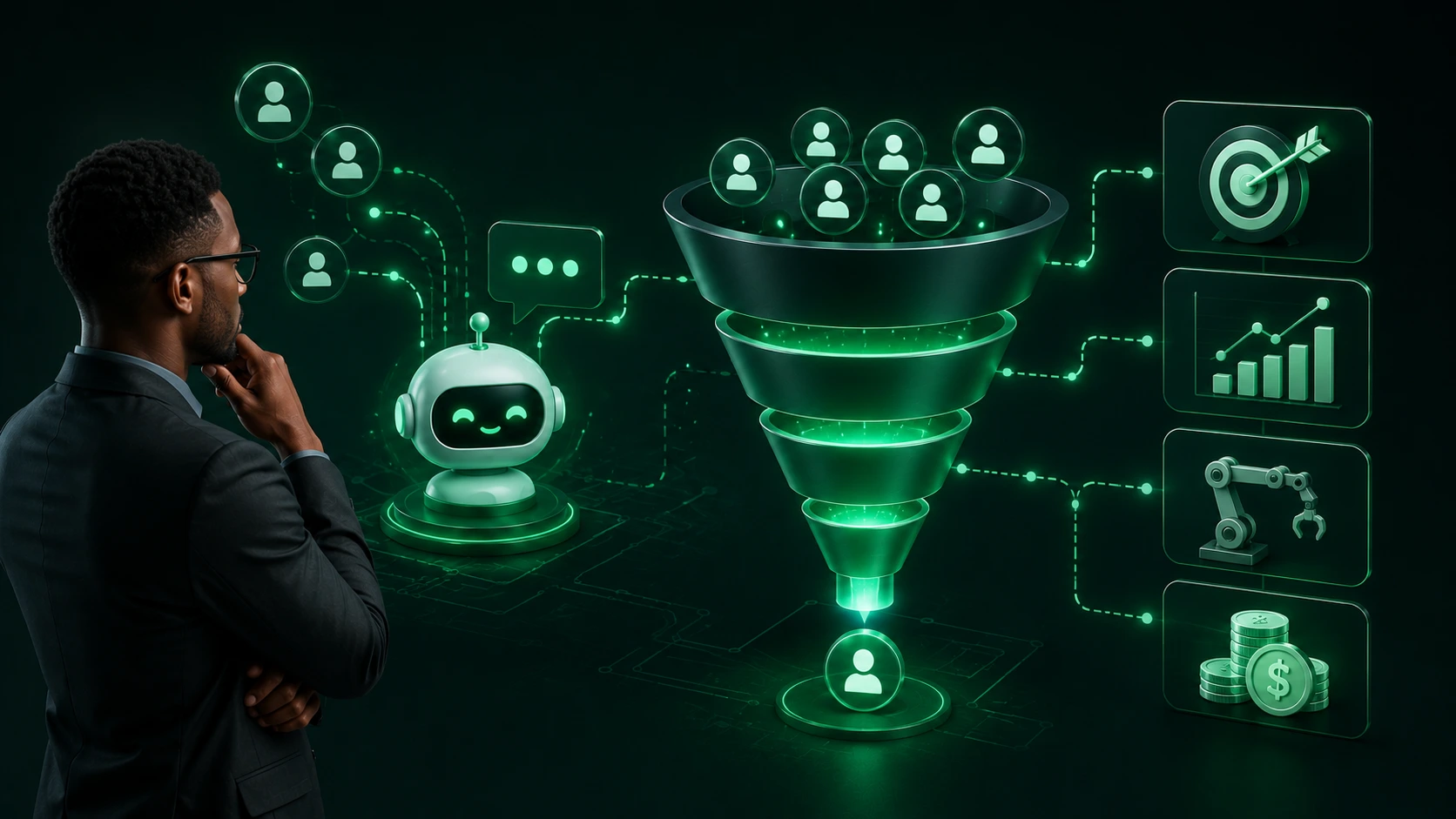
Sales funnel automation using AI chatbots is the practice of letting an artificial intelligence assistant handle each stage of the customer journey, from capturing a new lead, to qualifying intent, to nurturing the prospect, to closing the sale and re-engaging the buyer. The chatbot replaces or augments manual sales tasks, runs around the clock, and turns conversations on channels like WhatsApp into a measurable revenue engine.
Most sales teams in East Africa do not lose deals because their product is wrong. They lose deals because nobody replied to the prospect fast enough. A customer sends a WhatsApp message at 9 p.m., gets no reply until the next afternoon, and by then they have asked three competitors and bought from whoever answered first. This is the gap that sales funnel automation using AI chatbots is built to close.
Done well, it gives every prospect an immediate, useful, on-brand reply, qualifies them while a human sales rep is asleep, and books only the warmest leads onto your team's calendar.
This guide is written for business owners, marketing leads, and sales managers who want to move from chasing prospects manually to running a sales pipeline that operates on its own. You will learn what an AI chatbot funnel actually looks like, how it differs from the old form-and-call-back model, how to map each stage of your funnel to specific chatbot actions, what to measure, and how to build the whole thing on the channel African customers already use every day.
The playbook is grounded in how businesses serving Tanzanian, Kenyan, Ugandan, and Rwandan buyers actually behave, not in theory borrowed from Silicon Valley.
Sales funnel automation using AI chatbots is the use of conversational artificial intelligence to handle the work that moves a prospect from first interest to a paying customer, without a human having to be present at every step.
The chatbot greets the lead, asks qualifying questions, answers objections, recommends products, sends documents, books meetings, accepts orders, and follows up after the sale. A human only steps in when the conversation requires judgement, negotiation, or a personal touch.
The funnel itself has not changed. Customers still move through awareness, interest, consideration, decision, purchase, and retention. What has changed is who does the work between those stages. In a traditional funnel, a sales rep manually replies to inquiries, asks the same five qualifying questions every time, sends the same brochure, follows up on the same schedule, and then logs everything in a spreadsheet.
In an automated funnel, an AI assistant does all of that, twenty-four hours a day, in the customer's preferred language, on the channel the customer already uses.
A rule-based bot follows a decision tree. If the customer types "price", it sends the price list. If they type anything the tree was not designed for, it gets stuck or hands off to a human. An AI chatbot uses natural language understanding, which means it can interpret what the customer means even when they phrase the question in an unexpected way, mix English and Swahili, or pack three questions into one sentence. It can also reason over your business knowledge, pulling product details, pricing, stock information, or policy answers from sources you have given it, and produce a reply that sounds like one of your trained staff wrote it.
This is the difference between a customer asking "Bei ya bulk SMS kwa promo? Naomba sample" and getting either silence (rule-based bot fails) or a confident answer with pricing tiers, a sample message, and a sign-up link (AI chatbot). The first conversation is lost. The second becomes a lead in your pipeline.
A conversational funnel meets the customer in a chat thread they already check dozens of times a day. A form-first funnel asks them to click a button, wait for a page to load, type their details into fields, click submit, and then wait again for an email that might land in spam. Every extra step is a chance for the prospect to drop out.
Industry research consistently shows that messaging channels achieve far higher engagement than email or contact forms. According to Meta's analysis of business messaging, marketers using business messaging report a 58% increase in leads compared to traditional outreach. McKinsey's work on personalization similarly finds that personalization most often drives a 5 to 15 percent revenue lift, and chatbots are how that personalization gets delivered at scale.
Ready To Replace Your Slow, Manual Sales Process?
Notify Africa's WhatsApp marketing platform turns every inbound message into a tracked, automated sales conversation.
Explore WhatsApp MarketingAn AI chatbot is not a single tool that does one job. It is an always-on team member that does a different job at each stage of the funnel. Mapping the chatbot's responsibilities stage by stage is the fastest way to see where automation will free up the most time and recover the most lost revenue.
At the top of the funnel, the chatbot's job is to make sure no inbound interest is ever lost. It greets every new visitor or message sender within seconds, captures their name and contact details, identifies what brought them in, and answers their first set of questions. On a website, this can happen through a chat widget.
On WhatsApp, it happens through a click-to-WhatsApp ad, a QR code on a flyer, a "Chat with us" button on a Google Business profile, or a direct message to your business number.
The key win at this stage is speed. Most leads will convert with whoever responds first, not whoever has the best product. A chatbot that replies in seconds at 11 p.m. on a Saturday will out-convert a sales rep who replies at 10 a.m. on Monday, every single time.
Once a prospect is engaged, the chatbot moves into qualification mode. This is where the BANT framework — Budget, Authority, Need, and Timeline — earns its place in your automation. The chatbot weaves these questions into a natural conversation rather than asking them in a flat, interrogating order.
It learns whether the prospect is buying for themselves or for an organization, how soon they need a solution, what budget range they are working with, and what specific outcome they care about most.
This used to be a human's job, and a tedious one. Sales reps spend a meaningful share of their time qualifying leads that turn out to be wrong fits. An AI chatbot handles that work in seconds, scores each lead, and only escalates the ones worth a rep's time.
Cold or not-yet-ready leads stay in an automated nurturing sequence — gentle WhatsApp follow-ups, case studies, helpful tips, a check-in a week later — until they either heat up or unsubscribe. The Meta-published guidance on the WhatsApp Business Platform shows how interactive messages, quick replies, and structured templates can be used to keep these nurture flows compliant and conversational.
At the bottom of the funnel, the chatbot does the heavy lifting that traditionally requires a sales rep on a call. It sends product catalogues, shares pricing, answers objections, offers discounts where authorized, accepts orders, generates payment links for M-Pesa, Mixx by Yas, Airtel Money, or card, and confirms the transaction.
For higher-value B2B deals, the chatbot instead books a calendar slot with a sales rep, pre-loaded with the full conversation history so the rep walks into the call already knowing the buyer.
This is the stage where the cost of friction is highest. A buyer who has decided to purchase will leave for a competitor if the checkout is confusing or if they have to wait for a human to confirm details. An automated funnel removes that wait entirely.
The funnel does not end at the sale. The chatbot continues the relationship: it sends order confirmations, shipping updates, delivery confirmations, and a thank-you message. It asks for a review at the right moment, offers a re-order reminder when consumables are running low, and proactively recommends complementary products.
For service businesses, it handles renewal reminders, anniversary discounts, and feedback collection. This is where most businesses leave money on the table — and where automation produces the highest return per hour of work saved.
See What An Automated Funnel Looks Like On Your Numbers
Talk to the Notify Africa team about mapping a chatbot to your existing sales process.
Book A Discovery CallIf you are going to automate a sales funnel, you want to do it on the channel where your customers already pay attention. In East Africa, that channel is WhatsApp. The numbers are not subtle. WhatsApp Business marketing typically achieves an open rate around 98%, with click-through rates in the 45 to 60 percent range, while email marketing averages closer to 21 percent open and a few percent click. Most businesses see a return on investment from WhatsApp ranging from 200% to 800%, depending on industry and execution.
The reason is simple. Customers see WhatsApp notifications instantly. They reply in minutes, often in seconds. They are already comfortable buying from businesses through chat. They are not used to being marketed to on WhatsApp the way they are on email or SMS, which means a well-crafted WhatsApp conversation still feels like a personal exchange rather than a campaign.
For a business in Tanzania, Kenya, Uganda, or Rwanda, WhatsApp is also the channel with the lowest customer friction. Your buyer does not need to download anything new, register on your website, or remember a password. They already have your message in the same app they use to talk to their family. The Notify Africa WhatsApp Business API platform is built around exactly this reality: a Meta-approved Business Solution Provider connection, multi-agent inbox for human handovers, and AI chatbot logic that runs the conversation between human touchpoints.
For audiences that are not on WhatsApp, or for high-volume, low-cost notifications like OTPs, order alerts, and delivery confirmations, bulk SMS remains the fallback channel that complements your WhatsApp funnel rather than competing with it. A typical setup runs the conversational funnel on WhatsApp and uses SMS for delivery codes, failed-payment retries, and any audience segment that has not opted in to WhatsApp.
The theory is simple. The execution is where most businesses get stuck. Here is what a working end-to-end AI chatbot sales funnel actually looks like, stage by stage, on a real business day.
A potential customer sees an Instagram ad for a Dar es Salaam furniture store. They tap the "Send Message" button and land in a WhatsApp chat with the store. The AI chatbot greets them by name (pulled from their WhatsApp profile), asks what caught their interest, and shows the matching product catalogue with prices in TZS. The customer asks if it comes in a different colour. The bot answers, sends a photo of the variant, and asks if they would like to know the delivery cost to their area.
The customer shares their location, gets a delivery quote, and asks how to pay. The bot generates an M-Pesa payment link, the customer pays, and the bot confirms the order. A human only gets involved if the customer asks for something the bot does not have an answer for, like a bulk order discount, in which case the conversation is handed off with full context attached.
That is one buyer. The same chatbot is handling fifty other buyers at the same time, in the same way, without a single human touching the keyboard. The sales rep who would have replied to all fifty inquiries manually is instead reviewing the warm leads the bot has flagged for personal attention. The business has not added headcount. It has multiplied the capacity of the team it already had.
What you cannot see from outside the conversation is what is happening in the background. Each interaction is logged. Each lead is scored. Each customer's history is stored for the next conversation.
The team's dashboard shows which messages converted, which dropped off, and which questions the bot is being asked most often. That data is the fuel for the next round of improvements.
Start Building Your Automated Funnel Today
Create a Notify Africa account, connect WhatsApp, and launch your first automated conversation.
Create A Free AccountBuilding an automated sales funnel is a project, but not a complicated one if you sequence the steps correctly. The mistake most teams make is to start with the technology. The right starting point is the funnel itself.
The first step is to map your existing sales conversations on paper.
List the five to ten most common questions a prospect asks before they buy. List the five most common objections. List the steps a sales rep currently takes from "new inquiry" to "paid invoice". This is your raw material. Every automation you build will be a direct response to something already happening in your business.
The second step is to define what a qualified lead actually looks like for you.
For a B2B software seller, this might be a decision-maker at a company with more than twenty staff, with a budget over a defined threshold, looking to buy within ninety days. For an online clothing retailer, it might be anyone who has asked about a specific size in a specific product. The clearer this definition is, the better your chatbot will sort warm leads from cold ones.
The third step is to choose your channel mix.
WhatsApp will almost always be your primary conversational channel, with SMS as a fallback for transactional and non-opted-in audiences. If you have a website, layer the bot into a click-to-WhatsApp button rather than a separate site-only chat widget, so every conversation ends up in one inbox.
The fourth step is to build the bot itself.
Start with the top of the funnel: greet, capture, qualify. Then build the middle: nurture flows, objection handling, FAQ answers. Then build the bottom: catalogue, payment, order confirmation. Then build the post-sale layer: shipping updates, reviews, re-orders. Avoid trying to launch everything at once. Get the top of the funnel working first, then expand.
The fifth step is to connect everything to the systems you already use.
Your CRM, your e-commerce platform, your payment provider, your shipping provider. Notify Africa's developer API handles these integrations so the chatbot is not a silo — it is the front-end of your existing business operations. If you are technical or work with a developer, you can also wire in custom logic, webhooks, and HMAC-signed callbacks for sensitive flows like payments.
The sixth step is to set up your handover rules.
The chatbot does not need to do everything. It needs to do the high-volume, low-judgement work, and pass everything else cleanly to a human. Define exactly when a human takes over: a specific keyword, a deal value above a threshold, a complaint, a request for a manager.
The seventh and ongoing step is to review the transcripts.
The single biggest improvement in any chatbot funnel comes from reading what real customers are actually saying, finding the moments where the bot fails, and patching them one by one. This is how a chatbot gets smarter over time and how your funnel becomes a long-term competitive advantage. For teams ready to layer in a more capable AI assistant on top of their funnel, the same transcript review process drives the training data that makes the assistant sharper week after week.
If you cannot measure it, you cannot improve it. An AI chatbot sales funnel produces more data than any sales process you have run before. The trick is to focus on a small set of numbers that map to revenue.
Track response time first. Time-to-first-reply should be under thirty seconds for an automated funnel. If it is not, something is misconfigured. Track engagement rate next: of the people who receive a message, how many reply. On WhatsApp this should be substantially higher than email benchmarks.
Track qualification rate: of the people who start a conversation, how many become qualified leads. This tells you whether your top-of-funnel targeting is good. Track conversion rate: of the qualified leads, how many become paying customers. This tells you whether your bottom-of-funnel handling is good.
Track handover rate: how many conversations need a human to step in. Too high and your bot is under-trained. Too low and your bot may be losing nuanced deals it should have escalated.
Track revenue per conversation. This is the single most useful number in the funnel. Divide total revenue from chatbot-initiated conversations by the number of conversations. Watch this number trend over weeks. Every improvement to your funnel should push this number up.
Finally, track customer satisfaction. Send a one-question survey after each closed conversation. A funnel that converts but leaves customers unhappy is a funnel that will hollow out over time.
A sales funnel automation playbook copied from a North American or European source will not work as well in Tanzania or its neighbours. The customer behaviours, payment methods, regulatory environment, and language preferences are different. A funnel built for this market needs to reflect that.
Start with language. Many of your customers will write in Swahili, switch to English mid-sentence, and use local short-forms. Your chatbot needs to handle this fluently, not force the buyer to pick one language at the start. A bot that replies in clean Swahili when spoken to in Swahili converts at a different level than one that defaults to English.
Build for the payment methods customers actually use. M-Pesa, Mixx by Yas, Airtel Money, and bank transfer should be first-class options. Card payment is useful for some segments but should not be the default flow.
Respect the regulatory environment. The Personal Data Protection Act, 2022 governs how you collect, store, and process personal data from customers in Tanzania, and the Personal Data Protection Commission oversees compliance. Your chatbot must collect explicit consent before storing data, must tell customers what their data will be used for, and must allow them to opt out of marketing messages at any time. The Tanzania Communications Regulatory Authority sets the rules for bulk messaging and electronic communications, and any SMS layer in your funnel needs to follow them, including sender ID registration and opt-out compliance.
Build for low bandwidth and intermittent connectivity. Customers in rural areas may receive your message but only read it hours later when they are back on network. Your funnel should not penalize a delayed reply. Conversations should pick up exactly where they left off, even if the gap is two days.
The fastest way to make an automated funnel fail is to treat it as a one-time project rather than a living system. The bots that work are the ones that get reviewed, edited, and improved every week. The bots that fail are the ones that get launched and forgotten.
A second common pitfall is over-automation. Trying to make the bot handle every edge case results in a stiff, awkward experience. The best funnels automate the eighty percent of conversations that are predictable and route the twenty percent that are not to a human, fast and cleanly.
A third is launching without analytics. If you do not know which messages convert and which lose customers, you cannot improve. Set up tracking before you set up flows.
A fourth is forgetting compliance. Sending marketing messages to people who have not opted in is not just a regulatory risk in Tanzania — it will also get your business phone number flagged by Meta and your message delivery rate will collapse. Build opt-in into the very first message of every funnel and respect every opt-out request immediately.
A fifth is treating the chatbot as a cost-saving tool only. The biggest wins are in revenue, not cost. A chatbot that recovers ten abandoned carts a week, or that closes five extra deals at 11 p.m. when nobody is in the office, has paid for itself many times over.
Get Expert Help Designing Your Chatbot Funnel
Our team helps Tanzanian and East African businesses launch chatbot-powered sales funnels that convert.
Talk To Notify AfricaA sales funnel is the journey a prospect takes from first interest to purchase, and beyond. An AI chatbot is one of the tools that automates that journey. The funnel is the strategy. The chatbot is the engine that runs it. A business can have a sales funnel without a chatbot, and it usually relies on manual work, slow response times, and human bottlenecks. A business with an AI chatbot funnel runs the same journey at much greater speed and scale, with humans focused only on the highest-value moments.
Yes, and small businesses often gain more from automation than large ones because their teams are smaller and their staff are stretched thinner. A solo entrepreneur who replies to messages personally simply cannot match the response speed of an automated funnel. Modern WhatsApp Business platforms remove the need to write code, so the entry barrier is now about having clear sales conversations to map, not about technical resources. The investment is paid back quickly when one extra deal a week is closed because a customer got an answer at midnight.
A basic top-of-funnel automation — greet, capture, qualify, hand off — can be live in a few days. A complete funnel covering nurture flows, catalogue browsing, payment, and post-sale follow-up usually takes a few weeks to set up properly, with ongoing weekly refinement after that. The right way to think about it is not as a one-off launch but as a system that gets better every month. Most of the value compounds over the first three to six months as the chatbot is trained on real customer conversations.
The cost has two parts: the platform fee for the chatbot tool and the per-message cost for the channel. On WhatsApp, Meta charges per conversation, with rates that depend on the type of message (utility, marketing, or service) and the country. SMS is charged per message and starts at low local rates such as TZS 13 per message on Notify Africa's bulk SMS service. The combined cost is almost always lower than the cost of the human time it replaces, especially when measured per closed deal.
Conclusion
Sales funnel automation using AI chatbots is not a futuristic concept. It is what high-performing African businesses are already using to outsell competitors who still depend on a single person checking WhatsApp during office hours. The principle is straightforward: every prospect deserves an instant, accurate, helpful reply, regardless of what time it is or how many other inquiries are in the queue. A chatbot can deliver that. A human team alone, however dedicated, cannot.
The takeaways are simple. Map your existing sales process before you build anything. Start your automation at the top of the funnel and expand stage by stage. Build on WhatsApp because that is where your customers already are. Measure revenue per conversation rather than vanity metrics. Treat the chatbot as a living system that gets refined every week.
Notify Africa has built the WhatsApp marketing platform, bulk SMS service, and AI assistant tooling that East African businesses use to make this work in practice. If you want to see what your sales funnel could look like fully automated, the team is ready to walk you through it on your real numbers.
Turn Conversations Into Revenue, Around The Clock
See how Notify Africa's AI-powered messaging platform can automate your sales funnel from first message to closed deal.
Get Started
A solution by iPF Softwares, an ISO 27001:2022 certified software development company.