 WhatsApp
No-Code WhatsApp Chatbot Builder for Tanzanian Businesses
Fauzia Ibrahim
Last Updated :
19th June 2026
By Beatha Beichumila
Product Specialist
Share this article with your friends
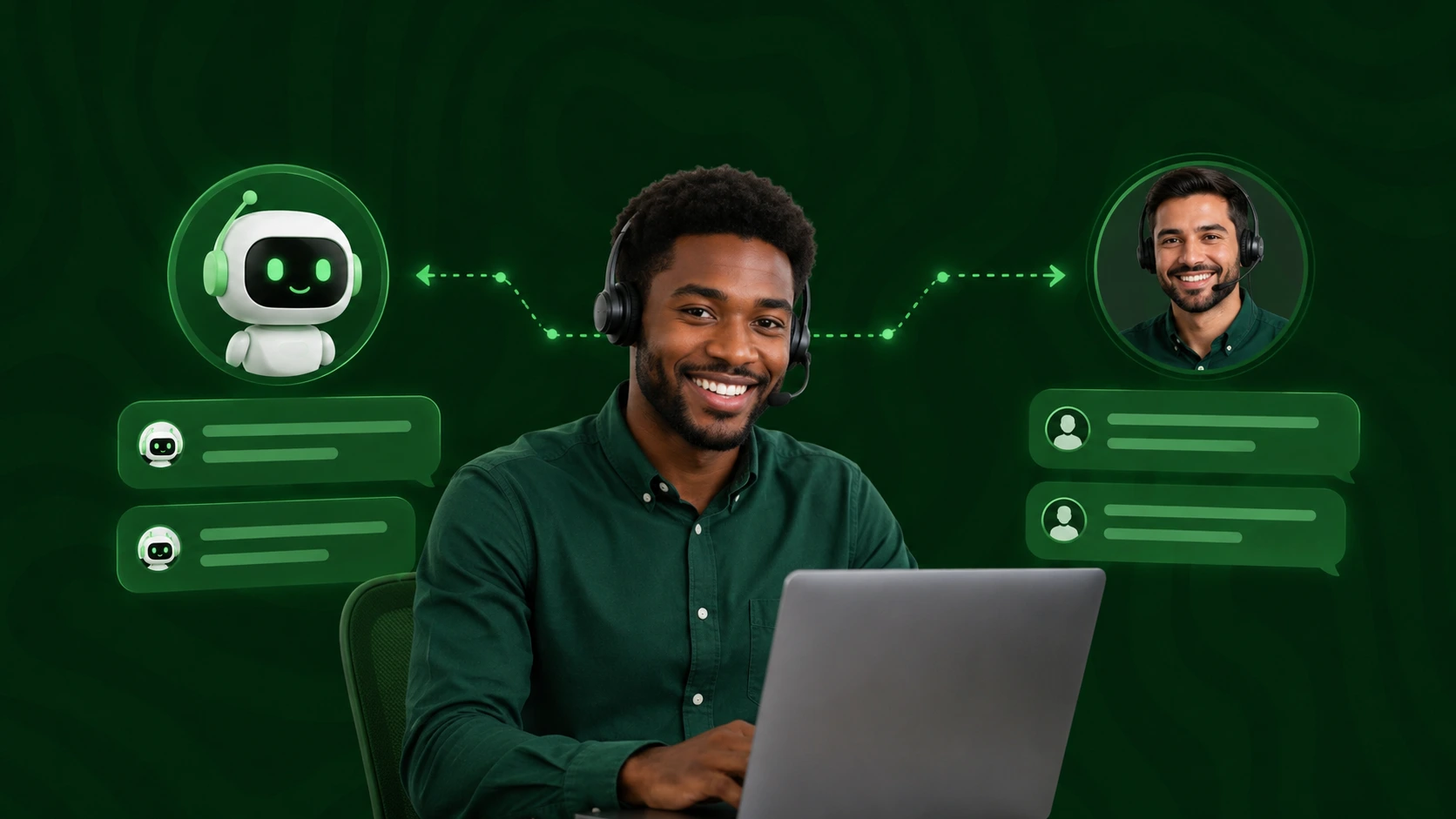
A hybrid chatbot with human takeover is a customer messaging system where an AI agent handles routine conversations automatically and transfers the chat to a live human agent the moment judgment, empathy, or a complex decision is needed. The full chat history travels with the customer, so the human agent picks up exactly where the AI left off without asking the person to repeat anything.
Customers in Dar es Salaam, Arusha, Mwanza and Dodoma now expect a reply within minutes, not hours. Yet the same customer who wants an instant answer about your price list will also, ten minutes later, want a real person to walk them through a refund, a custom quote, or a complaint. No single tool solves both jobs well. A pure chatbot frustrates anyone with a non-standard question. A pure human team burns out trying to answer the same five FAQs all day and goes silent after 5 PM.
This guide shows how a hybrid chatbot with human takeover fixes both problems at once. You will see how the model works on WhatsApp, the web, Instagram and SMS, the exact moments the AI should hand a chat to your team, how to design a handoff that feels seamless, the local industries getting the strongest returns, and how to roll the whole system out on Notify Africa without a developer in the room.
A hybrid chatbot is a conversational system that combines two layers in one inbox. The first layer is an AI agent trained on your business knowledge — your FAQs, product catalogue, prices, service hours, policies. The second layer is your human team, sitting in a shared inbox. The AI handles the volume. Your team handles the nuance.
"Human takeover" is the specific moment the AI stops replying and a real person takes the conversation. Good systems make this transition invisible to the customer. The bot pauses, the human takes ownership, the chat continues in the same thread, and the customer never has to repeat themselves.
This is sometimes called chatbot-to-human handoff, human-in-the-loop support, or hybrid customer service. The mechanics are the same. According to industry analysis from TechTarget, the handoff is the single most fragile moment in any AI support deployment — get it right and the customer barely notices, get it wrong and you lose them.
A regular chatbot tries to answer everything itself. When it runs out of answers, it either loops, says "I don't understand," or drops the customer into a dead end. A hybrid chatbot is designed from day one with the assumption that some conversations must reach a human, and the question is not whether to escalate but when and how cleanly.
A pure live chat team answers every message manually. That works until volume rises, until 9 PM hits, or until the same "how much does it cost?" question gets asked for the fortieth time that day. A hybrid system lets the AI absorb the predictable workload so your agents only see chats that need a real person.
The data on customer preferences is now clear, and it points in two directions at once.
Customers want speed for simple questions. Zendesk research finds the majority of consumers would rather get an instant chatbot reply than wait for a human when the question is routine — checking an order, confirming opening hours, asking a price.
Customers want humans for anything that feels personal, complicated, or emotional. Surveys consistently show that for complaints and complex issues, people overwhelmingly prefer a real person, and a large majority believe companies should always offer a human option somewhere in the journey.
The data summarised by SurveyMonkey shows nearly nine in ten consumers want the right to escalate to a person at any time.
The business case is just as strong. The same chat that costs your team several minutes of agent time can be handled by an AI in seconds. Industry estimates suggest a typical AI-handled message costs a fraction of a human-handled one. When the bot resolves a large share of the volume, the cost-per-conversation drops sharply while the conversations that do reach your team are higher-value — leads ready to buy, complaints that need empathy, custom requests worth quoting.
The hybrid model captures both sides. The AI handles speed and scale. Humans handle judgment and trust. Customers get the experience they actually want at each stage.
A Practical Example From a Dar Es Salaam Retailer
A clothing retailer on Samora Avenue gets 400 WhatsApp messages a day. Before hybrid, two staff spent most of their day typing the same answers: "Yes we deliver to Mbezi," "The dress is 65,000 TZS," "We are open until 7 PM." After hybrid, the AI answered those questions in under five seconds. The two staff now only see chats about sizing advice, custom orders, returns, and bulk school uniform enquiries — the chats that actually generate revenue. Same team. Different work.
Ready To See A Hybrid Chatbot Built On Your Own Business Data?
Let our team show you a live demo using your real FAQs, product catalogue and tone of voice.
Book a free demo →
The mechanics differ slightly across channels, but the principles are the same. Here is what happens behind the scenes when a hybrid chatbot deployed on the official WhatsApp Business Platform hands a chat to your team.
A customer messages your WhatsApp Business number. The AI receives the message through the WhatsApp Cloud API, identifies the intent, and replies if it has a confident answer. The full conversation is logged in a shared team inbox in real time.
The moment an escalation rule fires — the customer asks for a person, the AI detects frustration, or the topic falls outside its scope — the bot pauses. The conversation appears in your agent inbox with a flag, the reason for escalation, a summary of what was discussed, and the customer's profile.
Your agent claims the chat. The customer sees the next reply come from a real person, ideally with a name. The agent has every prior message visible. The customer never repeats themselves. When the agent resolves the issue, they can either leave the conversation closed, hand it back to the AI for follow-up messages, or trigger a satisfaction survey.
For this to work properly you need a Meta-approved Business Solution Provider running the connection. Notify Africa is an officially approved BSP for the WhatsApp Business Platform in Tanzania, which means messages flow through compliant infrastructure and your handoff system meets WhatsApp Business Messaging Policy requirements out of the box. See the full picture on the WhatsApp marketing platform page and the AI assistant product page.
Start reaching your customers today
Send SMS, email and WhatsApp campaigns in minutes.
Start free trialA well-built hybrid system runs the same logic across every channel. The same AI agent and the same shared inbox handle WhatsApp, web widget conversations, Instagram DMs, Messenger and even SMS for follow-ups. Your team sees one queue. The customer experience stays consistent whether they message you from your website or from WhatsApp.
The single most important design decision in any hybrid deployment is the escalation rule set. Hand off too eagerly and you waste your team's time on questions the bot should answer. Hand off too late and you frustrate the customer. The following triggers are the proven baseline used by mature hybrid deployments.
The customer explicitly asks for a person. Phrases like "talk to someone," "I want a human," "agent please," or the Swahili equivalent "nataka kuongea na mtu" should trigger an immediate handoff with no friction.
The AI's confidence on the answer is below a threshold. If the bot is not sure, it should not guess. It should pass the question to a human.
Sentiment analysis detects frustration. Repeated caps, exclamation marks, complaint keywords, or a customer rephrasing the same question three times are signals that judgment and empathy are needed.
The topic is outside the bot's scope. Refunds, custom pricing negotiations, complaints, legal queries, medical questions, and account-specific issues should route to a human by default.
The customer has high purchase intent. A lead who has asked about price, availability and delivery in sequence is ready to buy. Hand them to a salesperson who can close.
Repeated unresolved attempts. If the AI has tried twice and the customer is still asking, escalate before they leave.
After hours, the AI should collect the request, give a clear expected response window, and create a queued conversation for the next agent shift.
Research summarised by industry coverage of 2026 hybrid support benchmarks finds that the strongest deployments fire three triggers reliably — explicit request, sentiment drop, and AI low confidence on a critical question — and these alone catch the overwhelming majority of cases where a human should step in.
The mechanics of escalation are simple. The customer experience around them is where most deployments succeed or fail. Apply these seven rules.
Be transparent about who is speaking. The AI should identify itself early. When a human takes over, the message should make that clear. Customers tolerate AI far better when they know what they are talking to.
Hand off in the same thread. Never make the customer move to a new channel or start a new chat. The conversation must continue in the original WhatsApp thread, web chat session or Instagram DM.
Pass the full context to the agent. The agent must see every prior message, the detected intent, the customer profile, any CRM data, and the reason the AI escalated. Asking a customer to repeat themselves is the fastest way to lose them.
Give a realistic wait time. If the next agent will respond in two minutes, say two minutes. If it is the weekend and they will reply on Monday at 8 AM, say that. Vague promises destroy trust.
Pause the AI completely while the human is in the chat. Overlapping replies — bot and agent both responding — are the signature mistake of a poorly built system.
Allow the human to reactivate the AI on demand. Once the issue is solved, the agent can hand the conversation back to the AI for follow-ups, satisfaction surveys, or future routine queries.
Log the outcome for AI training. Every human-handled chat is data the AI can learn from. Mature systems use these resolutions to expand the bot's knowledge base, so over time fewer chats need a human at all.
Want Your AI To Handle Eighty Percent Of Chats And Hand The Rest To Your Team?
Notify Africa deploys hybrid chatbots on WhatsApp, web, Instagram and SMS — trained on your own business data.
Get started free →
Some sectors see returns within weeks. The pattern is consistent — wherever a business gets a high volume of repetitive enquiries mixed with a small number of high-value conversations, hybrid pays back fast.
The AI handles product availability, prices, delivery zones, payment options including M-Pesa, Mixx by Yas and Airtel Money, and order status. Your team only sees custom orders, complaints, and bulk enquiries. Cart recovery messages can be automated and only escalate when the customer engages. This pairs naturally with the patterns covered in the guide on combining bulk WhatsApp and SMS marketing.
The AI answers availability, room types, package inclusions, transfer logistics and seasonal pricing in English and Swahili. Your team takes over once a guest is ready to confirm dates, negotiate group rates, or has a special request. Inbound enquiries from international travellers reach a real person at the moment they are ready to book.
The AI handles balance enquiries, branch locations, opening hours, document requirements, premium calculations and basic policy questions. Anything involving an account, a claim, or a complaint routes immediately to a trained agent — both for service quality and for regulatory reasons.
The AI answers admission requirements, fee structures, term dates, location, and basic application steps. The admissions team only handles enrolled-student questions, fee negotiations, and parent escalations. Exam reminders, attendance updates and emergency alerts can be sent through the same Notify Africa platform via bulk SMS.
The AI handles "where is my parcel," delivery slot changes, recipient details and proof of delivery. Operations only sees genuine exceptions — failed deliveries, address corrections, damaged goods.
The AI handles appointment booking, opening hours, branch directions and product availability. Anything clinical — symptoms, dosage, medical advice — should escalate to a qualified human by default. This is one of the clearest cases where the escalation rules matter as much as the AI itself.
Start reaching your customers today
Send SMS, email and WhatsApp campaigns in minutes.
Start free trialThe deployment is faster than most teams expect. The work is mostly in preparation, not in technology. Here is the realistic sequence.
First, collect your business knowledge in one place. Pull your FAQs, price list, service descriptions, opening hours, delivery zones, refund policy and the answers your team types most often. The quality of this content is what your AI will sound like.
Second, decide your escalation rules. Map the questions the AI is allowed to answer alone and the questions that must always go to a human. Write down the trigger phrases. Decide your after-hours behaviour.
Third, register on the Notify Africa platform and connect your channels. Verify your WhatsApp Business number through the official Cloud API, add your website widget, link any Instagram or Messenger accounts.
The AI assistant product handles the training step — you upload your FAQs, your website content or your product documents, and the AI builds its knowledge base from them.
Fourth, set up your shared inbox and assign team roles. Decide who handles which queue. Configure your business hours. Add canned responses for common scenarios.
Fifth, run a closed test with internal users for a few days. Watch where the AI gets confident, where it hesitates and where customers ask things you did not anticipate. Adjust the knowledge base and escalation rules based on real conversations.
Sixth, launch to customers. Monitor the first two weeks closely. Most teams find the AI absorbs a far larger share of conversations than they expected once the knowledge base is sharp.
For the deeper background on the AI side, see the explainer on what an AI chatbot is and how it works for Tanzanian businesses and the breakdown of AI chatbot benefits for Tanzanian businesses. For the design decisions on the WhatsApp side specifically, the guide on designing effective AI chatbots on WhatsApp goes deeper on conversation structure.
You cannot improve what you do not measure. The following metrics tell you whether your hybrid system is paying back.
Automation rate. The percentage of conversations the AI resolves end-to-end without a human. Healthy deployments reach 60 to 80 percent within the first quarter.
First response time. Should drop to a few seconds across all conversations once the AI is live.
Average handle time on escalated chats. Should fall, because agents arrive with full context and only handle the high-value cases.
Customer satisfaction score on AI-only versus human-handled chats. Watch these separately. If AI-only CSAT lags, your knowledge base needs work. If human CSAT lags, your escalation timing is wrong.
Escalation accuracy. Of the chats that escalated, how many genuinely needed a human? Of the chats that did not escalate, how many should have? Both directions matter.
Conversion rate on sales conversations. The clearest revenue measure. Hybrid teams consistently see lifts here because high-intent buyers reach a salesperson immediately.
Cost per conversation. Should fall sharply. The combined cost of AI infrastructure plus a leaner human team beats a pure-human operation handling the same volume.
See Exactly How A Hybrid Chatbot Performs On Your Real Conversations
Our team will set up a 30-day pilot on your WhatsApp number and report on every metric above.
Talk to a specialist →
A regular chatbot tries to answer every question itself, often hitting dead ends when the question is unusual. A hybrid chatbot is built around the assumption that some chats must reach a human. It runs an AI agent for routine conversations and routes anything that needs judgment, empathy or a complex decision to a live agent in a shared inbox, with the full conversation history attached.
Yes, but they should never reply at the same moment. The correct sequence is that the AI handles the conversation, pauses when a handoff is triggered, the human takes over in the same thread, and the AI optionally resumes later for follow-up messages or a satisfaction survey. Overlapping replies confuse customers and are the signature mistake of a poorly built system.
They should. Transparency builds trust. The AI introduces itself, and when a human takes over the message should make that clear. Research shows customers tolerate and even prefer AI for routine tasks as long as they know what they are interacting with and have a clear path to a human when needed.
There is no practical ceiling on the AI side. The bot can hold thousands of conversations in parallel without queueing. The constraint becomes your human team — how many escalated chats they can handle. The whole point of the hybrid model is that the AI absorbs the volume so your team only sees the chats that actually need them.
For a small or mid-sized business with their FAQs and product information ready, a basic deployment can go live within a few days. A fuller rollout with custom escalation rules, multiple channels, CRM integration and team training typically takes two to four weeks. Notify Africa's onboarding process handles WhatsApp Business API verification, training the AI on your data and configuring the shared inbox.
A hybrid chatbot with human takeover is not about replacing your team. It is about pointing your team at the conversations that matter. The AI absorbs the predictable volume — prices, opening hours, delivery zones, order status — so your agents can spend their day on the conversations that close sales, recover unhappy customers, and build the relationships your business runs on.
The three things to get right are the knowledge base the AI is trained on, the escalation rules that decide when a human steps in, and the handoff experience the customer feels. Do those three well and you end up with faster replies, lower cost per conversation, higher conversion on high-intent leads, and a team that is doing more interesting work.
Build Your Hybrid Chatbot On Notify Africa
Train an AI on your business data, connect WhatsApp and your website, and let your team handle only the chats that need them.
Create your free account →

A solution by iPF Softwares, an ISO 27001:2022 certified software development company.