
 AI Chatbots
What Is Business Automation With AI? A Practical Guide
Fauzia Ibrahim
Last Updated :
16th May 2026
By Fauzia Ibrahim
Product Specialist
Share this article with your friends
An AI chatbot is software that uses artificial intelligence to simulate human conversation, automatically answering customer questions, collecting leads, and providing support without human involvement. For businesses in Tanzania, AI chatbots can be deployed on WhatsApp or a website to respond to customers 24 hours a day, handle routine inquiries instantly, and free up staff for higher-value work.
Most small and medium businesses in Tanzania share the same frustration. A customer sends a WhatsApp message at 9 PM asking about your prices or delivery options. Nobody sees it until the next morning. By then, they have already found someone who answered them. That window — the gap between when a customer asks and when you respond — is where sales are lost every single day.
An AI chatbot closes that window permanently. It responds in seconds, at any hour, in English or Swahili, with exactly the information your customer needs. It qualifies leads, answers FAQs, confirms orders, and passes complex conversations to your team only when a human is genuinely required.
This guide explains exactly what an AI chatbot is, how the technology works, why Tanzanian businesses across retail, hospitality, logistics, and professional services are adopting it, and how you can build and deploy your own in a matter of hours — no technical background needed.
An AI chatbot is a software program that uses artificial intelligence to understand customer messages and respond to them automatically in natural language. Unlike older rule-based bots that could only follow rigid scripts, modern AI chatbots understand context, intent, and variation in phrasing. A customer can write "do you deliver to Mwanza?" or "can I get delivery to Mwanza?" or "Mwanza delivery?" and the chatbot understands all three questions the same way.
The core technology behind today's AI chatbots is Natural Language Processing, or NLP. NLP allows the system to parse human language — including informal phrasing, abbreviations, and even partial sentences — and extract meaning from it. When you train your chatbot on your business documents, product descriptions, or website content, the AI learns to recognize the topics your customers ask about and construct appropriate responses from the knowledge you have given it.
What separates an AI chatbot from a basic FAQ page is conversation is this, A chatbot can ask follow-up questions, remember what was said earlier in the same conversation, and adjust its response based on context.
It can move a customer from a general inquiry through to a qualified lead, a booking confirmation, or an order update — all within a single chat thread.
A human agent brings empathy, judgment, and the ability to handle genuinely complex or emotionally sensitive situations. An AI chatbot brings speed, consistency, and availability. Chatbot interactions cost approximately $0.50 on average, compared to $6.00 for a human agent interaction — and a chatbot can handle hundreds of conversations simultaneously while your staff handles one at a time.
The most effective businesses in Tanzania are not choosing one over the other. They are using AI chatbots to handle the routine — the repetitive questions, the basic lead qualification, the order status checks — so that human agents can focus entirely on conversations that require genuine personal attention. 77% of bot users successfully resolve their issues without human intervention at least sometimes, which means the majority of your incoming inquiries can be handled before your team even looks at their phone. Chatbots are one part of a wider picture; our guide to business automation with AI explains how chatbots, assistants and agents differ.
Understanding how a chatbot works helps you set it up correctly and train it well. The process has four main stages.
Before your chatbot can answer a single question, it needs to learn about your business. You give it knowledge by uploading documents — product catalogues, price lists, service guides, FAQs — or by pointing it at your website URL. The AI processes this content and builds an internal knowledge base it can query whenever a customer asks a question.
This is the most important stage. A chatbot is only as useful as the information it has been trained on. The more complete and accurate your training content, the more accurately the bot will respond. If your price list changes, you update the training material and retrain the bot. Think of this as onboarding a new employee — except this one reads every document in minutes and never forgets.
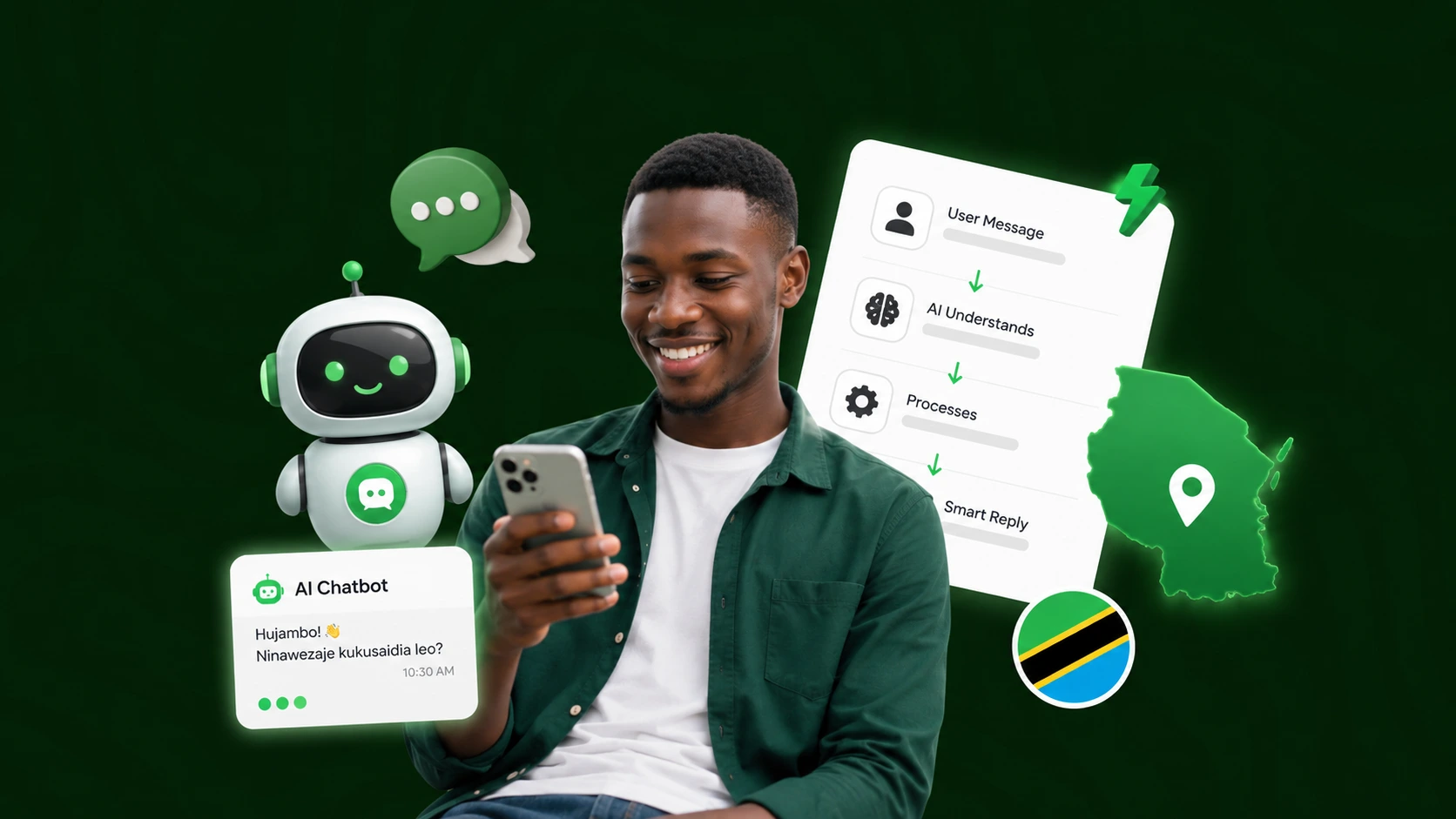
When a customer sends a message, the AI breaks it down using NLP. It identifies the intent behind the message (what the customer is trying to do), the entities mentioned (specific products, locations, dates), and the context of the ongoing conversation. Based on this analysis, it searches its knowledge base for the most relevant response.
Companies using AI chatbots report 33 to 45 percent reductions in average handle times and up to 30 percent improvement in first-contact resolution — partly because the AI matches questions to answers faster and more consistently than a human scanning through documents.
The chatbot constructs a response using the information it has retrieved, formats it appropriately for the channel (WhatsApp, website chat, or both), and delivers it — typically within two to three seconds of the customer's message arriving. On WhatsApp, this can include text, documents, and links. On a website, it can include buttons, quick replies, and forms.
Well-designed chatbots know their limits. When a customer's message falls outside the chatbot's knowledge, expresses frustration, or involves a genuinely complex issue, the bot hands the conversation over to a human agent with full context preserved. The agent can see the entire conversation history and step in without asking the customer to repeat themselves.
Tanzania's business environment creates specific conditions that make AI chatbots especially valuable. Understanding these conditions helps you see where your chatbot will have the biggest impact.
Tanzanian consumers — particularly in Dar es Salaam, Arusha, Mwanza, and Dodoma — are active WhatsApp users. WhatsApp is not just a messaging app here; it is the primary channel for business inquiries, customer support, order placement, and follow-up. Tanzania's digital economy is one of East Africa's fastest-growing, with WhatsApp having become the de facto business communication tool for SMEs, tourism operators, and service businesses nationwide.
When a customer messages your business on WhatsApp and receives an instant, accurate reply at 11 PM on a Sunday, their perception of your brand changes immediately. You are no longer a small business that responds when someone checks their phone. You are a business that is always available.
In a competitive market, the first business to respond often wins the customer. A chatbot ensures you are always first. According to WhatsApp Business Platform documentation, businesses that respond to messages within the first hour see significantly higher conversion rates. A chatbot does not respond within the first hour. It responds within the first three seconds.
Most Tanzanian SMEs cannot afford a dedicated customer support team. A sole proprietor in retail, a small hotel in Zanzibar, a logistics company with ten drivers — these businesses receive dozens of WhatsApp messages every day that consume hours of time that could be spent on revenue-generating activities. An AI chatbot handles the volume so the owner or team can focus on delivery, sales, and operations.
Tanzania is linguistically diverse. Being able to respond fluently in Swahili builds immediate trust with customers who feel more comfortable in their first language. A well-trained AI chatbot can be configured to converse in Swahili, English, or both — and can even offer customers a language selection at the start of the conversation.
Ready To See How A Chatbot Can Work In Your Business?
Create a free account on Notify Africa and build your first AI chatbot in under an hour. No developers, no complicated setup, no upfront payment.
Create Your Free AccountThe practical applications depend on your industry, but these are the use cases delivering the most value across Tanzanian businesses right now.
Your chatbot greets every incoming inquiry, asks qualifying questions, and identifies which leads are ready to buy. It can capture the customer's name, contact, location, and specific needs, then either close the sale itself (for simple, fixed-price products) or pass a fully qualified lead to your sales team. AI chatbots deliver conversion improvements of 20 percent or more, with proactive chat triggering up to a 40 percent lift. ChatBot
For most businesses, 70 to 80 percent of incoming messages ask the same 15 to 20 questions. Your chatbot handles all of them without human involvement. Pricing, delivery areas, opening hours, return policies, payment methods — answered instantly, consistently, and without the risk of a staff member giving incorrect information.
Customers who have placed orders want to know their status without calling or messaging your team. A chatbot connected to your order management process can provide real-time updates at any time of day, reducing inbound inquiry volume significantly.
Service businesses — clinics, salons, consultancies, law firms, car workshops — can use a chatbot to collect booking requests, confirm appointments, and send automated reminders that reduce no-shows. The entire booking interaction happens within WhatsApp without any manual involvement from your staff.
For schools, churches, event organizers, and community groups, a chatbot can handle registration inquiries, share event details, and respond to hundreds of simultaneous messages that would otherwise overwhelm a single person's phone. The WhatsApp marketing platform from Notify Africa supports this at scale with campaign tools built directly into the same dashboard as your chatbot.
Retailers can deploy a chatbot to answer product queries, recommend items based on a customer's budget or needs, confirm orders placed via WhatsApp, and send payment confirmation and delivery updates. The chatbot becomes an always-on sales assistant for every customer simultaneously.
Hotels, lodges, and safari operators receive a high volume of repetitive booking inquiries. A chatbot can handle initial enquiries, share rates and availability, collect guest information, and confirm bookings — before handing over to a human reservations agent for final confirmation. Tourism businesses on the islands are among the most sophisticated WhatsApp users in the region, with some boutique hotels running entire guest experiences through WhatsApp from pre-arrival to checkout.
Logistics companies can use chatbots to provide delivery status updates to both senders and recipients, communicate with drivers about schedule changes, and handle inbound inquiries about pricing and coverage areas — without anyone needing to pick up a phone.
Microfinance institutions, savings groups (Vicoba), insurance agents, and mobile money operators face high inquiry volumes from customers asking about rates, eligibility, and processes. A chatbot can handle first-level information requests and pre-qualify applicants before a human advisor steps in.
Schools, colleges, and training providers can use chatbots to respond to student enrollment inquiries, share exam timetables and fee structures, send attendance reminders to parents, and field routine administrative questions.
Notify Africa's AI chatbot platform is built specifically for Tanzanian businesses, with a no-code setup process that takes most users under an hour from registration to their first live conversation. Here is exactly how it works.
Go to account.notify.africa/auth/register and create a free account. No payment is required to get started. Once your account is active, you will see the full dashboard, which gives you access to Bulk SMS, WhatsApp marketing, and the AI Agent builder.
Inside your dashboard, navigate to the AI Agent section. This is where you create, configure, and manage your chatbots.
Click "Create New Agent" to begin. You will be presented with two options: start from a pre-built template, or build from scratch.
Templates include configurations designed for specific use cases — Sales Agent, FAQ Agent, Customer Support Agent, and others. Choosing a template gives you a working chatbot structure immediately, with conversation flows and response logic already in place. You then customize it with your own business information. If your use case is more specific or unusual, starting from scratch gives you full control over how the chatbot behaves.
Give your chatbot a name. This is the name your customers will interact with — so make it relevant to your business and feel natural in conversation.
This is the step that determines how well your chatbot performs. You have two training methods:
Document Upload: Upload PDF files, Word documents, or text files containing your product catalogue, service descriptions, pricing, FAQs, policies, and any other information your customers regularly ask about. The AI reads this content and uses it to answer questions.
Website Link: If your business has a website, you can provide the URL and the AI will crawl your site and use the content it finds as its knowledge base. This is the fastest method if your website content is current and comprehensive.
Use both methods together for the best results. Train on your website for general business information and supplement with specific documents for pricing, policies, or product details that may not be on your public website.
Once your chatbot is trained and tested, you deploy it. Notify Africa supports two deployment channels:
WhatsApp Integration: Connect your chatbot to your WhatsApp Business number through the WhatsApp Business API. Every message your customers send to that number will be handled by your chatbot first, with seamless handover to your team for conversations that require human attention.
Website Widget: Embed a chat widget on your website so visitors can get instant answers without leaving the page. This is particularly effective for lead capture — a visitor who gets an immediate, helpful response is significantly more likely to convert than one who fills in a contact form and waits.
You can deploy to both channels simultaneously from the same chatbot configuration, so your customers get a consistent experience regardless of how they contact you.
Deploy Your Chatbot On WhatsApp and Your Website Today
Thousands of Tanzanian businesses are already using Notify Africa to automate customer conversations. Join them and start responding to every inquiry instantly.
Start Building Your ChatbotThe quality of your chatbot depends on decisions you make during setup. Here are the principles that separate high-performing bots from frustrating ones.
Incomplete training produces incomplete answers. Before you launch, compile every question you have ever received from a customer and make sure the answer to each one exists in your training documents. Think of the 20 questions your team answers every week and ensure the chatbot can handle all of them fluently.
If your training documents are written in formal, technical language, your chatbot will respond in formal, technical language. Tanzanian customers generally prefer a warm, approachable tone. Write your training content the way you would speak to a customer in person.
Define exactly when the chatbot should pass a conversation to a human. Good escalation triggers include expressions of frustration, requests involving money or complaints, and questions the bot cannot answer from its knowledge base. A chatbot that tries to handle everything and handles some things badly damages customer trust more than no chatbot at all.
Your chatbot is not a one-time setup. As your products, prices, and policies change, your training materials must be updated. Review your chatbot conversations monthly, identify the questions it handled poorly, and add better answers to your training data. Over time, your bot will get progressively better.
When a human agent takes over from the chatbot, ensure they have visibility of the full conversation history. Nothing erodes customer trust faster than being asked to repeat information they already provided to the bot.
Ready to Build Your First Chatbot?
No coding required. No technical knowledge needed. Just create your account, choose a template, train your bot, and go live on WhatsApp or your website.
Get Started FreeA normal chatbot follows a fixed script. If a customer's message does not match a pre-set phrase exactly, the bot fails. An AI chatbot uses natural language processing to understand the meaning and intent behind a message, even when it is phrased in unexpected ways. This makes AI chatbots far more effective for real customer conversations where phrasing varies enormously. Modern AI chatbots can also learn from conversation history and improve their responses over time.
Yes. Notify Africa's AI chatbot integrates directly with the WhatsApp Business API, meaning your chatbot can receive and respond to messages sent to your WhatsApp Business number automatically. You do not need to be a developer or have any technical skills to set this up through the Notify Africa platform.
Most businesses complete their first chatbot in under one hour. The setup involves creating an account, choosing a template, uploading training documents or a website URL, naming your bot, and deploying it. The longest part of the process is usually gathering your training materials — the platform itself is quick and straightforward.
No. The Notify Africa AI Agent builder is designed for business owners and marketing teams with no technical background. You do not need to write code. You choose a template, upload your content, and deploy through a visual interface. If you want a custom integration with your existing systems, Notify Africa also provides developer tools through the SMS API and developer platform.
Yes. You can train your chatbot using Swahili-language documents, configure it to respond in Swahili, or set it up to offer customers a language choice at the beginning of each conversation. For Tanzanian businesses serving local customers, Swahili-enabled chatbots significantly improve customer comfort and trust.
When a customer asks something outside the chatbot's trained knowledge, the bot should be configured to acknowledge the gap and escalate the conversation to a human agent. On the Notify Africa platform, this handover preserves the full conversation history so your team member can step in with complete context and without asking the customer to repeat themselves.
Yes, and this is one of the core advantages over human agents. An AI chatbot can handle unlimited simultaneous conversations without any degradation in response time or quality. Whether you receive five messages or five hundred messages at the same moment, every customer receives an instant response. AI chatbots can manage up to 80 percent of routine tasks and customer inquiries, freeing human agents to tackle more complex issues.
Notify Africa is operated by iPF Softwares, an ISO 27001:2022 certified software development company. ISO 27001:2022 is the international standard for information security management. This certification means that your customer data and business information are handled under formally verified security controls and processes.
Yes. The Notify Africa platform brings Bulk SMS, WhatsApp marketing, and AI Chatbots into a single dashboard. You can run a WhatsApp broadcast campaign, capture replies with your chatbot, qualify interested leads automatically, and pass warm prospects to your sales team — all within the same platform.
By 2027, 25 percent of organizations globally will use chatbots as their primary customer service channel. The businesses in Tanzania that move now will have a head start in customer experience, response time, and operational efficiency that will be very difficult for slower-moving competitors to close.
An AI chatbot is not a luxury for large corporations. It is a practical tool for any Tanzanian business — a retailer in Kariakoo, a logistics company in Mikocheni, a hotel in Arusha, a consultancy in Dodoma — that receives customer inquiries and wants to handle them better. The barrier to entry has never been lower, and the business case has never been clearer.
Notify Africa gives you everything you need to build, train, and deploy your own AI chatbot on WhatsApp or your website, backed by local support in English and Swahili, with no coding required and no large upfront investment.
Key takeaways from this guide:
An AI chatbot uses natural language processing to understand and respond to customer messages automatically, 24 hours a day.
You can train your chatbot using your own documents and website content — no developer required.
Deployment on WhatsApp and your website is available from a single platform.
The biggest gains come from handling routine inquiries at scale, freeing your team for high-value customer interactions.
Notify Africa's AI chatbot templates, including Sales Agent, FAQ Agent, and Customer Support Agent, give you a working structure in minutes.
Start building your chatbot today and close the gap between when your customers ask and when they get an answer.
Build Your AI Chatbot for Free — account.notify.africa/auth/register
Have questions before you get started? Talk to the Notify Africa team — local support in Dar es Salaam, available in English and Swahili.

A solution by iPF Softwares, an ISO 27001:2022 certified software development company.

