 SMS
Best Practices for SMS API Security in Tanzania
Bryson Mwita
Last Updated :
20th March 2026
By Isack Kimaro
Marketing Specialist
Share this article with your friends
Bulk SMS automation is the process of sending pre-written text messages to customers automatically, triggered by specific actions, dates, or conditions — without manual effort for each send. Common examples include appointment reminders, welcome messages, payment alerts, and drip campaigns. For Tanzanian businesses, SMS automation saves time, improves customer experience, and drives consistent revenue even outside business hours.
Most Tanzanian business owners who start with SMS marketing quickly discover the same problem: manually sending messages to hundreds or thousands of customers is time-consuming, inconsistent, and impossible to scale. You forget to send the appointment reminder.
The follow-up message goes out three days late, or not at all. Your new customer never receives a welcome message because you were busy with something else.
SMS automation solves all of that.
Instead of relying on you or a team member to manually craft and send every message at the right moment, automation does the work for you. You set up the message once, define the trigger — a customer signs up, an appointment is tomorrow, a payment is overdue, a customer has not visited in 30 days — and the platform sends the right message to the right person at exactly the right time.
Automation is revolutionizing the way businesses connect with customers, with 80% now using software to power their SMS marketing strategies.
In Tanzania, where mobile penetration continues to climb and customer expectations are rising, SMS automation is rapidly becoming a competitive necessity rather than a nice-to-have.
This guide explains exactly what SMS automation is, how it works, which types of automated messages deliver the best results for Tanzanian businesses, and how to get started without technical complexity.
Whether you run a clinic in Dar es Salaam, a logistics company in Arusha, or a retail shop in Mwanza, there is an automation workflow in this guide that applies directly to your business.
SMS automation is a feature within bulk SMS platforms that allows businesses to send text messages automatically based on pre-set rules, triggers, or schedules — without anyone having to manually hit send each time.
Think of it as setting up a smart messaging system that runs quietly in the background. You build the rules once, and from that point forward, the right messages go out to the right customers at precisely the right moment.
SMS marketing automation refers to using SMS marketing platforms and automation features to deliver personalized messages, manage automated drip campaigns, and track responses. Unlike traditional methods, automation handles repetitive tasks like sending appointment reminders or scheduled text messages so you can focus on strategic marketing.
The three core components of any SMS automation system are:
Triggers. The event or condition that starts the automated message. A trigger could be a customer signing up, a specific date arriving, a payment being missed, a purchase being completed, or a set number of days passing since a customer last engaged.
Conditions. The rules that determine which contacts receive which messages. For example: send this message only to customers who have not visited in 30 days, or only to VIP loyalty members, or only to contacts in Zanzibar.
Actions. The message itself — what gets sent, when it goes out, and in what sequence if it is part of a multi-step campaign.
Together, these three elements let you build sophisticated customer communication systems that feel personal and timely, even when you are running them at scale across thousands of contacts.
This is one of the most common questions from Tanzanian business owners who are already sending bulk SMS campaigns. The distinction is important.
Bulk SMS is the practice of sending the same message to a large group of contacts at one time. You decide to send today, you write the message, you hit send. It is manual, campaign-driven, and typically one-size-fits-all.
SMS automation sends messages based on triggers and timing rules, not on someone's manual decision. The messages go out automatically in response to what individual customers do — or do not do.
Here is a practical example:
Bulk SMS approach: Every Friday, a restaurant manually sends a promotional message to their entire contact list advertising the weekend special.
SMS automation approach: When a customer makes a reservation, they automatically receive a confirmation message. Twenty-four hours before their booking, they receive a reminder. After their meal, they automatically receive a thank-you message with a link to leave a review. If they have not returned in 45 days, they automatically receive a "we miss you" message with a discount on their next visit.
The automated approach delivers four relevant, timely, personalized messages — none of which required any staff effort after the initial setup.
Automated flows like abandoned cart or post-purchase messages generate up to 30 times more revenue per recipient than one-off campaigns because they are so timely and targeted. That multiplier is what makes automation such a powerful investment for growing businesses.
Tanzania's business environment has specific characteristics that make SMS automation particularly valuable.
Staff time is precious. Most small and medium businesses in Tanzania operate with lean teams. Every hour a staff member spends manually sending reminder messages is an hour they are not spending on customer service, sales, or core operations. Automation reclaims that time permanently.
Customers expect timely communication. Across Tanzania's growing urban centres and beyond, customer expectations are rising. A customer who books an appointment expects a confirmation. A buyer who places an order expects an update. When these touchpoints are absent, trust erodes. Automation ensures they never fall through the cracks.
SMS reaches everyone. Nearly every adult in Africa owns a mobile phone — most of them basic phones that do not rely on internet access. SMS works on every device. Automation on top of SMS therefore reaches your entire customer base, not just those with smartphones or data connectivity.
Consistency builds reputation. A customer who receives a well-timed appointment reminder, followed by a post-visit thank-you, followed by a loyalty offer a month later, experiences your business as organised, attentive, and professional — regardless of whether those messages were automated or manually crafted. Consistency at scale is impossible without automation.
Revenue runs while you sleep. Automating mundane tasks like appointment reminders, drip campaigns, or follow-ups saves time and money. With scheduling and triggered response automation, businesses can focus on essential functions while their SMS automation platform does the behind-the-scenes work.
Start reaching your customers today
Send SMS, email and WhatsApp campaigns in minutes.
Start free trialThere are several distinct types of SMS automation, each designed for a different stage of the customer relationship. Here is how each works in the Tanzanian business context.
A welcome message is sent automatically when a new customer joins your contact list, signs up for your service, or makes their first purchase.
Why it matters: You can create autoresponders to welcome new contacts with a promotional offer or let customers know how soon they can expect a response. First impressions shape long-term relationships. A new customer who receives an immediate, warm welcome message is far more likely to become a loyal repeat buyer than one who signs up and hears nothing.
Example: A tour operator sets up a welcome automation that fires the moment a traveller submits an enquiry form. The tourist immediately receives: "Karibu! Thank you for your interest in Yetu Sfaris & Tours. Our team will reach you within 2 hours. Call us anytime: 0754 000 000." No one has to manually check the enquiry form and send that message.
Appointment reminder automations send messages to customers a set number of hours or days before a scheduled appointment, booking, or event.
Why it matters: Appointment-based businesses such as salons, healthcare clinics, and professional services experience a 38% reduction in no-shows when using SMS reminders. In Tanzania, where no-show rates in healthcare and service businesses can be significant, this single automation can pay for your entire SMS platform subscription many times over in recovered appointment revenue.
Example: A Dar es Salaam dental clinic uses Notify Africa's automation to send a reminder 24 hours before every appointment: "Reminder: Your dental appointment at TamuSmile Clinic is tomorrow, Tuesday 21 March at 10:00am. Call 0712 000 000 to reschedule." No receptionist action required after the booking is made.
E-commerce businesses, logistics companies, and retailers who process orders can automate the full customer notification journey — from confirmation of order receipt through to delivery.
Why it matters: Customers who receive proactive updates about their orders are significantly less likely to call your support line, and significantly more likely to buy again. Automation ensures customers always receive important information such as appointment reminders or order confirmations and never miss an update.
Example: Bravo Logistics — an active Notify Africa customer — uses automated SMS to send drivers and clients real-time dispatch updates, ETAs, and route change notifications throughout the day. The result: fewer missed calls, smoother handoffs, and on-time deliveries even when schedules shift unexpectedly.
A drip campaign is a series of pre-written messages sent to contacts over a defined period of time, with intervals between each message. The sequence "drips" information, offers, or value to the recipient progressively.
Why it matters: Drip campaigns are the most sophisticated form of SMS automation because they allow you to guide a customer through a journey — from initial interest to first purchase, from first purchase to loyalty, from dormant to re-engaged — using planned, sequenced messaging rather than one-off broadcasts.
Example: A Tanzanian microfinance institution sets up a drip campaign for loan applicants. Day 1: "Your application is under review. We'll update you within 48 hours." Day 3 (if no response to credit check): "Your application needs one more document. Call us at 0756 000 000." Day 7 (if approved): "Great news — your loan of TZS [amount] is approved. Visit our nearest branch to collect." Every step is automated based on application status, with no manual send required.
Automated payment reminder messages are triggered a set number of days before a payment is due, on the due date, and again after the due date if payment has not been received.
Why it matters: Financial institutions using SMS alerts have seen a 37% increase in customer engagement for security and transactional notifications. For Tanzanian businesses that manage credit, subscriptions, rent, or instalment payments, automating payment reminders is one of the fastest ways to improve cash flow without additional staff effort.
Example: A school that collects fees in termly instalments uses Notify Africa to automatically send parents a reminder five days before each instalment is due, another on the due date, and a polite follow-up three days after if the fee has not been cleared. The system runs entirely without staff intervention between setup and receipt.
Automated messages triggered by a customer's birthday, registration anniversary, or loyalty milestone create a personal connection at scale.
Why it matters: Customers who receive a birthday message with a personalised offer feel valued in a way that generic broadcast messages cannot replicate. Personalized touches such as customer names, appointment details, or specific discount codes level up customer loyalty and repeat business.
Example: A Dar es Salaam restaurant collects customer birthdates during loyalty card registration. Every customer receives an automated birthday message: "Happy Birthday [Name]! Celebrate with us — enjoy a complimentary dessert when you dine at TamuRestaurant this month. Show this message to your server." The message feels personal. It costs nothing to send after setup. And it drives real bookings.
Re-engagement automations trigger when a contact has not interacted with your business for a defined number of days. They are designed to bring dormant customers back.
Why it matters: Acquiring a new customer costs significantly more than retaining an existing one. Automated SMS workflows have increased customer retention by 22% for subscription-based businesses. Tcra A well-timed re-engagement message to a customer who has not visited in 60 days can recover revenue that would otherwise be lost to a competitor.
Example: A Mwanza pharmacy sets a 45-day re-engagement trigger. Any customer who has not filled a prescription in 45 days receives: "Hi [Name], we haven't seen you in a while at Afya Pharmacy. Come in this week and get 10% off your next prescription. We're open Mon–Sat, 8am–7pm."
When a customer texts a keyword to subscribe to your SMS list, an automated response can be sent instantly to confirm their subscription and deliver an immediate reward — a discount code, a welcome offer, or useful information.
Why it matters: Instant responses to opt-in actions set the tone for the relationship. A customer who texts your keyword and receives nothing is immediately uncertain about whether it worked. A customer who receives an instant confirmation — and a welcome offer — is already engaged.
Example: A Dar es Salaam clothing boutique promotes: "Text STYLE to [shortcode] for exclusive weekly deals." The moment a customer texts STYLE, they automatically receive: "Welcome to StyleHub! Show this message in-store today for 15% off your next purchase. Jibu STOP kuacha kupokea ujumbe huu." For more ready-to-use message examples you can adapt to your own business, see our SMS marketing templates for Tanzanian businesses.
Start reaching your customers today
Send SMS, email and WhatsApp campaigns in minutes.
Start free trialDrip campaigns deserve a deeper explanation because they are the most powerful — and most misunderstood — form of SMS automation available to Tanzanian businesses.
A drip campaign is a sequence of SMS messages sent over time, where each message is designed to move the recipient one step closer to a desired outcome: a purchase, a booking, a loyalty milestone, or a renewal.
Planning and scheduling campaigns helps you stay organized, consistent, and strategic with your SMS marketing. Action-based triggers — customer actions like purchases, sign-ups, or website activity — can trigger messaging such as thanking customers for their purchase, following up with cart abandonment reminders to recover lost sales, and notifying users of shipping updates or delivery status.
A simple drip campaign structure for a Tanzanian safari company might look like this:
Day 0 (enquiry received): "Asante for your enquiry with SunriseSafaris! Our team will contact you within 2 hours with a custom itinerary. Questions? Call: 0756 000 000"
Day 2 (if no booking made): "Hi [Name], your custom Serengeti safari quote is ready. Reply YES and we'll send it right away, or call us directly: 0756 000 000"
Day 5 (if still no booking): "[Name], we're holding your preferred dates for just 2 more days. Book now and receive a complimentary airport transfer. Call 0756 000 000."
Day 14 (if still no booking): "Hi [Name], your safari dream doesn't have to wait. We have new availability in July and August. Shall we build you a fresh itinerary? Reply YES or call us."
Each message is triggered by the passage of time, not manual effort. The campaign runs continuously across all new enquiries — simultaneously nurturing a new lead without anyone on the safari company's team having to remember to follow up.
Factor | Manual SMS Sending | SMS Automation |
|---|---|---|
Time investment | High — every message requires staff action | Low — set up once, runs indefinitely |
Consistency | Dependent on staff memory and availability | 100% consistent, never missed |
Personalization | Limited by time available | Full merge field personalization at scale |
Timing precision | Approximate — based on staff availability | Exact — triggers fire to the minute |
Scalability | Breaks down at high volume | Scales effortlessly from 10 to 100,000 contacts |
Revenue generation | Only during working hours | Runs 24/7, including nights and weekends |
Cost over time | Increases with volume (staff time) | Fixed setup cost, declining cost per outcome |
Notify Africa offers workflow automation as part of its business messaging platform, designed specifically for the Tanzanian and East African market. Here is how automation works in practice on the platform:
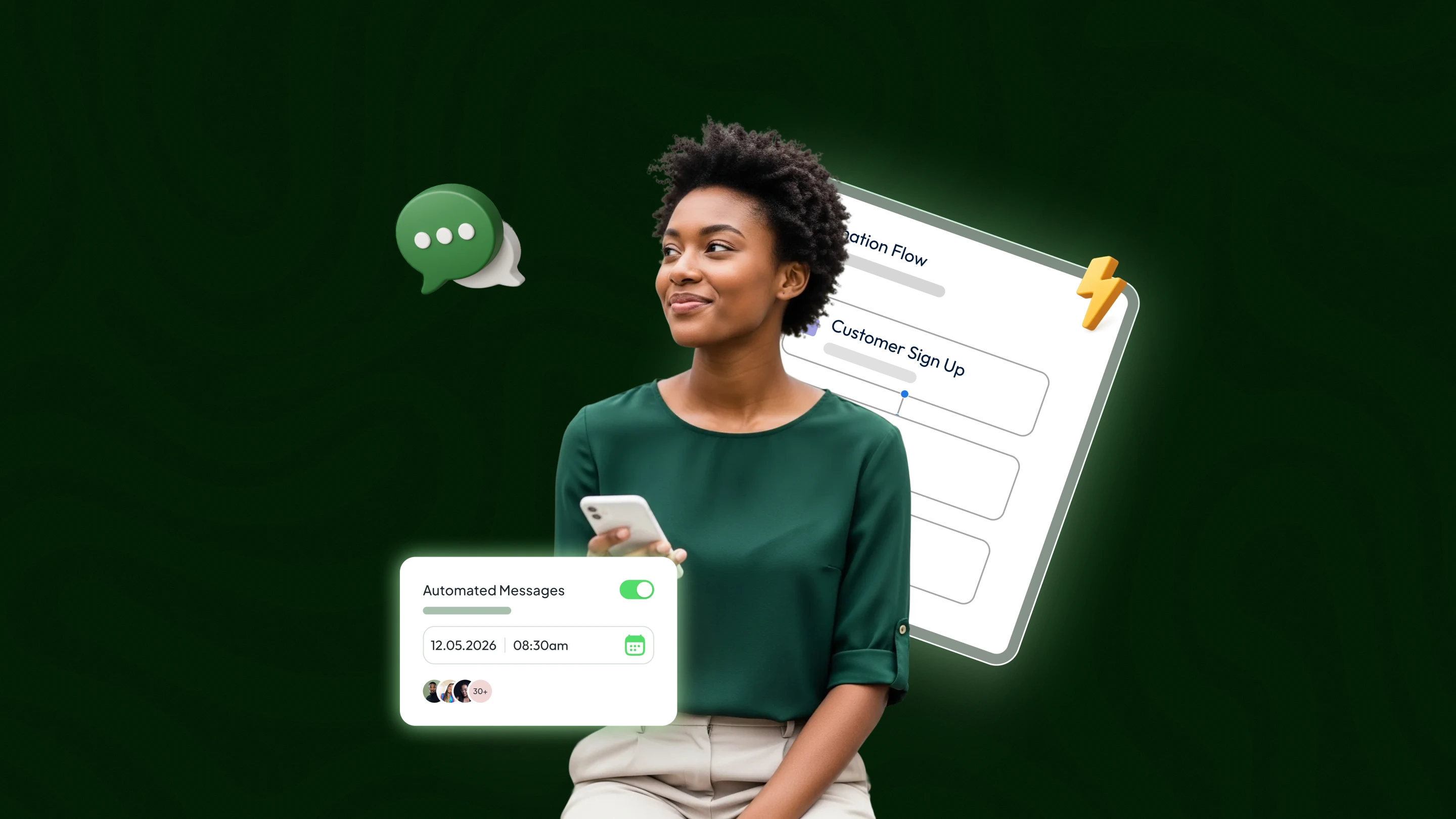
Workflows builder. Notify Africa customizes bulk SMS, AI chatbot, forms, and automation tools for your workflows and audience. The platform allows you to define the trigger event, set conditions for which contacts qualify, write your message, and set the timing — all within a single workflow interface.
Scheduled campaigns. Beyond trigger-based automation, you can schedule any campaign to send at a future date and time. This allows you to plan your entire month's promotional calendar in advance and have every campaign go out automatically at the optimal moment.
Personalization at scale. Every automated message can include merge fields — the recipient's name, appointment date, payment amount, or any other custom data — making each message feel individually written even when it is sent to thousands of people simultaneously.
Two-way messaging integration. Notify Africa's platform lets you send messages, reply instantly, and manage clients effortlessly from one unified inbox. When an automated message triggers a customer reply, your team can pick up the conversation from the same dashboard.
API integration for developers. For businesses with existing systems — a CRM, a booking platform, an e-commerce store, or a custom application — Notify Africa's API allows you to trigger automated SMS messages directly from your own software, based on events in your system. A payment marked as received in your accounting software can automatically trigger a payment confirmation SMS. A new registration in your booking system can instantly fire a welcome message.
Multi-channel capability. Notify Africa's automation extends beyond SMS. Workflows can incorporate WhatsApp Business messages, giving businesses the option to route different types of automated communication to the most appropriate channel for each customer.
Getting started with automation is straightforward, but a few common mistakes can undermine your results. Avoid these from the beginning:
Automating without a clear goal. Every automated workflow should have a defined purpose and a measurable outcome. Before you build any automation, ask: what do I want this message to make the recipient do? If you cannot answer that clearly, redesign the message before you go live.
Over-automating and messaging too frequently. Automation makes it easy to send a lot of messages. That does not mean you should. 67% of businesses plan to increase their SMS marketing budgets in 2025, but volume must be matched with relevance. Sending automated messages that feel irrelevant or excessive will drive opt-outs regardless of how sophisticated your workflow is.
Forgetting to personalize. The value of automation is precision, not uniformity. Use merge fields to include the recipient's name, their specific appointment details, or their relevant account information. A generic automated message is only marginally better than no message at all.
Setting and forgetting without review. Automation runs independently, but it still needs periodic review. Check your open rates, opt-out rates, and conversion data every month. If a workflow is generating high opt-outs, the trigger timing, message content, or target segment needs adjustment.
Not testing before going live. Always send test messages to yourself and a colleague before activating any automation. Check that merge fields populate correctly, that the message renders well on different handsets, and that the timing logic works as intended.
Using unregistered sender IDs for automated messages. In Tanzania, all SMS — including automated and transactional messages — must come from a registered sender ID. Ensure your sender ID is fully registered across all Tanzanian networks before activating any automation. Notify Africa manages this registration process on your behalf.
If you are new to SMS automation, the most effective approach is to start with one high-value workflow, execute it well, and expand from there.
Day 1: Create your Notify Africa account. Sign up at notify.africa and access your dashboard with free trial credits. No technical setup required.
Day 2: Register your sender ID. Apply for your business sender ID through the dashboard. Notify Africa handles the submission to Tanzanian network operators.
Day 3: Identify your single highest-value automation. For most businesses, this is either an appointment reminder (if you take bookings) or a welcome message (if you collect new customer sign-ups). Choose the one with the most obvious immediate ROI for your specific business.
Day 4: Build and write your first workflow. Write the message copy, define the trigger, set the timing, and configure personalisation fields. Keep the first workflow simple — one trigger, one message.
Day 5: Test thoroughly. Send test messages to yourself. Confirm personalisation works. Confirm timing fires correctly. Check that the message reads well on both a smartphone and a basic feature phone.
Day 6: Activate and monitor. Go live. Watch the first automated messages sent. Review delivery reports in your dashboard.
Day 7: Plan your next workflow. With your first automation running successfully, identify the next highest-value workflow to build. Repeat the cycle.
Within a month of this approach, most Tanzanian businesses have three to five active automations running simultaneously — covering welcome messages, appointment reminders, payment alerts, and a basic re-engagement campaign — all with minimal ongoing effort
What is the difference between SMS automation and a scheduled SMS campaign?
A scheduled campaign is a one-off message sent to a group of contacts at a specific pre-set time — for example, a promotional blast scheduled for next Tuesday morning. SMS automation is an ongoing workflow that sends messages automatically based on triggers and conditions, not a single manual scheduling decision. Automation fires continuously as new contacts meet the trigger criteria; a scheduled campaign fires once.
Do I need technical skills or a developer to set up SMS automation in Tanzania?
No. Notify Africa's platform is designed for business owners without technical backgrounds. Workflow setup is done through a visual dashboard interface. For businesses that want to integrate SMS automation directly with their own software systems, Notify Africa's developer API is available with full documentation.
How much does SMS automation cost in Tanzania?
Automated messages use SMS credits in the same way as manually sent messages. The cost per message is the same regardless of whether a human or an automated workflow triggered the send. The efficiency gain from automation — time saved, no-shows reduced, re-engagement revenue recovered — typically makes the cost-per-outcome of automated messages significantly lower than manual campaigns. Contact the Notify Africa team for current credit pricing tailored to your expected monthly volume.
Can I personalise automated SMS messages in Tanzania?
Yes. Notify Africa's automation supports merge fields for personalization — including the recipient's name, appointment date, payment amount, or any other custom data stored in your contact records. Using AI for personalization and automation is the most popular SMS marketing trend for businesses, with 40% of businesses adopting it as their top priority.
How many automated workflows can I run simultaneously on Notify Africa?
Multiple workflows can run simultaneously on the Notify Africa platform, allowing you to have a welcome sequence, an appointment reminder workflow, a re-engagement campaign, and a payment reminder automation all active at the same time. Contact the Notify Africa team for specifics on workflow limits applicable to your account plan.
Can SMS automation work alongside WhatsApp automation on Notify Africa?
Yes. Notify Africa's platform supports both SMS and WhatsApp Business messaging from a single dashboard. Automation workflows can incorporate both channels, allowing you to route different message types to the most appropriate channel for each customer — for example, using SMS for time-critical reminders (since it reaches all phones without internet) and WhatsApp for richer promotional content with images or documents.
What happens if a customer replies to an automated SMS?
Replies are captured in your Notify Africa unified inbox, where your team can respond directly. For businesses that receive high volumes of replies, Notify Africa's AI chatbot capability can handle common responses automatically — answering FAQs, capturing leads, or routing the customer to the right team member — reducing the manual load further.
Is SMS automation compliant with Tanzania's regulations?
Automated SMS messages are subject to the same TCRA and Personal Data Protection Act obligations as manually sent messages. This means you need a registered sender ID, you can only send to contacts who have consented to receive messages from your business, and every marketing automation must include an opt-out mechanism. Notify Africa's platform is built to support TCRA-compliant sending, and the team provides guidance on setting up automations that meet local regulatory requirements. For a full guide to compliance, read our SMS Marketing Compliance in Tanzania guide.
How long does it take to set up an SMS automation on Notify Africa?
A basic automation — such as an appointment reminder or welcome message — can be built and tested in under an hour once your sender ID is registered and your contact list is uploaded. More complex multi-step drip campaigns with branching conditions may take a few hours to configure and test properly.
Can I automate SMS in Swahili on Notify Africa?
Yes. Notify Africa fully supports Swahili-language automated messages. For automated messages in Swahili using extended characters, note that Unicode encoding may reduce the per-message character limit, which the platform will flag automatically as you write your message content.
SMS automation is not a luxury reserved for large corporations with sophisticated marketing technology teams. It is a practical, accessible, and affordable tool that any Tanzanian business — from a two-person clinic to a growing logistics company — can implement and benefit from immediately.
The core value is simple: you do the work of writing and configuring your messages once. The platform does the work of sending them at exactly the right moment, to exactly the right person, indefinitely — whether you are in a meeting, asleep, or managing three other priorities simultaneously.
Automated flows generate up to 30 times more revenue per recipient than one-off campaigns because they are so timely and targeted. That is not a theoretical projection — it is what happens when the right message reaches the right customer at precisely the right moment, every time, without fail.
Notify Africa gives Tanzanian businesses everything needed to launch SMS automation quickly and confidently: a locally-optimised platform, TCRA-compliant infrastructure, Swahili and English support, and a team that understands the specific communication needs of businesses operating in Tanzania and across East Africa.
Ready to let your messaging work while you focus on running your business? Create your free Notify Africa account and set up your first automated workflow today — or book a free demo with the team to see exactly how automation can work for your specific business.

A solution by iPF Softwares, an ISO 27001:2022 certified software development company.