 AI Chatbots
Best AI Chatbot Platforms in Tanzania (Comparison Guide)
Fauzia Ibrahim
Last Updated :
27th May 2026
By Fauzia Ibrahim
Product Specialist
Share this article with your friends
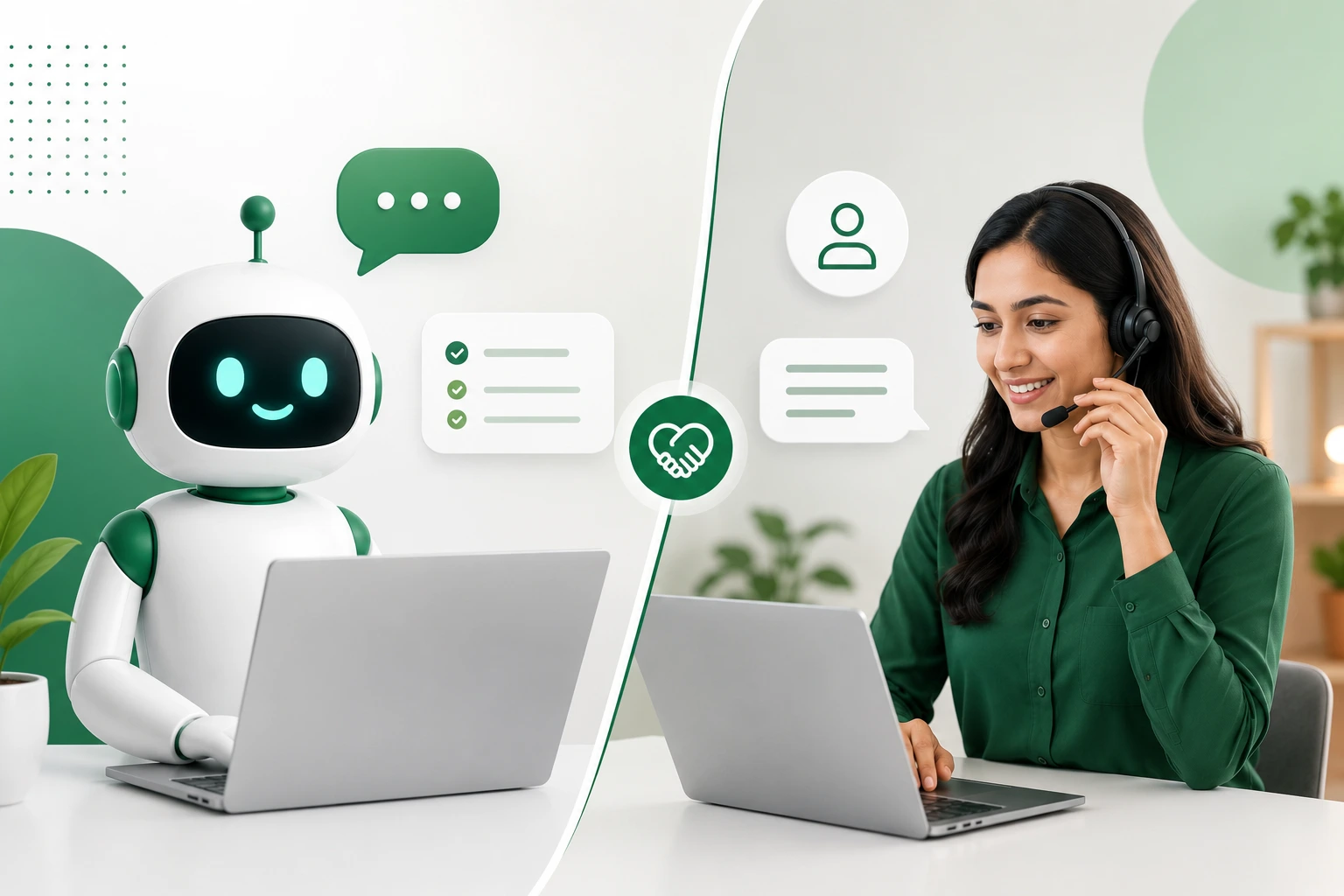
In Tanzania, an AI chatbot handles instant, 24/7, high-volume customer queries (order status, prices, FAQs, lead capture) at a fraction of the cost of staffing, while human support is best for complex, emotional or high-value cases that need judgement and empathy. Most growing Tanzanian businesses get the best results from a hybrid model: AI agents resolve routine conversations first, then hand off to a human when needed.
Your customer messages your business at 9:47 PM asking whether a product is in stock. Your support team logged off three hours ago. By morning, that customer has already bought from a competitor who replied in seconds. This is the daily reality for thousands of Tanzanian businesses, and it sits at the heart of the AI chatbot vs human support debate.
The honest answer is that this is rarely an either-or decision. AI chatbots and human agents solve different problems, and the businesses winning in Tanzania's fast-digitising market are the ones that know exactly which conversations to automate and which to keep human.
This guide breaks down how the two compare on speed, cost, language, empathy and compliance, which queries each one should handle, what it looks like across real Tanzanian industries, and how to deploy an AI agent for your business without losing the personal touch your customers value. By the end, you'll know exactly where AI belongs in your support stack and where it doesn't.
An AI chatbot is software that understands customer questions in natural language and replies instantly, around the clock, while human support is a trained person who handles conversations using judgement, empathy and discretion. The core difference is that AI scales infinitely at near-zero marginal cost, whereas humans bring understanding and trust that software cannot fully replicate.
A modern AI chatbot, often called an AI agent or AI assistant, is far more capable than the rigid "press 1 for sales" bots of the past. Today's agents are trained on your own business information, your website content, your FAQs, your product catalogue, your pricing, and they answer customer questions conversationally. A good AI agent can confirm an order, share delivery timelines, capture a lead's contact details, qualify a sales enquiry, and route a serious complaint to your team, all without a human touching the keyboard.
The most useful agents are always-on and multichannel. They live wherever your customers already are: WhatsApp, your website chat widget, Instagram, Facebook Messenger and even SMS, so a customer never waits for office hours. Notify Africa's AI agent for Tanzanian businesses is built exactly this way: you train it in minutes on your existing documents and set its tone to match your brand voice.
Human agents excel where conversations get messy, emotional or high-stakes. A frustrated customer disputing a wrong charge, a corporate client negotiating a contract, or a patient describing a sensitive health concern all deserve a person who can read tone, exercise discretion, and make exceptions a script cannot. Humans also build the long-term relationships that turn one-time buyers into loyal clients.
This is not a small detail. According to SurveyMonkey's customer experience research, 89% of consumers believe companies should always offer the option to speak with a human, and 78% say it's important to be able to switch from an AI agent to a person mid-conversation. Customers are happy to be served by AI, but they do not want to feel trapped by it.
Tanzanian businesses are rethinking support because customer expectations and digital reach have both exploded at the same time. Customers now expect instant replies on the channels they already use, while the cost of staffing a support desk around the clock keeps rising.
The market data makes the shift impossible to ignore. According to the Tanzania Communications Regulatory Authority (TCRA), the country recorded 106.9 million mobile subscriptions and roughly 58 million internet subscriptions by the end of 2025, with smartphone penetration climbing past 41%. Mobile money is now woven into daily commerce, with M-Pesa, Mixx by Yas and Airtel Money handling the bulk of the more than 6.3 billion mobile money transactions recorded across 2025. Your customers are online, on their phones, and ready to transact at any hour.
At the same time, expectations for speed have hardened. Research compiled by Freshworks shows nearly half of customers expect a response within four hours and a meaningful share want help within 15 minutes.
A small or mid-size Tanzanian business simply cannot staff humans to meet that demand 24 hours a day, seven days a week, which is why automation has moved from a luxury to a survival tool. This is the same logic that already pushes businesses toward a bulk SMS platform for instant, large-scale customer messaging.
See What Always-On Support Could Do For Your Business Book a free demo and watch how a trained AI agent replies to real customer questions in seconds. Book A Free Demo →
AI chatbots win decisively on speed, cost, availability and scale, while human agents win on empathy, complex problem-solving and relationship-building. Neither replaces the other outright; each is stronger in different parts of the customer journey. The comparison below shows where each one earns its place.
Factor | AI Chatbot / Agent | Human Support |
|---|---|---|
Availability | 24/7, including nights, weekends and public holidays | Limited to staffed hours and shifts |
Response speed | Instant, even during high traffic | Depends on queue length and agent load |
Cost per conversation | Very low and fixed at scale | Rises with every new hire |
Handling volume spikes | Unlimited simultaneous chats | Constrained by headcount |
Consistency | Same accurate answer every time | Varies by agent, mood and fatigue |
Empathy and nuance | Limited; struggles with emotion | Strong; reads tone and context |
Complex or sensitive cases | Best escalated to a human | Excellent |
Languages | Can be configured for English and Swahili | Depends on staff skills |
This is where AI wins outright. An AI agent answers the moment a message arrives, whether it's midday or 2 AM, and never makes a customer wait in a queue. Data summarised by Zendesk via Zoom found that 61% of people prefer an instant AI reply over waiting for a human agent. In a market where customers shop on WhatsApp late at night, that immediacy directly protects sales.
The economics are stark. Industry analysis compiled by ChatMaxima estimates an AI-handled interaction costs roughly a fraction of a US dollar compared with several dollars for a human-handled one, a difference that compounds enormously at scale. For a Tanzanian SME, that can mean serving ten times the customer volume without adding a single salary, while reserving paid agent hours for the conversations that genuinely need a person.
Generic global chatbots often stumble on Tanzanian customers because they default to English and miss local context. The advantage of training an AI agent on your own materials is that you control how it speaks. Because Notify Africa is built in Tanzania and lets you customise tone and train the agent on your content, you can configure it to serve customers comfortably in both English and Swahili, the way your front desk already does. Pairing this with WhatsApp Business automation meets customers on the channel they use most.
Here humans win, and it isn't close. When a customer is upset, confused or making a high-value decision, an AI agent can recognise the situation but cannot truly reassure, negotiate or improvise the way a skilled person can. The smart approach is not to force AI into these moments but to design your system so the agent hands off cleanly to a human the instant a conversation needs one.
A flash sale, a product launch, an exam-results day or a festive promotion can flood your inbox with hundreds of simultaneous messages. Human teams buckle under that load; an AI agent handles unlimited conversations at once without slowing down. This elasticity is the single biggest operational reason Tanzanian businesses adopt AI support.
AI should handle the high-volume, repetitive and informational queries that make up the majority of customer messages, while humans should handle complex, emotional, high-value or exception-based cases. Getting this split right is what separates a chatbot that delights customers from one that annoys them.
Best handled by an AI agent:
Order and delivery status checks
Pricing, stock availability and opening hours
Frequently asked questions and how-to guidance
Booking confirmations and appointment reminders
Capturing and qualifying new sales leads
Routing messages to the right department
Best kept with a human:
Complaints and disputes that need a resolution decision
Sensitive matters such as health, money or legal issues
Negotiations, custom quotes and high-value sales
Anything where a customer is clearly frustrated or distressed
Edge cases the AI hasn't been trained on
The data backs this division. The Zendesk and Zoom analysis notes that 81% of consumers expect a bot to escalate to a human when needed, yet far fewer say this actually happens. Build your AI support so escalation is seamless, and you capture the speed of automation without the frustration of a dead end.
A modern AI agent works by learning your business, deploying across your customer channels, and answering conversations automatically while routing the hard ones to your team. Setup is far simpler than most business owners expect.
The process is straightforward. First, you train the agent by uploading your existing website content, FAQs and business documents, which gives it accurate, on-brand knowledge in minutes rather than weeks. Next, you customise its tone and set rules so it sounds like your brand and knows when to escalate. Finally, you deploy it across the channels your customers use, including WhatsApp, web chat, Instagram, Messenger and SMS, from a single workspace.
This is the model behind Notify Africa's AI assistant for customer engagement, which is built specifically for Tanzanian businesses and connects naturally with the same platform that powers your bulk messaging and automation. For teams that want to build deeper custom integrations, the developer API and documentation make it possible to connect the agent to your own systems, CRM or e-commerce store.
Get Early Access To Your AI Agent Join the Notify Africa wishlist and be first to deploy a 24/7 AI assistant trained on your own business. Claim Early Access →
The right balance of AI and human support shifts depending on your sector, because each industry has a different mix of routine and sensitive conversations. Here is how the split plays out across common Tanzanian business types.
Online shops and dukas selling through Instagram and WhatsApp get flooded with "Is this available?", "How much?" and "Where's my order?" messages, often outside working hours. An AI agent answers these instantly and captures the lead, while a human steps in for returns, complaints or bulk orders. The result is more closed sales and fewer lost late-night customers.
Financial services field huge volumes of routine queries, balance checks, branch locations, document requirements, repayment dates, that an AI agent can answer 24/7. Sensitive matters like loan disputes, fraud concerns or claim negotiations stay firmly with trained human staff. This mirrors how regulated firms already use a reliable messaging backbone for alerts and one-time passwords.
Clinics and pharmacies can use AI agents for appointment booking, reminders, opening hours and general product enquiries, freeing staff for patient care. Anything involving symptoms, diagnoses or medical advice should always route to a qualified human, with the AI acting purely as a triage and scheduling layer.
Courier and logistics firms handle constant "Where is my parcel?" traffic. An AI agent tied to your tracking data answers these instantly day and night, while dispatchers and support staff handle exceptions like failed deliveries or address changes.
Schools, colleges and training providers see predictable surges around admissions and exam results. An AI agent absorbs the spike, answering eligibility, fees and deadline questions at scale, while admissions officers focus on counselling and enrolment decisions that need a personal conversation.
Event organisers face intense, time-boxed bursts of questions about schedules, venues and tickets. AI handles the volume in real time, which complements the bulk SMS confirmations and reminders many Tanzanian event teams already rely on to keep attendees informed.
Start reaching your customers today
Send SMS, email and WhatsApp campaigns in minutes.
Start free trialYes, using AI chatbots and automated messaging is legal in Tanzania, provided you follow TCRA rules on consent, sender identity and consumer protection. Automation does not exempt you from the same compliance obligations that govern any business communication.
Three principles matter most. First, obtain consent: under the Electronic and Postal Communications (Consumer Protection) Regulations, you should have a customer's opt-in before sending them marketing messages, and you must honour opt-out requests. Second, register your Sender ID with the TCRA so your messages are properly identified and trusted, rather than flagged as spam. Third, be transparent: best practice, and rising consumer expectation, is to make clear when a customer is talking to an AI rather than a person, and to offer a route to a human.
The transparency point is not just regulatory caution; it is commercial. The SurveyMonkey research found that a notable share of consumers would lose trust in a business that hid the fact they were dealing with an AI. Building consent, clear identification and easy human escalation into your support from day one protects both your compliance standing and your reputation. If you want help configuring compliant flows, the Notify Africa team can guide you through setup and onboarding.
The best rollout introduces AI as the first responder and humans as the escalation layer, so customers get instant answers without ever feeling abandoned. Treat AI as an amplifier of your team, not a replacement for it.
A practical sequence works well. Start by letting the AI agent handle your most common, repetitive queries, the ones your staff answer dozens of times a day. Set clear escalation triggers so that frustration, complex requests or sensitive topics route immediately to a person. Always give customers a visible path to reach a human, since the research is clear that people want that reassurance even when they rarely use it. Finally, review the conversations the AI gets wrong and feed those back into its training so it improves over time.
Done this way, your human team stops drowning in repetitive messages and spends its energy on the conversations that actually build revenue and loyalty. Your customers get speed and availability from the AI and judgement and warmth from your people, the combination that consistently outperforms either approach alone.
Build Support That Never Sleeps, Backed By A Real Team Start free with Notify Africa and combine AI automation with reliable, locally-supported messaging. Start For Free Today →
No, and it shouldn't. An AI chatbot is best at handling high-volume, routine queries instantly and around the clock, but it cannot match a human's empathy, judgement or ability to resolve complex disputes. Research shows the overwhelming majority of consumers still want the option to reach a person. The most effective setup is a hybrid one where AI handles the first response and humans take over sensitive or high-value cases, which lets a small team serve far more customers without losing quality.
Yes. Because a modern AI agent is trained on your own content and its tone is configurable, you can set it up to communicate with customers in both English and Swahili. This is a major advantage over generic global bots that default to English and miss local context. Since Notify Africa is built in Tanzania, the AI assistant is designed to serve Tanzanian customers naturally in the language they prefer, the same way your front-line staff already do.
An AI agent costs dramatically less per conversation than a human agent, and that gap widens as your volume grows. Industry data puts the cost of an AI-handled interaction at a small fraction of a human-handled one. For a Tanzanian SME, this means you can serve many times more customers without adding salaries, while keeping your human team focused on the cases that genuinely need a person. The exact pricing depends on your channels and volume, which the Notify Africa team can scope for you.
Yes. Using AI chatbots and automated messaging is legal in Tanzania as long as you follow TCRA regulations. That means obtaining customer consent before sending marketing messages, honouring opt-outs, registering your Sender ID, and being transparent that customers are interacting with an AI. These are the same consumer-protection principles that apply to any business communication, and building them in from the start keeps you compliant and trusted.
An AI chatbot is far faster. It responds the instant a message arrives, at any hour, and handles unlimited conversations simultaneously without queues. A human agent's speed depends on staffing levels, working hours and how busy the team is. For routine questions, AI delivers near-instant answers that customers increasingly expect, while humans remain better suited to complex conversations where thoughtfulness matters more than speed.
Let your AI agent handle repetitive, informational and transactional queries: order and delivery status, pricing, stock availability, opening hours, FAQs, appointment booking and lead capture. Keep complaints, disputes, negotiations, sensitive personal matters and anything emotionally charged with your human team. A well-designed agent should also recognise when a conversation falls outside its scope and escalate it to a person automatically.
Far less time than most business owners expect. A modern AI agent can be trained in minutes by uploading your existing website content, FAQs and business documents, then configured with your preferred tone and deployed across channels like WhatsApp, web chat and SMS. The heavier lifting is refining its answers over time based on real conversations, but you can be live and answering customers very quickly rather than waiting weeks.
Yes. The strongest Tanzanian customer-communication setups combine channels: an AI agent for instant conversational replies, WhatsApp Business for direct engagement, and bulk SMS for reach to every phone in the country. Running these from one platform means a lead captured by your AI agent can be followed up by SMS or WhatsApp automatically, creating a single, joined-up customer journey rather than disconnected tools.
The AI chatbot vs human support question has a clear answer for Tanzanian businesses: stop choosing sides. AI agents give you the instant, always-on, low-cost responsiveness your customers now demand, while your human team delivers the empathy and judgement that build lasting trust. The businesses pulling ahead are the ones using each for what it does best.
Here is what to take away:
AI handles the routine, repetitive and high-volume queries instantly, 24/7, at a fraction of staffing cost.
Humans own the complex, sensitive and high-value conversations where empathy and judgement matter.
A hybrid model, AI first, human on escalation, consistently beats either approach alone.
TCRA compliance and clear AI transparency protect both your standing and your reputation.
With Tanzania's digital market growing every quarter, the cost of slow, office-hours-only support is rising fast. Notify Africa gives you the tools to combine intelligent automation with reliable, locally-supported messaging, all in one place.
Put AI And Human Support To Work Together Talk to a Tanzania-based expert and design a support setup that scales with your business. Talk To An Expert →

A solution by iPF Softwares, an ISO 27001:2022 certified software development company.