 WhatsApp
How to Send Bulk WhatsApp Messages to Customers in Tanzania
Fauzia Ibrahim
Last Updated :
29th May 2026
By Beatha Beichumila
Product Specialist
Share this article with your friends
A WhatsApp drip campaign is a sequence of automated, pre-scheduled messages sent to an opted-in contact over days or weeks, triggered by a customer action or a time delay. To run one, you connect the official WhatsApp Business API through a verified provider, segment your audience, write approved message templates, set the timing and triggers, then launch and track delivery, open, and reply rates.
Most Tanzanian businesses already know that customers read WhatsApp messages within minutes — but very few send anything beyond a single, one-off blast. The result is predictable: one message goes out, a handful of people reply, and the rest of the list goes cold. A drip campaign fixes that. Instead of one shot, you deliver a planned sequence that warms a contact up, answers their questions in order, and nudges them toward a sale at exactly the right moment.
This guide walks you through how to run WhatsApp drip campaigns from scratch — what they are, why they outperform single broadcasts, the exact setup steps, the message sequences that convert, and the compliance rules you must follow to keep your number safe.
Whether you sell physical products, run a clinic, manage a school, or operate a logistics business, you will leave with a repeatable system you can launch this week. Everything here is built around the way Tanzanian customers actually use their phones — mobile-first, WhatsApp-default, and ready to respond.
A WhatsApp drip campaign is an automated series of messages delivered to a contact over time, where each message is triggered either by a time delay or by something the customer does. The name comes from the idea of "dripping" information slowly rather than dumping everything at once. Each message has one job — welcome, educate, remind, recommend, or recover — and together they guide the contact along a clear path toward a decision.
A broadcast sends the same message to everyone at the same moment, then stops.
A drip campaign sends different messages to each person, spaced out, based on where they are in their journey.
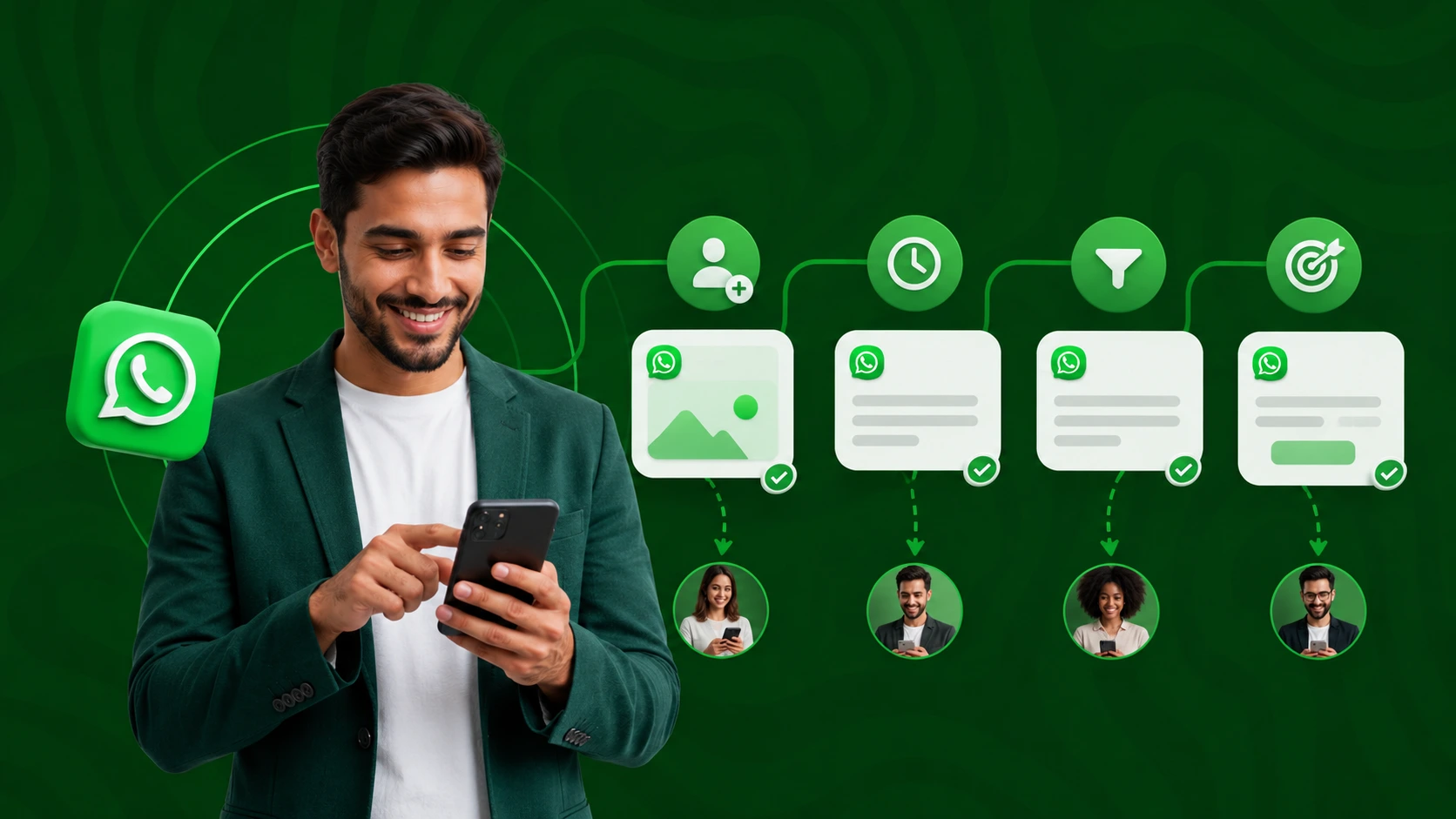
So a new lead might receive a friendly welcome on day one, a short explainer on day two, a customer testimonial on day four, and a limited-time offer on day six — automatically, with no one manually typing each message. That structured rhythm is what turns casual interest into paying customers, and it is exactly what our WhatsApp marketing platform is designed to power.
WhatsApp drips and SMS drips share the same logic, but WhatsApp adds richer tools: images, videos, PDFs, product catalogues, location pins, and tappable buttons that SMS cannot carry. SMS, on the other hand, reaches every phone in the country instantly — even feature phones with no internet — which is why many businesses run both.
A smart strategy uses WhatsApp for rich, conversational nurturing and bulk SMS in Tanzania for universal, no-data-required alerts like OTPs and delivery confirmations. Using both channels from one dashboard means no contact slips through a gap.
WhatsApp drip campaigns work in Tanzania because the country is overwhelmingly mobile-first and WhatsApp is the default messaging app for everyday communication. The reach is simply too large to ignore. According to the Tanzania Communications Regulatory Authority (TCRA),
Tanzania passed 58 million internet subscriptions and more than 100 million active mobile lines by the end of 2025, with mobile broadband making up the vast majority of connections. Data from DataReportal's Digital 2025 Tanzania report confirms the same pattern — tens of millions of mobile connections, most of them broadband-capable, with people accessing the internet almost entirely through their phones.
For a business, that translates into three concrete advantages:
Attention. WhatsApp messages are read where your customers already spend their time, not buried in an email inbox they rarely open.
Engagement. Open rates on WhatsApp reach as high as 98%, far above email, and replies come back in minutes rather than days.
Conversation. Because customers can reply directly, a drip campaign can branch into a real two-way chat — something a billboard or a radio spot can never do.
When you combine that reach with an automated sequence that follows up at the right time, you stop losing leads to silence and start converting them on a channel they trust.
Soft nudge: If you are weighing WhatsApp against your current outreach, mapping your customer journey first usually reveals where leads are going cold — and that is exactly where a drip sequence pays for itself.
Before you build a single message, you need three things in place: API access, consent, and approved templates. Skipping any of them is the fastest way to get your number restricted.
To send automated messages at scale, you need the official WhatsApp Business API — not the free WhatsApp Business app, which is built for small, manual chats and has no real automation, segmentation, or reporting.
The API is only available through a Meta-approved WhatsApp Business Solution Provider (BSP). Notify Africa handles the entire setup for you: Meta business verification, number registration, and API connection, so your business gets a verified WhatsApp presence ready to send and receive at scale. For teams that want to build directly against the API, our WhatsApp and SMS tools for developers expose the same infrastructure programmatically.
You may only message people who have actively agreed to hear from you on WhatsApp. This is non-negotiable under Meta's WhatsApp Business Messaging Policy, and it is also the right thing to do. A purchase, a website visit, or a form fill does not automatically count as WhatsApp consent — the opt-in must clearly name the channel and what the person is signing up for.
Strong opt-in language looks like this: "I agree to receive order updates and offers from [Your Business] on WhatsApp. Reply STOP anytime to unsubscribe." Always log how and when each contact opted in; if your number is ever reported, that proof protects your account.
This requirement aligns neatly with local rules. Under the Electronic and Postal Communications (Consumer Protection) Regulations enforced by the TCRA, businesses must obtain consent before sending marketing communications and must honour opt-out requests — so a clean, consent-first list keeps you compliant on both fronts at once.
Any message your business sends first — before the customer replies — must use a pre-approved template. Templates fall into categories such as marketing, utility, and authentication, and each is reviewed by Meta before it can go out.
Marketing templates carry promotions and offers; utility templates handle order updates, reminders, and confirmations; authentication templates deliver one-time passcodes. Getting templates approved in advance is part of a healthy drip setup, and a good platform helps you draft and submit them correctly the first time.
Ready To Launch Your First WhatsApp Drip Campaign?
Get the official WhatsApp Business API, approved templates, and local onboarding — all set up for you
Start for FreeSetting up a drip campaign comes down to seven clear steps: define the goal, segment the audience, map the sequence, write the templates, set the timing and triggers, test on a small batch, then launch and measure. Follow them in order and you will avoid the mistakes that sink most first attempts.
Every drip campaign should have a single, measurable objective. Are you onboarding new sign-ups, recovering abandoned orders, re-activating dormant customers, or nurturing fresh leads toward a first purchase? A focused goal decides everything downstream — how many messages you send, what they say, and how you measure success. A campaign that tries to do everything converts no one.
A generic sequence sent to your whole database is not a drip campaign — it is just scheduled noise. Group your contacts so each person receives messages that fit their situation. Useful segments for Tanzanian businesses include:
New leads who have shown interest but not bought
First-time buyers who need post-purchase onboarding
Repeat customers ready for upsells and loyalty offers
Dormant contacts who have gone quiet and need re-engaging
Location-based groups, for region-specific offers or store openings
With Notify Africa's contact segmentation, you can split by location, purchase history, or customer type, then personalise each message with names and custom fields so it reads one-to-one.
Sketch the whole journey before writing a word. Decide how many messages the sequence needs, what each one will achieve, and how far apart they should land. As a rule of thumb, three to five messages spread over one to two weeks works well for most goals — enough to build momentum without overwhelming the contact. Write the purpose of each message in one line: message one welcomes, message two educates, message three proves value with a testimonial, message four makes the offer, message five creates gentle urgency.
Now write each message. Keep them short, warm, and genuinely useful, with one clear call to action per message. Lead with value, not a hard sell — the early messages earn the right to make an offer later. Use rich media where it helps: a product photo, a short demo video, a price-list PDF, or tappable buttons that let the customer reply with a single tap.
Where a message is business-initiated, format it as an approved template; where the customer has already replied, you can chat freely within the 24-hour service window.
Decide what starts the sequence and what spaces it out. Time-based triggers send messages at fixed intervals (day one, day three, day six). Action-based triggers respond to behaviour — a sign-up fires the welcome series, an abandoned cart fires a recovery series, a completed purchase fires an onboarding series. Schedule sends for times when Tanzanian customers are actually on their phones, and avoid late nights. Importantly, the moment a contact replies, pause the automated drip and route them to a person or an AI assistant — a live conversation always beats a scheduled message.
Before you send to thousands, send to a small test group first. Check that names and custom fields populate correctly, that links and buttons work, that media loads, and that delivery reports come back clean. This catches formatting errors and invalid numbers before they affect your whole audience — and protects your sender reputation.
Go live, then watch the numbers in real time. Track delivery rate, open rate, reply rate, click-throughs, and ultimately conversions. If read rates are weak, rewrite the opening line. If clicks are weak, simplify the call to action or switch from a raw link to a button. Treat every campaign as a test you improve, not a one-time event. Notify Africa's real-time campaign reports give you all of this in one dashboard so you can see exactly which message in the sequence is doing the heavy lifting.
Build Smarter Sequences, Not Random Blasts
Segment, schedule, automate, and track every WhatsApp drip campaign from one dashboard
Start free trialThe best way to understand drip campaigns is to see them in action. Here are five sequences Tanzanian businesses can deploy right away, each mapped to a real goal.
Triggered when a new customer opts in. Message one thanks them and sets expectations. Message two, a day later, shows how your product or service works. Message three shares a quick tip or a popular product. This turns a stranger into an engaged contact and dramatically lowers early drop-off. It works beautifully for fintech apps, online shops, and service providers onboarding first-time users.
For e-commerce, this is the highest-ROI sequence there is. An hour after a customer leaves items unpurchased, message one gently reminds them. A day later, message two answers a likely objection — delivery time, payment options, or a size question. A final message offers a small incentive or free delivery. Because these reminders land on WhatsApp, where almost everyone reads them, recovery rates beat email by a wide margin.
For products with a longer decision cycle — vehicles, property, insurance, B2B services — a slow nurture wins. Space messages over a week or two: an educational message, a case study or testimonial, a comparison that addresses pain points, and finally a consultation offer. Each touch builds trust until the lead is ready to talk to sales.
When contacts go quiet, a short win-back series brings them back. Message one acknowledges the gap warmly ("We've missed you"). Message two shares what's new. Message three offers a returning-customer deal. Contacts who still don't respond move to a dormant list, which keeps your active list clean and your quality rating high.
Utility sequences keep customers informed automatically — order confirmation, dispatch alert, delivery notification, and, for subscriptions, a renewal reminder before the due date. These messages reduce support calls, build trust, and create natural openings for the next sale.
For sequences where the customer asks questions mid-flow, pairing your drip with an AI-powered WhatsApp chatbot means those questions get answered instantly, in English or Swahili, with a clean handover to a human agent when the conversation gets complex.
Most effective WhatsApp drip campaigns use three to five messages spread across one to two weeks. The exact number depends on your goal: a welcome series might be three short messages, while a high-value sales nurture could run five or six over two weeks.
The principle that matters is restraint — frequency, not volume, is what protects your account. Sending daily messages for a month is the surest way to collect blocks and reports. Space messages out, give each one a clear purpose, and stop the sequence once a contact converts or clearly disengages.
Compliance on WhatsApp is not optional — it is what keeps your number alive. Two systems govern your sending: Meta's policy and Tanzania's regulations, plus a quality score that decides how many messages you can send.
The Rules You Must Follow
Only message contacts who have explicitly opted in on WhatsApp.
Include a clear opt-out in your messages — typically "Reply STOP to unsubscribe."
Remove anyone who opts out immediately and permanently.
Keep messages relevant, personalised, and reasonably spaced.
These mirror both Meta's WhatsApp Business Messaging Policy and the TCRA's consumer-protection requirements, so following them keeps you safe with the platform and the regulator at the same time.
WhatsApp scores every sender on a quality rating — green for high quality, yellow for medium, red for low — based largely on how recipients react. Blocks and "report spam" taps drag your score down; high read rates and low complaints keep it green.
According to the WhatsApp Business Platform messaging limits documentation, businesses start with a modest daily cap on the number of unique users they can message with templates, then scale up through tiers — for example from 1,000 to 10,000 to 100,000 and eventually unlimited — as long as they maintain quality and consistent volume.
The lesson for drip campaigns is direct: a well-targeted, consent-based sequence does not just convert better, it also protects your deliverability and lets you scale faster over time. This is also why list hygiene matters — failed and unresponsive numbers should be cleaned out regularly so they don't drag your reputation down.
WhatsApp now charges on a per-message basis for template categories such as marketing, utility, and authentication, while customer-initiated service conversations are free when you reply within the 24-hour window.
That pricing model rewards precision: every message you send should earn its place, which is exactly the discipline a good drip campaign enforces. To see how this maps to your expected volume, talk to the Notify Africa team for a tailored estimate.
Send With Confidence, Not Caution
Notify Africa is a Meta-approved provider with built-in opt-out handling, quality monitoring, and local compliance support.
Get Started FreeEven strong sequences fail when teams make avoidable errors. Watch for these:
Messaging without explicit WhatsApp opt-in. A website visit or a purchase is not consent. This is the fastest route to a banned number.
Over-messaging. Daily promotions exhaust patience and trigger blocks. Respect frequency and add cool-downs when contacts stop engaging.
Skipping segmentation. One generic sequence for everyone reads as spam. Customers know when a message wasn't meant for them.
Ignoring delivery reports. Numbers that consistently fail should be removed, not carried into the next campaign.
Never pausing the drip when someone replies. A live question deserves a live answer, not the next scheduled template.
No measurement. If you don't track opens, replies, and conversions, you can't improve — and you'll repeat what isn't working.
Notify Africa gives Tanzanian businesses everything needed to run WhatsApp drip campaigns properly, in one platform built and supported locally.
You get the official, Meta-approved WhatsApp Business API with verified business status; rich media messaging with images, videos, catalogues, and interactive buttons; scheduling and automation to build triggered customer journeys; contact segmentation and personalisation for messages that feel one-to-one; a unified team inbox so no reply is missed; and real-time campaign reports that show exactly what's working.
You also get an AI-powered chatbot that handles questions 24/7 in English, Swahili, or both, and a local onboarding team based in Dar es Salaam that speaks your language and sets everything up for you.
Notify Africa is built by iPF Softwares, an ISO 27001:2022 certified software company, so your customer data is handled to international security standards.
For businesses that want one provider for both conversational WhatsApp and universal SMS reach, running both channels from a single dashboard means every customer is covered — whether they're online or not.
You can see more practical playbooks like this one on the Notify Africa blog.
Yes. The free WhatsApp Business app is designed for small-scale manual chats and lacks automation, segmentation, and reporting. To run automated sequences at scale you need the official WhatsApp Business API, which is only available through a Meta-approved Business Solution Provider. Notify Africa is an approved provider and handles the verification, number registration, and API setup for you, so your business is ready to send compliant, automated campaigns.
Most effective sequences use three to five messages spread over one to two weeks. The right number depends on your goal — a welcome series may need only three short messages, while a high-value sales nurture might run five or six. The key is to space messages out, give each a clear purpose, and stop once the contact converts or disengages, since over-messaging leads to blocks that damage your account.
Yes, provided you have explicit consent. Both Meta's WhatsApp Business Messaging Policy and the TCRA's consumer-protection regulations require businesses to obtain opt-in before sending marketing messages and to honour opt-out requests immediately. The safest approach is to collect a clear, channel-specific opt-in, log when and how it was given, and include a simple "Reply STOP to unsubscribe" instruction in your messages.
A broadcast sends one identical message to your entire list at the same moment, then stops. A drip campaign sends a planned series of different messages to each contact, spaced out and triggered by time or behaviour. Broadcasts suit one-off announcements; drips suit nurturing, onboarding, recovery, and re-engagement — anywhere a follow-up sequence converts better than a single message.
Yes. You can write templates and run full sequences in Swahili, English, or both, and personalise each message with the contact's name and details. Notify Africa's AI chatbot also responds to customer questions in either language, which means a drip that prompts a reply can flow naturally into a real conversation in the language your customer prefers.
Conclusion
WhatsApp drip campaigns turn scattered, one-off messages into a system that nurtures every contact toward a sale — automatically and on the channel Tanzanian customers actually use. The path is straightforward: get the official API and explicit consent, segment your audience, map a short sequence with a single clear goal, automate the timing, and measure what converts.
Keep these takeaways in hand:
A drip beats a broadcast because it follows up, in order, at the right time.
Consent and quality are everything — they keep your number safe and your reach growing.
Three to five well-spaced, segmented messages outperform daily blasts every time.
Pause the automation the moment a customer replies, and let a real conversation take over.
You now have the full framework to plan and launch your first sequence. When you're ready to put it live with the official WhatsApp Business API, approved templates, and a local team that sets it all up for you, Notify Africa is built for exactly this.

A solution by iPF Softwares, an ISO 27001:2022 certified software development company.