 WhatsApp
 Retargeting: Re-Engage Cold Leads in Tanzania
Beatha Beichumila
Last Updated :
29th May 2026
By Beatha Beichumila
Product Specialist
Share this article with your friends
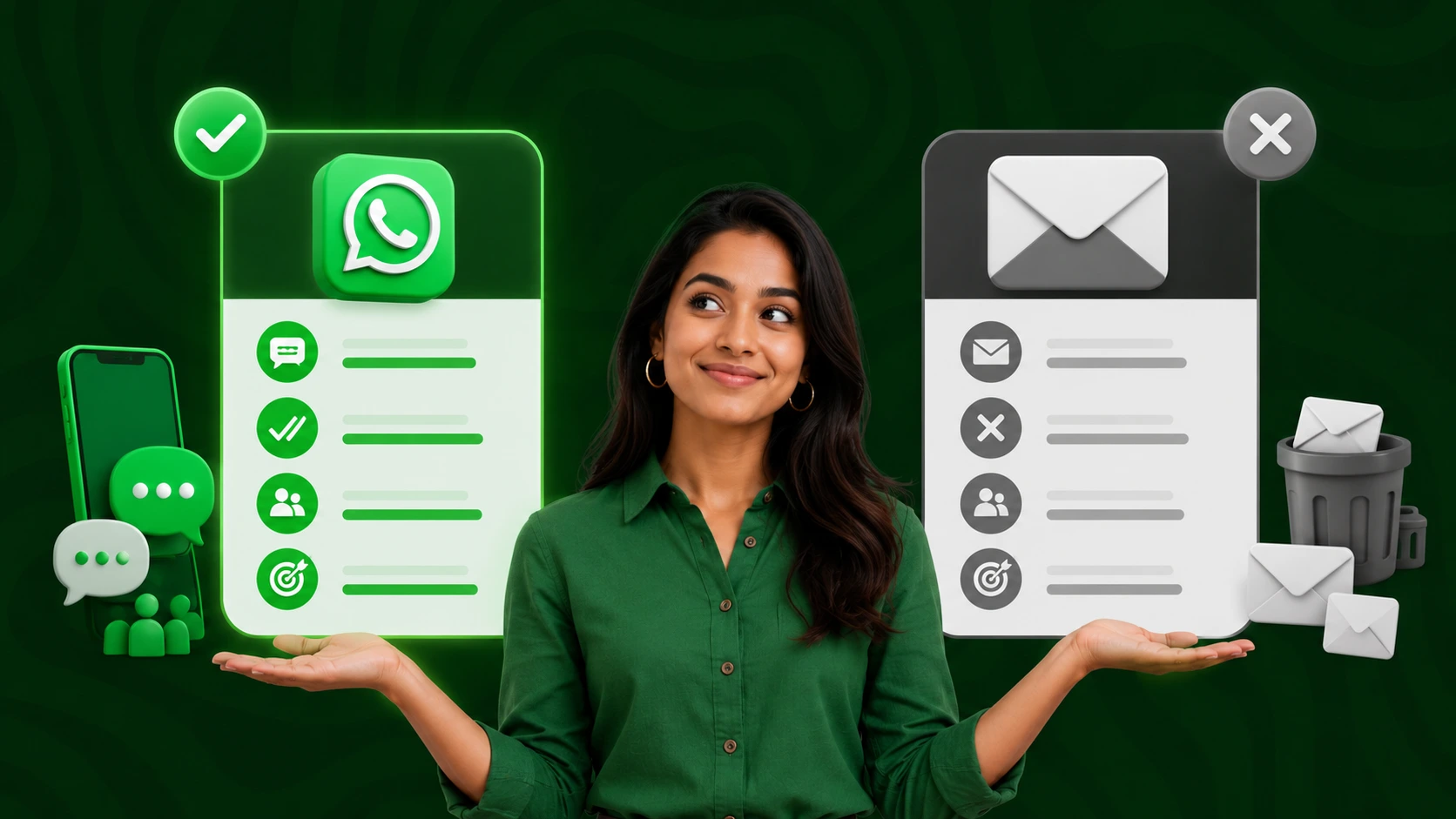
WhatsApp marketing reaches customers through the WhatsApp Business API with open rates near 98%, while email marketing delivers messages to inboxes at average open rates of 20–25%. WhatsApp wins on speed, open rates and conversational selling; email wins on long-form content, low per-contact cost and formal records. For most Tanzanian businesses, WhatsApp drives faster engagement and sales, while email supports newsletters and detailed updates.
If you are choosing where to spend your marketing budget this year, the question almost always comes down to one thing: where will your customers actually see the message? You can write the perfect promotion, but if it lands in a spam folder or sits unread for three days, it earns you nothing.
This is the real tension behind WhatsApp marketing vs email marketing — not which channel is "better" in theory, but which one gets opened, gets a reply, and turns into a sale in a market like Tanzania.
This guide breaks down both channels side by side: open rates, click-throughs, cost, message types, automation and the compliance rules that apply locally.
You will see where WhatsApp clearly pulls ahead, where email still earns its place, and how Tanzanian businesses are combining the two. By the end, you will know exactly which channel to lead with — and how to launch it without guesswork.
WhatsApp marketing is the practice of reaching customers through WhatsApp using the official WhatsApp Business API — sending bulk campaigns, automated notifications, and one-to-one conversations directly inside the app your customers already check dozens of times a day. Email marketing is the practice of sending promotional and transactional messages to a list of email addresses through an email service provider.
The core difference is the environment. Email arrives in a crowded inbox alongside invoices, newsletters and spam, where it competes for attention and often waits hours or days to be opened. A WhatsApp message arrives as a push notification in a chat list reserved mostly for family, friends and trusted businesses — so it gets seen almost immediately and, crucially, invites a reply.
WhatsApp marketing runs on the WhatsApp Business API, the official channel Meta provides for businesses sending at scale. Through a verified business account you can send rich media (images, videos, PDFs, catalogues, location pins and tappable buttons), trigger automated order and delivery updates, and let an AI chatbot answer questions around the clock. Because it is conversational, the same message that markets a product can also close the sale and handle support — all in one thread.
Email marketing sends campaigns to a subscriber list through platforms built for newsletters, drip sequences and segmentation. It excels at long-form storytelling, detailed product launches, receipts and content that customers may want to file and return to later.
Its strengths are low cost per contact and unlimited message length; its weaknesses are declining open rates, aggressive spam filtering and the formality that makes most people treat promotional email as low-priority.
WhatsApp messages are opened because they behave like personal messages, not broadcasts. Industry reporting consistently places WhatsApp open rates around 98%, while email open rates in 2025 sit closer to 20–25% across most regions according to email benchmark data from MailerLite. That single gap reshapes everything downstream — clicks, replies and conversions.
If you send 10,000 messages, a 98% open rate means roughly 9,800 people see your WhatsApp campaign. The same list emailed at a 22% open rate reaches around 2,200 inboxes. You are not just winning on percentages; you are reaching four to five times more people from the same contact list. This is why the Notify Africa WhatsApp platform frames WhatsApp engagement as roughly five times higher than email.
WhatsApp is not only opened more often — it is opened faster. Most business messages are read within minutes of arriving, and a large share of recipients reply within the first minute. Email, by contrast, is something people batch and check on their own schedule, often clearing promotions in bulk without reading them. For time-sensitive offers, appointment reminders and order updates, that speed difference is the whole game.
Notably, the MailerLite benchmarks point out that markets across Africa lean heavily on messaging apps like WhatsApp for promotional content, with lower iPhone ownership meaning email open rates here are less inflated by automatic-open privacy features. In other words, the WhatsApp advantage is even more pronounced in Tanzania than the global averages suggest.
Ready To Reach Customers Where They Actually Reply? Launch your first WhatsApp campaign in minutes with local onboarding support from day one. Start for Free
Here is how the two channels compare on the factors that decide a campaign's success.
Reach WhatsApp: More than 2 billion active users worldwide and one of the most-used apps in Tanzania. Email: Around 4.6 billion global users, but reach is fragmented across providers and spam filters.
Open Rate WhatsApp: Approximately 98%. Email: Roughly 20–25% on average.
Click-Through Rate WhatsApp: Frequently 45–60% for well-targeted promotional messages. Email: Typically 2–5%.
Speed To Open WhatsApp: Minutes — often seconds. Email: Hours to days.
Message Format WhatsApp: Short, conversational, rich media, interactive buttons, two-way replies. Email: Long-form, design-heavy, one-way unless the reader replies manually.
Cost Model WhatsApp: Priced per conversation through the Business API; higher per message but far higher engagement. Email: Very low per-contact cost on a monthly subscription, but lower returns per send.
Best Use WhatsApp: Promotions, flash sales, reminders, order updates, support, lead capture. Email: Newsletters, detailed announcements, receipts, long-term nurture sequences.
Compliance WhatsApp: Requires customer opt-in and Meta-approved message templates. Email: Requires opt-in and a working unsubscribe link.
The honest takeaway: WhatsApp wins decisively on visibility, speed and conversion, while email holds its ground on cost-efficiency for large lists and on content that deserves more than a few lines. For driving immediate action in Tanzania, WhatsApp is the stronger lead channel.
For most Tanzanian businesses, WhatsApp is the stronger primary channel because it matches how local customers actually communicate.
WhatsApp is among the most-used digital platforms in the country, and mobile-first behaviour dominates — most people access the internet through a smartphone, where a WhatsApp notification is impossible to ignore. The annual Digital 2025 Tanzania report from DataReportal documents this mobile-led, messaging-first usage pattern in detail.
Why WhatsApp Fits Tanzania
Three local realities tilt the balance toward WhatsApp.
First, email penetration among everyday consumers is far lower than smartphone and WhatsApp usage, so an email list will rarely match the reach of a WhatsApp audience.
Second, WhatsApp supports both English and Swahili naturally, which matters for customer trust and clarity.
Third, conversational commerce fits how Tanzanians already buy — asking a question, getting a price, confirming an order, and paying, all in one thread.
A WhatsApp chatbot that answers in Swahili at 9pm closes business that a static email never could.
Email is not obsolete here. For B2B relationships, formal proposals, invoices, monthly newsletters and detailed onboarding content, email remains the cleaner record and the more appropriate tone.
Many businesses keep email for depth and documentation while using WhatsApp for everything that needs a fast response.
The smartest setup is not WhatsApp instead of email — it is WhatsApp for speed and email for substance.
For The Fastest, Most Reliable Reach In Tanzania Combine WhatsApp campaigns with a Meta-verified business number and local support that speaks your language. Talk to an Expert
The cost models work in opposite directions, which is why a pure price comparison misleads. Email charges very little per contact — often a fixed monthly fee regardless of how many you send — so the cost per message is tiny. The WhatsApp Business API uses conversation-based pricing, so each message costs more than an email.
But cost per send is the wrong metric. The number that matters is cost per result. If an email reaches 22% of your list and converts a fraction of those, while a WhatsApp message reaches 98% and converts at far higher click and reply rates, the WhatsApp campaign frequently delivers a lower cost per sale even at a higher cost per message. Email's celebrated return on investment — often quoted around 36 to 1 in long-standing Litmus benchmark studies — is real, but it depends entirely on getting messages opened, which is exactly where WhatsApp has the edge in this market.
If you already run bulk SMS campaigns with Notify Africa, you can think of WhatsApp as the higher-engagement, richer-media layer on top of SMS — and many businesses run all three channels from one dashboard. For exact WhatsApp conversation pricing tailored to your volumes, it is best to request a quote directly rather than rely on generic estimates.
Use the channel that matches the job. The decision is rarely all-or-nothing — it depends on the message and the moment.
Use WhatsApp When:
You need the message opened and acted on quickly, such as flash sales, restocks or limited offers.
You are sending order confirmations, dispatch alerts, delivery updates or appointment reminders.
You want a two-way conversation that can answer questions and close a sale in the same thread.
You are capturing and qualifying leads, including after hours through an AI chatbot.
Use Email When:
You are sending newsletters, long-form announcements or detailed product education.
You need a permanent, searchable record like a receipt, invoice or contract summary.
You are running a multi-week nurture sequence for B2B prospects.
The Multichannel Play
The highest-performing strategy uses both, with each doing what it does best. Warm prospects up with an email that tells the full story, then drive the action through WhatsApp where it gets seen and answered. Layer in bulk SMS for guaranteed delivery when a contact has no smartphone or data, and let an AI chatbot handle the replies WhatsApp generates. Developers can wire these channels into existing systems through the Notify Africa API and developer documentation, so triggers like a new order or a missed payment fire the right message automatically.
WhatsApp marketing in Tanzania is legal and effective, but it is governed by two layers of rules: Meta's platform policies and Tanzanian law. Getting both right protects your sender reputation and keeps you out of regulatory trouble.
On the platform side, the WhatsApp Business API requires opt-in. You may only message customers who have agreed to hear from you, business-initiated marketing messages must use pre-approved templates, and abusive sending damages your quality rating.
Working through a Meta-approved Business Solution Provider keeps your account verified and compliant — Notify Africa connects you as an official BSP and handles the Meta verification for you. Meta publishes its messaging policies on the WhatsApp Business Platform, which is worth reviewing before you launch.
On the legal side, Tanzania's Personal Data Protection Act, 2022, which took effect on 1 May 2023 and is enforced by the Personal Data Protection Commission, sets clear obligations on how you collect, store and process customer contact data. Consent, purpose limitation and data-subject rights all apply to a WhatsApp contact list just as they do to any database.
Electronic communications more broadly fall under the Tanzania Communications Regulatory Authority (TCRA) and its consumer-protection framework, which reinforces consent and opt-out requirements. In practice the rule is simple: get permission, say who you are, send only what people agreed to, and make opting out easy.
Get WhatsApp Marketing Set Up The Compliant Way Verified Business API, opt-in handling and Tanzanian compliance built in — guided by a local team. Book a Demo
Getting started is faster than most businesses expect, because the technical setup is handled for you. As a Meta-approved Business Solution Provider, Notify Africa manages the official verification, the API connection and the template approvals, so you focus on the campaigns rather than the plumbing.
The path looks like this:
Create a free account and access your dashboard instantly, with no payment required to start.
Choose your WhatsApp solution — Business API, bulk campaigns, AI chatbot, or the full suite.
Connect and verify your business number through the official Meta process, handled by the onboarding team.
Build your campaign with rich media and buttons, or configure your AI chatbot with your FAQs and escalation rules in English, Swahili or both.
Go live, then track delivery, open rates, clicks and chatbot performance in real time and optimise from there.
Once you are live, the unified team inbox lets your staff manage every customer conversation in one place, assign chats and add notes — so a WhatsApp campaign that generates hundreds of replies never overwhelms your team. You can find more practical playbooks on the Notify Africa blog as you scale.
WhatsApp marketing is better for speed, visibility and conversion, with open rates near 98% versus 20–25% for email. Email is better for long-form content, formal records and very low cost per contact. For most Tanzanian businesses, WhatsApp is the stronger primary channel for promotions, reminders and support, while email works best for newsletters and detailed announcements. The strongest results usually come from using both together — email to inform, WhatsApp to activate.
WhatsApp messages arrive as push notifications in a chat list reserved for personal and trusted contacts, so they get seen almost immediately. Email lands in a crowded inbox alongside spam, newsletters and work mail, where it competes for attention and is often cleared in bulk without being read. Spam filters and inbox fatigue further suppress email opens, while WhatsApp's personal, conversational nature keeps engagement consistently high.
Yes. Through the WhatsApp Business API you can schedule campaigns, trigger automated messages based on customer actions, and build full customer journeys from welcome messages to follow-up reminders. An AI chatbot can also handle replies, qualify leads and escalate complex questions to a human agent. This gives you the automation depth of email drip campaigns combined with WhatsApp's far higher engagement.
The WhatsApp marketing vs email marketing debate has a clear answer for Tanzanian businesses: lead with WhatsApp, support with email. WhatsApp reaches your customers where they already are, gets opened almost every time, and turns conversations into sales — while email remains valuable for newsletters, formal records and long-form content.
The key takeaways:
WhatsApp open rates sit near 98%, against 20–25% for email.
WhatsApp wins on speed, click-throughs and conversational selling; email wins on cost per contact and depth.
In Tanzania's mobile-first, messaging-led market, WhatsApp is the stronger primary channel.
Compliance means opt-in consent under the Personal Data Protection Act, 2022 and Meta's platform rules — handled for you through an official Business Solution Provider.
You now have everything you need to choose the right channel and launch with confidence. With an official WhatsApp Business API, an AI chatbot that works in English and Swahili, and a local team that handles the setup, Notify Africa makes it simple to start reaching customers where they actually reply.
Put WhatsApp To Work For Your Business Today Get a verified Business API, bulk campaigns and an AI chatbot — set up by a local team, free to start. Get Started for Free

A solution by iPF Softwares, an ISO 27001:2022 certified software development company.