 WhatsApp
 Marketing vs Email Marketing in Tanzania
Beatha Beichumila
Last Updated :
15th May 2026
By Beatha Beichumila
Product Specialist
Share this article with your friends
The best WhatsApp marketing strategies for businesses in Tanzania include running segmented bulk campaigns with rich media, deploying AI chatbots for 24/7 lead qualification, automating follow-up sequences, sending appointment reminders, and using the WhatsApp Business API for verified, high-volume messaging. WhatsApp achieves up to 98% message open rates, making it the highest-performing customer communication channel available to Tanzanian businesses today.
If you are a business owner in Tanzania and your customers are not responding to your emails, barely opening your SMS campaigns, and ignoring your social media posts, the problem is not your product. It is your channel.
WhatsApp is where your customers actually live. They open it before they check email. They reply to it faster than they respond to a phone call. And in Tanzania, where internet penetration reached 82.6% by September 2025 and mobile broadband accounts for over 99% of all internet connections, WhatsApp is not a supplementary channel. It is the primary one.
This guide covers the proven WhatsApp marketing strategies that are working for Tanzanian businesses right now. You will learn how to build a strategy from scratch, which tactics drive real conversions, how to automate your customer communication, and how to avoid the mistakes that waste budget and damage your sender reputation.
Whether you run a retail shop in Dar es Salaam, a logistics operation in Mwanza, or a financial services firm serving clients across the country, these strategies are built for the Tanzanian market.
WhatsApp marketing is the use of WhatsApp to promote products and services, communicate with customers, support sales, and automate business processes through the WhatsApp Business platform. It ranges from one-to-one conversations to broadcast campaigns reaching thousands of contacts simultaneously, all delivered through the messaging app your customers already use every day.
The case for WhatsApp marketing in Tanzania is not theoretical. According to data from Infobip's Messaging Trends Report 2026, WhatsApp saw 16% year-on-year growth across Africa in 2025, and the platform is now used extensively across East Africa for customer support, financial services, and conversational commerce.
When you combine that growth with Tanzania's 67.72 million mobile connections and a population where over 80% now have internet access, you are looking at a customer base that is already on WhatsApp and already expecting businesses to meet them there.
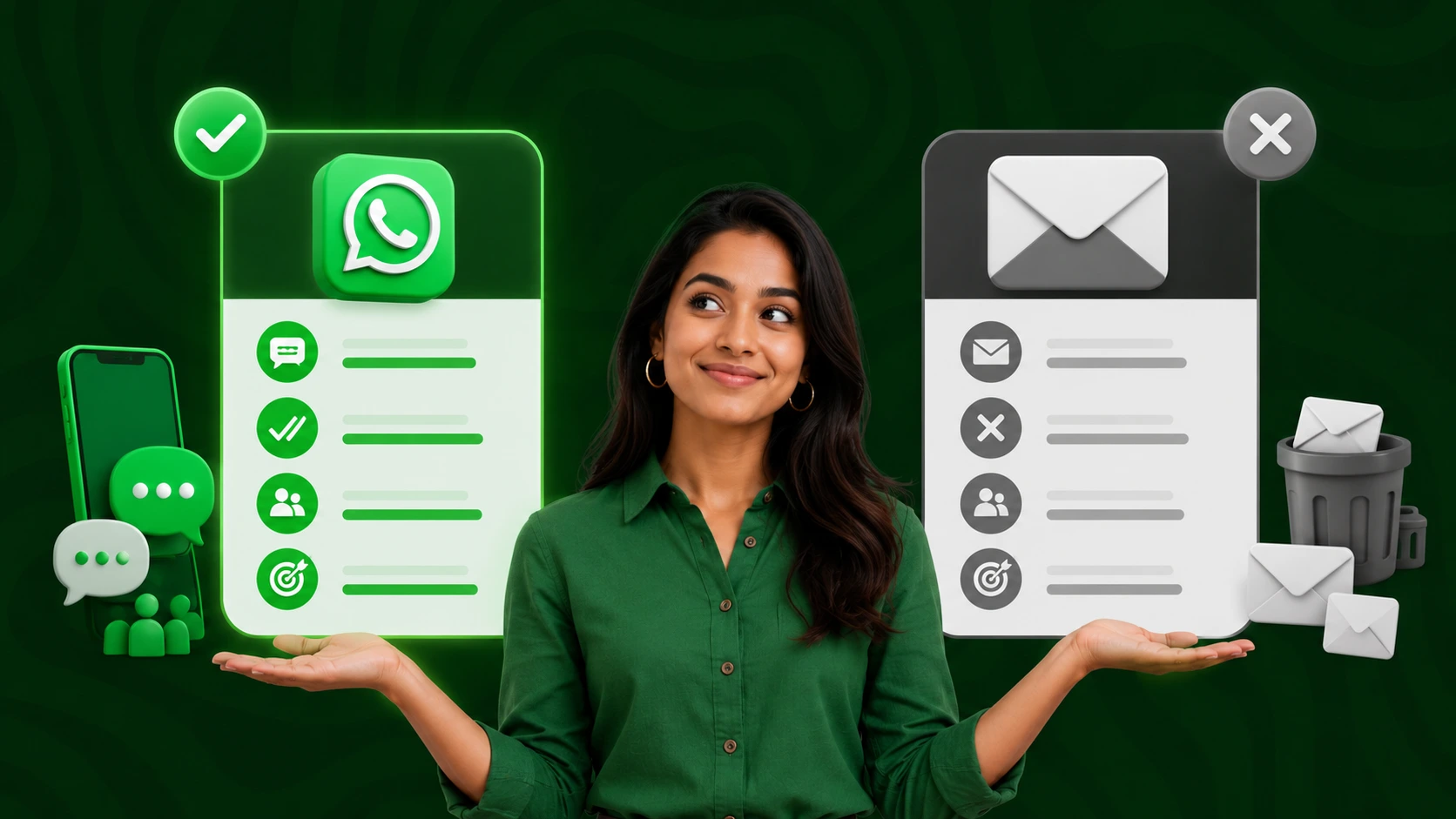
The numbers are not close. Email marketing averages a 20–21% open rate globally. SMS performs similarly and lacks rich media support. WhatsApp messages achieve an average open rate of 98%, with 88% of those messages read within five minutes of delivery.
Click-through rates on WhatsApp campaigns reach 45–60% on optimized sends, compared to 2–5% for email. For every 100 messages you send on WhatsApp, up to 60 may result in a direct engagement or conversion.
That performance gap is why businesses that shift budget toward WhatsApp consistently report lower cost per lead and higher return on communication spend.
For Tanzanian businesses operating on lean budgets where every marketing shilling must count, that difference in performance has a direct impact on the bottom line.
How Tanzania's Mobile Landscape Makes WhatsApp the Dominant Channel
Tanzania's mobile market provides the infrastructure that makes WhatsApp marketing unusually effective. The TCRA's September 2025 communications statistics confirm 56.3 million internet subscriptions, with 4G coverage now extending to over 94% of the population. As of 2024, approximately 81% of mobile connections were 3G or higher.
This means the majority of your customers have the connectivity to receive WhatsApp messages, view images and videos, click buttons, and reply, regardless of whether they are in Dar es Salaam or a smaller urban centre like Morogoro or Arusha.
Add to this the fact that mobile money services such as M-Pesa, Airtel Money, and Mixx by Yas are now embedded in everyday commerce, and you have a population that is not just connected but actively comfortable transacting and communicating through their phones.
WhatsApp sits at the centre of this mobile-first economy. It is where your customers discuss purchases, ask questions, and expect instant answers from businesses they trust.
A WhatsApp marketing strategy is not simply a matter of sending bulk messages to a saved phone list. Done incorrectly, it damages your sender reputation, gets your number flagged for spam, and burns customer trust. Done correctly, it becomes the most productive customer engagement channel your business operates. Here is how to build a solid foundation.
Every WhatsApp campaign should begin with a specific, measurable objective. Are you trying to generate new leads? Recover abandoned sales? Retain existing customers with loyalty offers? Reduce no-shows at appointments? Reduce inbound support calls by deflecting them to a chatbot? Each goal requires a different message type, a different audience segment, and a different automation flow. Businesses that treat WhatsApp as a broadcast-everything channel quickly hit quality rating issues. Businesses that align their campaigns to clear goals see the conversion numbers that justify scaling up.
WhatsApp only allows you to send messages to contacts who have opted in. This is not just a technical constraint. It is a regulatory requirement and a commercial necessity. Contacts who have actively opted in are more likely to engage, less likely to block your number, and more likely to convert. In Tanzania, opt-in collection is best done through in-store sign-up sheets, website contact forms, SMS opt-in flows, and during onboarding for new customers.
Once your list is built, segmentation is what turns a generic broadcast into a high-converting campaign. You can segment by location (Dar es Salaam vs upcountry), by purchase history (first-time buyers vs repeat customers), by industry (retail, agriculture, financial services), or by engagement status (active vs lapsed).
Platforms like Notify Africa's WhatsApp marketing platform include built-in contact segmentation tools that let you define these audiences and target them with messages tailored to exactly where they are in the customer journey.
The free WhatsApp Business app is designed for micro-businesses handling low message volumes manually. For any business that needs to send more than a few hundred messages, automate responses, run broadcast campaigns, deploy a chatbot, or manage conversations across a team, the WhatsApp Business API is the only viable option.
The API is not available directly to businesses. It requires connection through a Meta-approved WhatsApp Business Solution Provider (BSP). Notify Africa operates as an official BSP, handling the Meta verification process, number registration, and API setup for Tanzanian businesses.
This gives your business a verified WhatsApp presence with the ability to send bulk campaigns, configure automated flows, and manage all customer conversations from a shared team inbox, without the manual limitations of the standard app.
Ready to access the WhatsApp Business API for your Tanzanian business? Notify Africa handles the full setup, Meta verification, and onboarding. Start for free at account.notify.africa/auth/register or talk to our team to get started today.
With the foundation in place, the following strategies are the highest-impact approaches for Tanzanian businesses at every stage of the customer journey.
A broadcast campaign sends a single message to a large list of opted-in contacts simultaneously. On WhatsApp, unlike SMS, you are not limited to plain text. You can include images of products, promotional videos, PDFs of catalogues, location pins, and interactive buttons that take the customer directly to a specific action.
A clothing retailer in Dar es Salaam can send a new collection launch with an image, a product description, a price, and a one-tap button to place an order, all in a single message. A finance company can send a loan offer with a button to apply. A supermarket can send a flash sale with an image of the discounted products and a button to visit the store. For more ideas like these, see our WhatsApp campaign examples that increase sales, from flash sales to cart recovery.
The key to effective broadcast campaigns is relevance. Segment your audience before sending. A message about agricultural input delivery pricing sent to a list of Arusha-area farming cooperative contacts will outperform the same message sent to a general city contact list. Notify Africa's platform allows you to design rich media campaigns and target them to specific contact segments, so every broadcast feels less like a mass message and more like a relevant offer.
A drip sequence is a pre-built series of WhatsApp messages triggered by a specific customer action and delivered automatically over time. A new subscriber might receive a welcome message immediately, a product introduction the next day, a discount offer on day three, and a reminder on day five. A customer who requested a quote might receive a follow-up 24 hours later, then a case study on day two, then a final offer on day four.
Drip sequences work because they maintain consistent contact with prospects at exactly the moments they are most likely to convert, without requiring manual effort from your team. They are especially effective for businesses with longer sales cycles, such as insurance, real estate, education, and B2B services. Notify Africa's scheduling and automation tools let you build these sequences visually and deploy them to specific audience segments triggered by form submissions, purchases, or custom events.
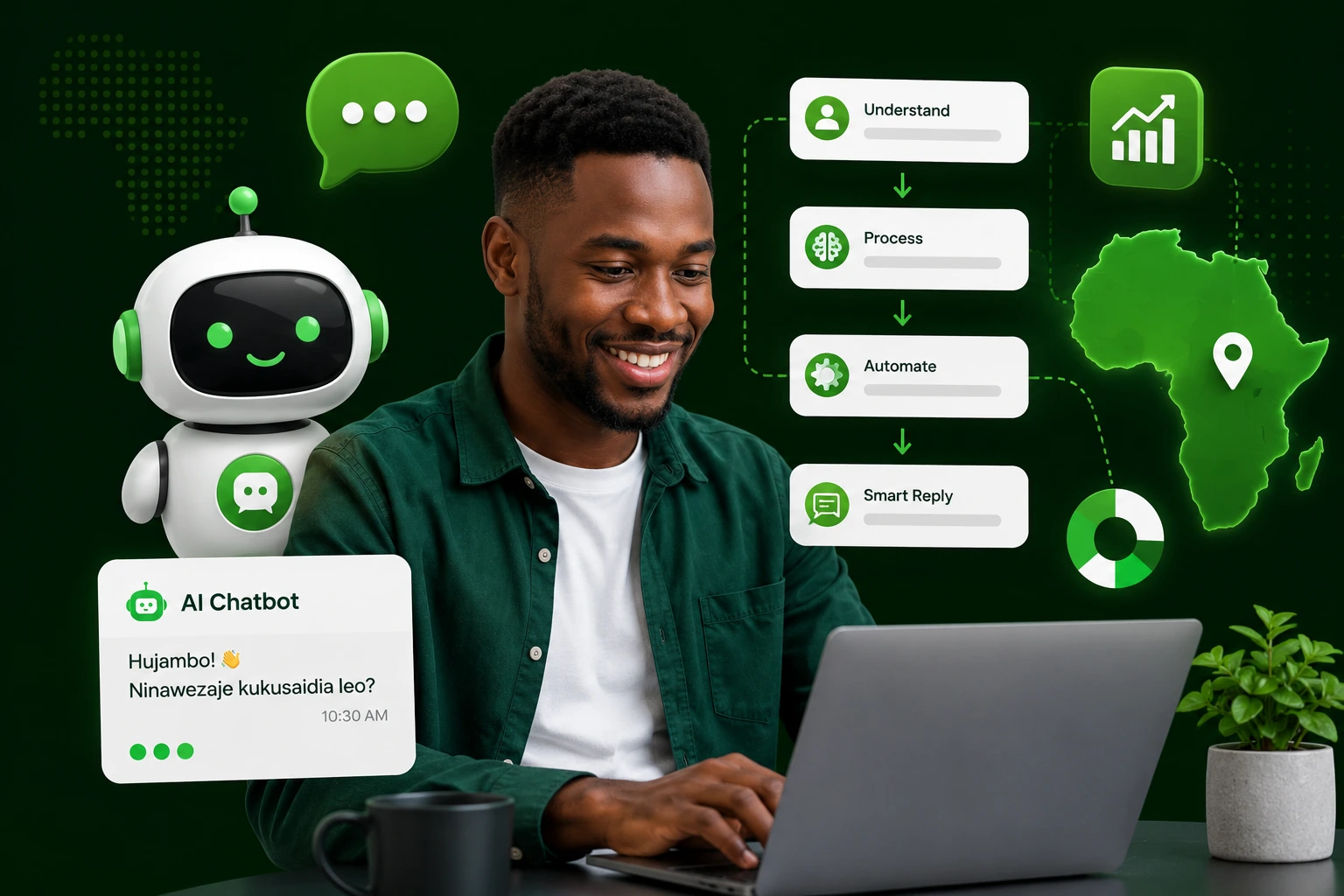
An AI-powered WhatsApp chatbot answers customer questions, collects lead information, qualifies prospects against defined criteria, routes hot leads to your sales team, and handles support requests, all automatically and at any hour of the day. For Tanzanian businesses whose customers are active in the evenings and on weekends when staff are off, the chatbot closes a significant gap in responsiveness that directly costs sales.
According to data from Infobip, 91% of all conversational AI interactions on their platform took place on WhatsApp in 2025. The chatbot is no longer a novelty. It is the expected first point of contact for a growing share of customers. Notify Africa's AI chatbot can be configured to operate in English, Swahili, or both, handle your business-specific FAQs, and hand off to a live agent when the conversation requires human judgement. This combination of automation and human escalation ensures no lead is ever dropped and no customer is ever left waiting.
Businesses that transact through WhatsApp or online channels face a consistent challenge: customers who express interest but do not complete a purchase. An automated WhatsApp follow-up changes this dramatically. Studies cited by Infobip indicate that companies using WhatsApp Business API have reported up to a 25% reduction in cart abandonment through timely follow-up messages. A message sent one hour after a customer viewed a product but did not buy, containing the product image and a one-tap purchase link, recovers a significant proportion of those lost sales.
This strategy applies to more than e-commerce. A travel agency whose customer requested a quote but went silent can use an automated follow-up to re-engage. A school that had a parent complete part of an enrolment form can send a reminder with the next steps. A clinic that had a patient book tentatively but not confirm can send an appointment confirmation request. In every case, the automation does the follow-up work without requiring a salesperson to manually chase each contact.
No-shows cost Tanzanian service businesses significant revenue every week. Clinics, salons, schools, logistics companies, and repair workshops all operate appointment-based or delivery-based models where a missed appointment or an unacknowledged delivery means wasted capacity. WhatsApp appointment reminders sent 24 hours and two hours before a scheduled appointment reduce no-show rates materially. The customer can confirm, reschedule, or cancel with a single reply, giving the business time to fill the slot.
Order and delivery updates serve a similar function for product-based businesses. Customers who receive real-time WhatsApp updates about their order status, dispatch confirmation, and expected delivery time require fewer inbound support calls, report higher satisfaction, and are more likely to become repeat buyers. These are not manual messages. They are automated notifications triggered by status changes in your order management system and delivered to the customer's WhatsApp the moment they are relevant.
Acquiring a new customer costs significantly more than retaining an existing one. WhatsApp is the most effective channel for loyalty communication because customers have already opted in, already trust your business, and are already in the habit of receiving messages from you.
A birthday discount sent via WhatsApp the morning of a customer's birthday, a VIP offer sent to your top ten percent of buyers, or a re-engagement message to customers who have not purchased in 60 days are all high-return uses of the channel.
Retail businesses, restaurants, salons, pharmacies, and financial services companies in Tanzania have all seen measurable retention improvements from consistent WhatsApp loyalty communication.
The bulk SMS campaigns that many Tanzanian businesses already run provide a useful parallel: the strategy is similar, but WhatsApp offers richer media, higher open rates, and two-way conversation that SMS cannot match.
This strategy is underused but genuinely valuable. Tanzanian businesses with distributed teams, field agents, delivery drivers, or branch locations across different cities can use a managed WhatsApp channel to send shift reminders, operational updates, internal announcements, and urgent alerts to all staff simultaneously.
Unlike general WhatsApp groups, a managed team communication channel through Notify Africa gives administrators control over who can broadcast, ensures messages are appropriately formatted, and maintains a record of internal communications.
Notify Africa's WhatsApp platform combines bulk campaigns, AI chatbots, automation, and a unified team inbox in a single dashboard built for Tanzania. See what is possible — book a free demo.
Personalization is the difference between a WhatsApp message that converts and one that gets ignored. Research shows that WhatsApp engagement increases for 72% of users when messages feel personalized, and 85% of consumers say they want timely, proactive communication from brands. Personalization on WhatsApp goes far beyond using a customer's first name.
Effective personalization in Tanzania means accounting for the real differences in your customer base. A customer in Arusha has different purchasing patterns, seasonal needs, and language preferences than one in Mbeya or Dar es Salaam.
A farming business customer needs information about input supply schedules and weather-sensitive pricing. A retail customer in an urban centre is more responsive to flash sale offers and loyalty rewards.
Building contact segments that reflect these real-world differences, and sending messages that speak directly to each segment's context, is what separates high-performing WhatsApp strategies from bulk blasts that land in the wrong inboxes.
Notify Africa's contact segmentation tools allow you to tag contacts by location, industry, purchase history, customer type, and engagement status.
Combined with personalization variables that insert names, account details, and specific offer terms automatically, every message your business sends can feel like a one-to-one communication even when you are reaching thousands of contacts.
The answer depends on your customer. Urban, educated, business-to-business audiences often prefer English for formal communications. Broader consumer audiences, particularly outside Dar es Salaam, respond better to Swahili.
Many Tanzanian businesses achieve better results by defaulting to Swahili for mass broadcasts and using English for professional or B2B communications.
Notify Africa's platform and AI chatbot support both languages, allowing you to configure language preferences at the contact segment level and serve every part of your audience in the language they are most comfortable with.
Understanding what not to do is as important as knowing the right strategies.
Messaging contacts without opt-in consent is the most serious error. It triggers spam reports, damages your quality rating, and can result in your WhatsApp Business account being restricted or banned. Collect opt-ins properly and keep records.
Sending too many messages too quickly, particularly to a new account, will cause Meta's system to flag your number and reduce your messaging limits. New accounts start with a cap of 250 messages per day. This increases as you demonstrate quality sending behaviour. Trying to shortcut this process damages your long-term throughput.
Using the standard WhatsApp Business app for bulk sending is a violation of WhatsApp's terms of service and leads to account bans. Businesses that need to scale beyond a handful of daily conversations must use the official API through an approved provider.
Sending generic, unrelated broadcasts to large unsegmented lists produces low engagement and high block rates. Both hurt your quality rating and reduce your deliverability over time.
Ignoring replies is a mistake that costs sales and trust. If a customer replies to your campaign and receives no response, the trust built by the campaign is immediately undermined. This is where a unified team inbox and an AI chatbot working together ensure every reply receives a timely, appropriate response.
The WhatsApp Business API is the enterprise version of WhatsApp that allows businesses to send bulk messages, automate responses, deploy chatbots, and manage conversations at scale through a verified business account. Unlike the free WhatsApp Business app, which is designed for small-volume manual use, the API has no daily message caps once your account is properly warmed up and your quality rating is maintained. Any Tanzanian business sending more than a few hundred messages per week, or needing automation and a team inbox, needs the API.
Yes. Tanzania's 4G network now covers over 94% of the population, meaning customers in secondary and tertiary cities such as Mwanza, Arusha, Dodoma, Mbeya, and Tanga are fully reachable on WhatsApp. For businesses with customers in rural and peri-urban areas, WhatsApp's low data consumption relative to other apps makes it accessible even on slower connections.
Yes. Notify Africa's platform and AI chatbot support both English and Swahili. Message templates can be created in either language, and your chatbot can be configured to detect and respond in the customer's preferred language automatically.
A WhatsApp AI chatbot is an automated conversational agent configured with your business's FAQs, product information, and service workflows. It responds to customer messages instantly, 24 hours a day, qualifies leads by asking pre-set questions, books appointments, collects payment details, and escalates complex conversations to a human agent when needed. For Tanzanian businesses where staff availability is limited outside business hours, a chatbot ensures no customer inquiry goes unanswered. Notify Africa's AI chatbot solution is purpose-built for this use case.
The strategy framework in this guide gives your business everything it needs to turn WhatsApp from a casual messaging app into a structured, automated, revenue-generating communication system. The key takeaways are clear. Tanzania's mobile infrastructure and WhatsApp's 98% open rates create a uniquely powerful environment for direct customer communication.
The WhatsApp Business API, accessed through an official provider like Notify Africa, is the only compliant, scalable route to bulk campaigns, automation, and chatbot deployment. Segmentation, personalization, and language-appropriate messaging are what separate high-converting campaigns from spammy broadcasts that damage your reputation. And automation — drip sequences, chatbots, appointment reminders, and follow-up flows — is what allows small and mid-size Tanzanian businesses to operate at a standard of customer communication that was previously only possible for large enterprises.
Notify Africa has built Tanzania's leading WhatsApp marketing platform specifically for businesses operating in this market. With local support, ISO-certified infrastructure, and deep integrations across Tanzanian mobile networks and payment systems, Notify Africa gives your business the tools to execute every strategy in this guide from a single dashboard.
Tanzania's most effective businesses are already running their customer communication on WhatsApp through Notify Africa. Join them. Start your free trial at account.notify.africa/auth/register or contact our team at +255 759 818 157 to book a demo today.

A solution by iPF Softwares, an ISO 27001:2022 certified software development company.