
 Call Center
Cloud PBX Explained: How to Run Business Calls Without Hardware
Beatha Beichumila
Last Updated :
25th November 2026
By Beatha Beichumila
Product Specialist
Share this article with your friends
Quick Answer: To follow up a customer call, send a short message soon after the call ends that confirms what was agreed and gives the next step. Use SMS for missed calls, short confirmations and customers on basic phones, because it reaches every handset. Use WhatsApp for details, documents, locations and ongoing conversations with customers who have agreed to receive messages there.
Most customer calls end with a promise. "I'll send you the price." "We'll call you back this afternoon." "Your appointment is on Thursday." Then the phone rings again, the next customer needs attention, and the promise slips. The caller waits, hears nothing, and buys from someone else.
A good call follow-up with SMS and WhatsApp fixes this. A short text after a missed call tells the caller you saw them and will call back. A WhatsApp message after an answered call puts the price, the location pin or the booking details in writing, where the customer can find them later. Each message takes seconds to send, and it often decides whether the call becomes a sale.
This guide shows you how to do it properly. You will learn which follow-ups every business needs, when SMS beats WhatsApp and when it is the other way round, the WhatsApp rules that catch many businesses out, and how quickly to follow up. You will also get ready messages in Swahili and English, sector examples, mistakes to avoid, and a simple way to measure whether your follow-up is working.
Call follow-up is any message or call back that you send after a customer contacts you by phone. Its job is to close the loop: confirm what was agreed, deliver what was promised, or reach a caller you could not answer. Without it, a phone call leaves no written record for the customer and no clear next step.
The Three Moments That Need a Follow-Up
Almost every follow-up falls into one of three moments.
After a missed call. The caller tried and failed to reach you. They need to know you noticed and when you will get back to them.
After an answered call with a promise. You said you would send a price, a document, directions or an answer. The follow-up delivers it.
After a completed call with a next step. A booking, an order, a payment or a complaint was agreed. The follow-up confirms the details and what happens next.
The missed call is the most urgent, because the customer is still deciding where to buy. The other two protect a sale you have already started.
Spoken details are easy to forget. A caller who heard your price, your M-Pesa number and your opening hours in one conversation will remember maybe one of them by evening. Numbers, directions, reference codes and dates belong in writing.
A written follow-up also builds trust. It shows the caller that your business is organised, and it gives them something to forward to the spouse, manager or school bursar who makes the final decision. In many Tanzanian households and offices, the person who calls is not the person who pays, so a forwardable message often reaches the real buyer.
Use SMS when the message must reach everyone, fast and short. Use WhatsApp when the message needs detail, media or a two-way chat, and the customer has agreed to hear from you there. Most businesses get the best results by using both, each for the job it does best.
Factor | SMS | |
|---|---|---|
Reach | Every mobile phone, including basic kitochi phones | Smartphones with WhatsApp and data |
Needs internet | No | Yes |
Length | Short, about 160 characters per message part | Long messages are fine |
Media and documents | Text only | Photos, PDFs, location pins, buttons |
Customer replies | Usually by calling back | Easy two-way chat |
Permission needed | Consent rules apply to marketing | Customer must opt in; strict rules after a phone call |
Best for | Missed-call alerts, confirmations, reminders | Quotes, documents, directions, ongoing support |
SMS is the safest default for missed calls. You often do not know whether the caller has a smartphone, data bundles or WhatsApp on that number. An SMS arrives on every handset on Vodacom, Airtel, Mixx by Yas and Halotel, and it arrives within seconds.
SMS also suits short confirmations and reminders: "Your appointment is tomorrow at 10 am" needs no photo or button. Keep each message short. A standard SMS holds about 160 characters of plain letters. Emojis and some special characters switch the message to a different format that holds only about 70 characters, so one smiley can double what you pay for that message.
WhatsApp is better when the follow-up carries detail. A hotel can send the room photos and the booking summary. A clinic can share a location pin so the patient finds the right building. A supplier can send a PDF quote that the customer forwards to their accountant.
WhatsApp also turns a single message into a conversation. If the customer has a question about the quote, they reply on the spot instead of calling again. That is why WhatsApp works well for follow-ups that are likely to lead to more discussion, such as sales enquiries and complaints.
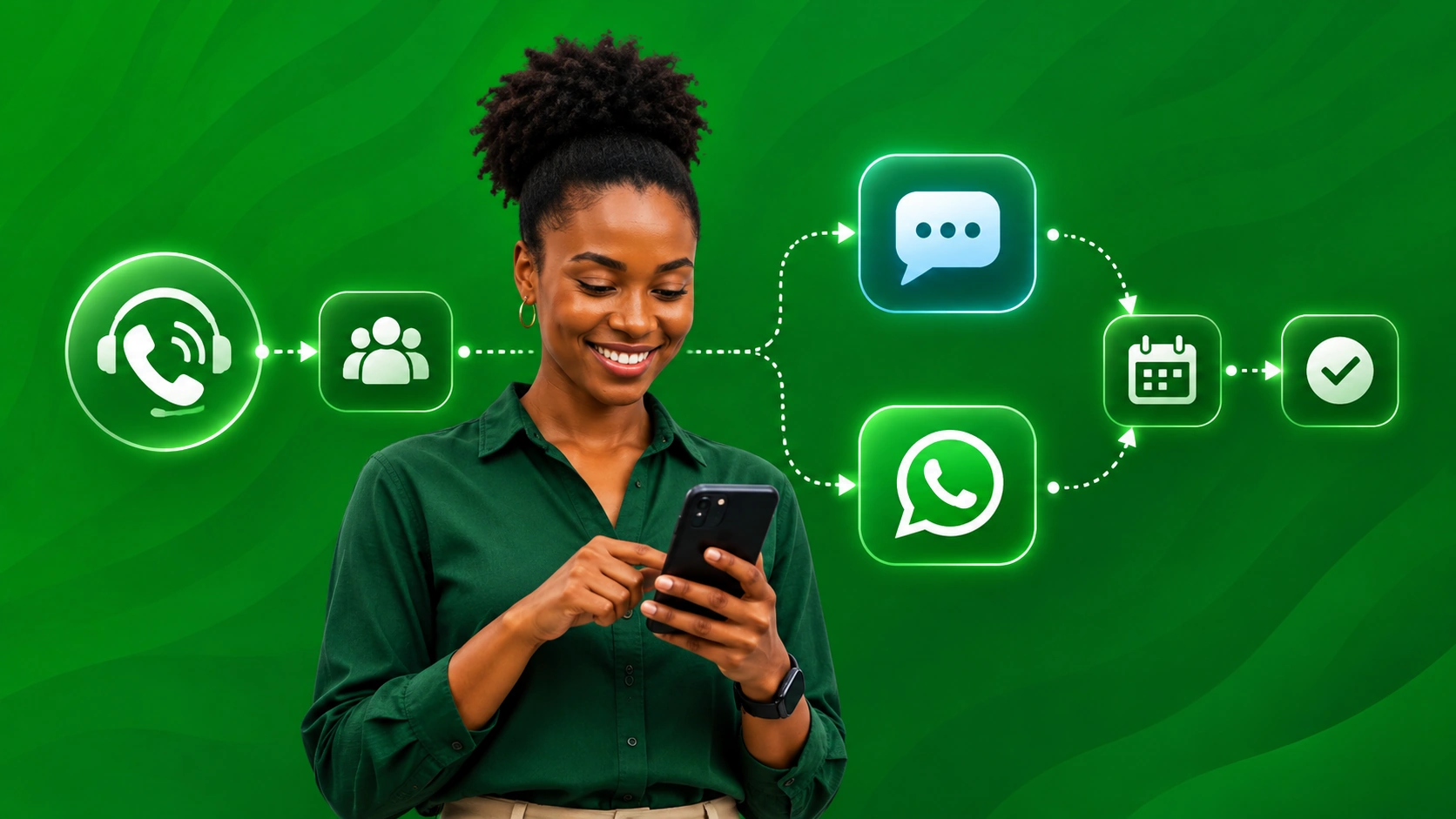
The two channels cover each other's gaps. A common pattern is SMS for every missed call, because it reaches everyone, and WhatsApp for answered calls where the customer wants details and has said yes to WhatsApp. If a WhatsApp message fails because the number is not on WhatsApp, an SMS still gets the message through.
Running both from separate tools creates its own problems: two inboxes, two contact lists and no link to the original call. A bulk SMS platform and WhatsApp Business messaging that sit with your phone line keep every call and message about one customer in one place.
Turn Every Missed Call Into a Text Back
Get a business number with missed-call text back, a call-back list and SMS follow-up included on every plan.
Get Your Business NumberWhatsApp follow-up has rules that SMS does not. The key one is that a normal phone call to your business number does not open a free-form WhatsApp conversation. To message a caller on WhatsApp after a regular call, you need their permission and a pre-approved message template.
Meta, which runs WhatsApp, uses a 24-hour customer service window. Meta's documentation on service messages explains that the window starts when a WhatsApp user messages or calls you on WhatsApp, and resets each time they do so again. While it is open, you can send any message you like. When it closes, you can only send pre-approved templates.
The important detail for call follow-up: the window opens when the customer contacts you on WhatsApp itself. A call to your ordinary business line is a phone call, not a WhatsApp call, so it does not open the window. Your first WhatsApp message after a regular phone call therefore has to be a template.
A template is a message you write in advance and submit for approval before use. It can include blanks, called variables, that you fill in for each customer, such as their name, a date or a price. Once approved, you can send it at any time.
Templates are grouped by purpose. Follow-ups that confirm a booking, deliver information the customer asked for or update an order are usually treated as utility messages. Messages that promote offers are treated as marketing. Write follow-up templates that clearly relate to the customer's call, and keep promotions out of them. When the customer replies, the window opens and your staff can chat freely for the next 24 hours.
You may only message people on WhatsApp who have agreed to hear from you there. Meta's opt-in guidance requires businesses to collect this permission before sending messages, and the WhatsApp Business Messaging Policy sets out what businesses may and may not send.
On a phone call, opt-in is simple. Ask: "Shall I send the details to you on WhatsApp, on this same number?" If the caller says yes, record it against their contact. That one sentence protects your WhatsApp account and makes the customer expect your message, so they open it.
Setting up follow-up takes a day or two of planning. Most of the work is deciding what each type of call needs, then writing the messages once so staff never type them from scratch.
Write down how your calls usually end. A typical list: missed during working hours, missed after hours, answered and needs a price, answered and booked, answered with a complaint, answered and needs payment details. Most businesses find six to eight outcomes cover nearly every call.
Match each outcome to SMS, WhatsApp or both. Missed calls go to SMS by default. Price requests, documents and directions go to WhatsApp where the caller agreed, with an SMS backup. Bookings and reminders work well on either.
Write each message in Swahili and English, and let staff pick the language the caller used. Keep SMS under 160 characters and avoid emojis. For WhatsApp, write each message as a template with variables, so it can be approved once and reused.
Set your phone system to send an SMS automatically when a call is not answered. The text should apologise, promise a call back within a stated time and give the caller another way to reach you. Our coming guide to setting up missed-call text back covers this step in detail.
Submit your WhatsApp follow-up templates for approval before you need them. Approval is usually quick, but rejected templates need rewriting, so do this before launch, not on a busy Monday. Development teams that want to connect follow-up to their own systems can use the WhatsApp API for developers or the SMS API.
A text back is a promise, so someone must keep it. Choose one person per shift to work through the missed-call list and call every customer back within the time your message promised. If the list has no owner, it fills up and the text back becomes a broken promise.
Once a week, check how many missed calls were called back, how fast, and how many follow-ups led to a sale or booking. Rewrite any message that gets few replies. The measures to track are covered later in this guide.
See Call Follow-Up Working for Your Business
Book a short demo and we will map your call outcomes to the right SMS and WhatsApp messages.
Book a DemoCopy these messages and change the parts in square brackets or curly brackets. Square brackets are details you fill in once. Curly brackets with numbers are WhatsApp template variables that change for each customer.
Missed Call During Working Hours (SMS)
Swahili: Habari, samahani tumekosa simu yako. Tutakupigia ndani ya dakika 30. Au tuandikie WhatsApp [namba]. - [Jina la Biashara]
English: Hi, sorry we missed your call. We will call you back within 30 minutes, or WhatsApp us on [number]. - [Business Name]
Missed Call After Hours (SMS)
Swahili: Asante kwa kutupigia. Tumefunga kwa sasa. Tutakupigia kesho kuanzia saa mbili asubuhi. - [Jina la Biashara]
English: Thanks for calling. We are closed right now and will call you back tomorrow from 8 am. - [Business Name]
For a deeper look at the hours when nobody is at the desk, see our guide to handling customer calls outside business hours.
Information Promised on the Call (WhatsApp Template)
Swahili: Habari {{1}}, asante kwa kuzungumza nasi leo. Kama ulivyoomba, haya ndiyo maelezo ya {{2}}: {{3}}. Ukiwa na swali, jibu ujumbe huu. - {{4}}
English: Hi {{1}}, thank you for speaking with us today. As requested, here are the details for {{2}}: {{3}}. Reply to this message with any questions. - {{4}}
Price Quote (WhatsApp Template)
Swahili: Habari {{1}}, kama tulivyozungumza, bei ya {{2}} ni TZS {{3}}. Bei hii ni halali hadi {{4}}. Jibu NDIYO kuthibitisha oda yako.
English: Hi {{1}}, as discussed, the price for {{2}} is TZS {{3}}, valid until {{4}}. Reply YES to confirm your order.
Appointment or Booking Confirmation (SMS or WhatsApp)
Swahili: Habari {{1}}, miadi yako na {{2}} imethibitishwa tarehe {{3}} saa {{4}}. Kubadilisha, piga {{5}}.
English: Hi {{1}}, your appointment with {{2}} is confirmed for {{3}} at {{4}}. To change it, call {{5}}.
Complaint Follow-Up (WhatsApp Template)
Swahili: Habari {{1}}, asante kwa kutueleza tatizo lako leo. Namba ya kumbukumbu ni {{2}}. {{3}} atakupigia kabla ya {{4}}.
English: Hi {{1}}, thank you for telling us about the problem today. Your reference number is {{2}}. {{3}} will call you before {{4}}.
Payment Details (SMS)
Swahili: Malipo kwa [Jina la Biashara]: Lipa Namba [namba], jina [jina rasmi]. Kumbukumbu: {{1}}. Hatutawahi kukuomba PIN yako.
English: Payment to [Business Name]: Till number [number], name [official name]. Reference: {{1}}. We will never ask for your PIN.
The last line of the payment message matters. Fraudsters copy business names and send fake payment numbers. A follow-up that always comes from the same official number, and always warns that you will never ask for a PIN, teaches customers to spot a fake.
Follow up a missed call within minutes and a promise within the hour. The longer a caller waits, the more likely they are to call a competitor or forget why they called. Speed matters most for new customers who have not bought from you before.
Situation | Message | Call back or next action |
|---|---|---|
Missed call, working hours | SMS within seconds, sent automatically | Call back within 30 minutes |
Missed call, after hours | SMS within seconds, sent automatically | Call back first thing next working morning |
Price or information promised | WhatsApp or SMS within 1 hour | Check for a reply the same day |
Booking or order agreed | Confirmation within minutes | Reminder the day before |
Complaint received | Reference number within 1 hour | Call back by the time promised |
These are practical targets, not legal limits. Pick timings your team can keep every day, then write them into the messages. A realistic promise you keep builds more trust than a fast one you break.
If your team cannot keep up with call volume in busy hours, an AI receptionist can answer the overflow and hand you a list of who called and why. Our comparison of AI receptionists and human receptionists explains how businesses split the work between the two.
Never Lose a Caller to Slow Follow-Up
Start with a business number, a call-back list and automatic text back, ready in 1 to 2 working days.
Start Your Free SetupThe pattern is the same everywhere, but each sector has its own key moment. The examples below are illustrative.
A patient calls to book and nobody answers. An SMS says the clinic will call back within 30 minutes, and the receptionist books the slot from the call-back list. After booking, a WhatsApp message sends the date, time and a location pin, and an SMS reminder goes out the day before. Fewer patients miss appointments, and the clinic fills its schedule.
A parent asks about fees and admission. The admissions officer sends the fee structure as a PDF on WhatsApp, with the official payment details and a clear warning against paying anyone else. During admission season, missed-call SMS stops parents from calling ten times and filling the line.
A guest calls to ask about rooms or a safari. The follow-up on WhatsApp carries photos, the price and what is included, with a reply option to confirm. International guests often prefer WhatsApp to SMS, while local guests may want both.
A member calls about a loan balance. Sensitive figures should never go to a number that has not been verified as the member's own. The safer follow-up is an SMS with a reference number and the branch's official contact, then a call back to the registered number.
A customer calls to order stock. A WhatsApp quote with the item list and prices goes out within the hour, followed by payment details by SMS and a delivery update when the goods leave. Each step cuts down the "has my order left?" calls that block the line.
The biggest mistake is promising a call back and not making it. A text back with no call back is worse than silence, because it raises the customer's hopes and then disappoints them. Other common mistakes are easy to fix.
Sending marketing inside a follow-up. A message about the customer's call is welcome; an unrelated promotion in the same message feels like spam and can get WhatsApp templates rejected.
Sending WhatsApp messages without permission. It breaks WhatsApp's rules and can get your number restricted.
Writing long SMS messages. Each extra part costs more, and customers stop reading after a line or two.
Using personal phones and personal WhatsApp. The conversation leaves with the employee, and the business has no record.
Sending sensitive details to an unverified number. Balances, results and medical details need extra care.
Using a different sender for every message. Customers trust a business that always messages from the same name or number.
Notify Africa Call Center connects your business phone number with SMS and WhatsApp, so follow-up is part of the call system rather than a separate job. Here is what each plan includes for follow-up, based on the current product page.
Missed-call text back by SMS is included on every plan.
Every missed call goes onto a call-back list, grouped by caller, with one-click call back.
If nobody answers within 20 seconds, the call can forward to a mobile phone, or the caller gets a text back.
SMS follow-up uses the bulk SMS allowance on each plan: 300 messages on Starter, 1,500 on Business and 4,000 on Growth.
WhatsApp follow-up after calls is included on the Business and Growth plans, not on Starter.
Every call is transcribed, and transcripts are sent to your email, so you can check what was promised before following up.
Plans start at TZS 99,900 a month on Starter, with Business at TZS 279,900 and Growth at TZS 649,900. Prices include 18 per cent VAT, and a one-time setup fee is paid with the first month. You can compare everything on the pricing page. The call menu, greetings and optional AI receptionist work in Swahili and English, and a new business number is usually ready in 1 to 2 working days.
If your business relies on WhatsApp follow-up for quotes and documents, the Business plan is the usual starting point. If SMS text back and call-backs cover your needs, Starter is enough to begin.
Follow-up uses customers' phone numbers, which are personal data. Treat them with care, use them for the purpose the customer expects, and get clear consent before sending marketing. This section is general information, not legal advice.
The Personal Data Protection Act sets the principles for collecting and using personal data in Tanzania, and the Personal Data Protection Commission oversees it. In practice, a follow-up about a customer's own call fits what they expect when they phone you. Using the same number for unrelated promotions is a different purpose and needs consent.
Marketing by SMS also falls under the consumer protection rules of the Tanzania Communications Regulatory Authority. Their direction is consistent: send marketing messages only to people who agreed, say clearly who the message is from, and make it easy to stop receiving them. A good habit is to add "Tuma STOP kujiondoa" or "Reply STOP to opt out" to any promotional SMS, and honour it.
Keep a simple record of consent: the date, the channel and what the customer agreed to. If a customer asks you to stop, stop on every channel, not just the one they complained about.
Track four numbers each week. Together they tell you whether follow-up is turning calls into business or just creating more messages.
Call-back rate: the share of missed calls you called back. Aim for every single one.
Time to call back: the average gap between a missed call and your call back. It should match what your text back promised.
Reply rate: the share of WhatsApp follow-ups that get a reply. A low rate usually means the message is too long, too vague or sent too late.
Conversion: the share of followed-up calls that became a sale, booking or payment. This is the number that justifies the effort.
Compare the numbers by staff member and by time of day. If one shift misses its call-backs, or one message gets few replies, you know exactly what to fix.
Talk to Our Team About Your Call Follow-Up
Our Dar es Salaam team will help you choose the right plan and set up SMS and WhatsApp follow-up in Swahili and English.
Contact SalesA good follow-up message says who it is from, confirms what was discussed and gives one clear next step. For example: "Hi Asha, as discussed, the price for 20 bags of cement is TZS 380,000, valid until Friday. Reply YES to confirm." Keep it short, use the customer's name and the language they spoke on the call, and include any number, date or reference they need. Avoid adding unrelated offers. The message should feel like the natural end of the conversation, not the start of a sales campaign.
SMS is usually better for missed calls. You often do not know whether the caller uses WhatsApp on that number, and SMS reaches every phone, including basic phones without internet. A missed-call SMS also needs no prior permission in the way a WhatsApp message does, as long as it only deals with the call. Once you call the customer back, you can ask whether they would like details on WhatsApp and switch channels from there.
Yes, but only with their permission and, in most cases, only using an approved template. A normal phone call does not open WhatsApp's 24-hour customer service window, so free-form messages are not allowed until the customer messages you on WhatsApp. Ask on the call whether you may send details on WhatsApp, record their yes, and send a template. When the customer replies, you can chat freely for 24 hours from their last message.
Send the text back within seconds, automatically, and call back within 30 minutes during working hours. After hours, call back first thing the next working morning. The exact time matters less than keeping the promise in your message. If your text says 30 minutes, the call back must happen within 30 minutes. Callers who are still choosing a supplier often decide within the hour, so speed has a direct effect on sales.
A follow-up about the customer's own call is generally something they expect, because it relates to the contact they started. Promotional messages are different. Tanzania's data protection law and TCRA's consumer protection rules expect businesses to get consent for marketing, identify themselves and let people opt out. Keep follow-up messages about the call itself, record consent for anything promotional, and seek legal advice for your specific situation. This answer is general information, not legal advice.
A single standard SMS holds about 160 characters of plain text. Longer messages are split into parts and charged per part, though they arrive joined together on most phones. Emojis and some special characters switch the message to a format that holds about 70 characters per part, which can double the cost. For follow-up, one part is usually enough: who you are, what you will do next and how to reach you.
Use the language the customer used on the call. Most Tanzanian callers speak Swahili, and a follow-up in Swahili feels personal and easy to read. Business customers, tourists and some urban callers prefer English. The simplest approach is to write every message in both languages, then let staff choose. Have a native speaker check your Swahili wording, because a stiff or overly formal message can sound like an automated alert rather than a business that cares.
A WhatsApp message template is a pre-written message that a business submits for approval before using it. It can include blanks for details that change, such as the customer's name, a price or a date. Templates are the only messages a business may send on WhatsApp outside the 24-hour customer service window, which is why they matter for following up phone calls. Write separate templates for each call outcome, such as quotes, bookings and complaints.
Some follow-up can and should be automatic, especially the missed-call text back, which must arrive within seconds to be useful. Booking confirmations and reminders can also be automated once the booking is entered. Follow-ups that depend on the conversation, such as a quote or a complaint update, usually need a person to fill in the details. The best setup automates the alert and leaves the judgment to your staff.
Keep calls and follow-up messages in the same system as your business number, not on personal phones. That way every missed call lands on a shared call-back list, every message is linked to the caller, and managers can see who was followed up and when. Track your call-back rate, time to call back, reply rate and conversions each week. Call transcripts also help staff check what was promised before they send the follow-up.
A phone call is the start of a sale, not the end of one. Call follow-up with SMS and WhatsApp makes sure what was said on the phone turns into a booking, an order or a satisfied customer.
Use SMS for every missed call, because it reaches every phone within seconds.
Use WhatsApp for detail and documents, with the customer's permission and approved templates.
Write one message per call outcome, in Swahili and English, and keep every promise it makes.
Track call-backs, speed, replies and conversions every week.
You now have the rules, the timings and ready messages to start this week. If you want your phone line, SMS and WhatsApp working together from one place, Notify Africa's team in Dar es Salaam can set you up in a day or two and help you choose the plan that fits how your customers call.

A solution by iPF Softwares, an ISO 27001:2022 certified software development company.