 Call Center
How Much Does a Call Center Cost in Tanzania?
Beatha Beichumila
Last Updated :
22nd November 2026
By Beatha Beichumila
Product Specialist
Share this article with your friends
Quick Answer: An AI receptionist answers every call instantly, 24 hours a day, in more than one language, and costs far less than a salaried employee. A human receptionist handles complaints, sensitive calls, complex sales and walk-in visitors with judgment and warmth that AI cannot match. For most businesses, the best choice is both: people answer during working hours and the AI covers nights, weekends and busy moments.
Your receptionist is excellent. She knows the regular customers by name, calms angry callers and remembers who wanted a call back. But she works about nine hours a day. She takes lunch, annual leave and the occasional sick day, and she can only talk to one caller at a time. Every call that comes in outside those limits rings out, and in Tanzania an unanswered caller usually just dials the next business.
That is why so many owners are now asking about AI receptionist vs human receptionist. Is an AI voice agent good enough to trust with your customers? Is it cheaper? Will callers hang up when they hear a machine? And would replacing a person do more harm than good?
This guide gives you a straight answer. It compares the two options on what matters: hours covered, true cost, languages, caller experience, risk and legal duties under Tanzanian law. It shows where each one clearly wins, explains the hybrid setups most growing businesses use, and ends with a simple framework for choosing the right mix for a clinic, school, shop, hotel or SACCO.
A human receptionist is an employee who answers your calls, greets visitors and passes messages to the right person. An AI receptionist is software that answers phone calls with a natural voice, understands what the caller says, replies from your business information and hands the call to a person when needed. The human brings judgment and relationships. The AI brings constant availability and scale.
A good receptionist does far more than pick up the phone. They read a caller's mood, notice when a routine question hides a bigger problem, and know when to bend a rule for a loyal customer. They greet people who walk through the door, sign for deliveries, manage the visitors' book and often handle bookings, petty cash or filing in between calls.
Their limits come from being one person. They can hold only one conversation at a time. They work set hours, usually during the day. And their quality varies with workload, mood and experience, especially when they are new.
An AI receptionist, also called an AI voice agent, answers the call, listens to what the caller says in their own words, and replies out loud. It answers questions about opening hours, location, prices, services and how to pay, using the knowledge your business gives it. When the caller asks for a person, or when the question is beyond what it knows, it passes the call to a member of staff.
If you are new to the idea, our guide to what an AI receptionist is and how it answers calls 24/7 explains the technology in plain terms. In short, the AI never gets tired and never puts a caller on hold because the line is busy. But it only knows what you have taught it, and it has no real empathy, however polite it sounds.
The table below compares the two options on the factors owners ask about most. It compares typical capabilities, not any one product.
Factor | Human Receptionist | AI Receptionist |
|---|---|---|
Hours covered | Working hours, about 45 hours a week | 24 hours a day, 7 days a week |
Calls at the same time | One | Many at once |
Pick-up speed | Depends on workload | Instant |
Languages | Whatever the person speaks | Swahili and English, switching mid-call |
Empathy and judgment | Strong | Limited; polite but scripted to your knowledge |
Complaints and sensitive calls | Handles well | Should hand over to a person |
Walk-in visitors | Yes | No |
Consistency | Varies by day and person | Same answer every time |
Accuracy | Depends on memory and training | Depends on the knowledge you keep updated |
Sick days, leave, staff turnover | Yes | None |
Records of every call | Only if they write notes | Logged automatically |
Monthly cost | Salary plus employer costs | Fraction of a salary |
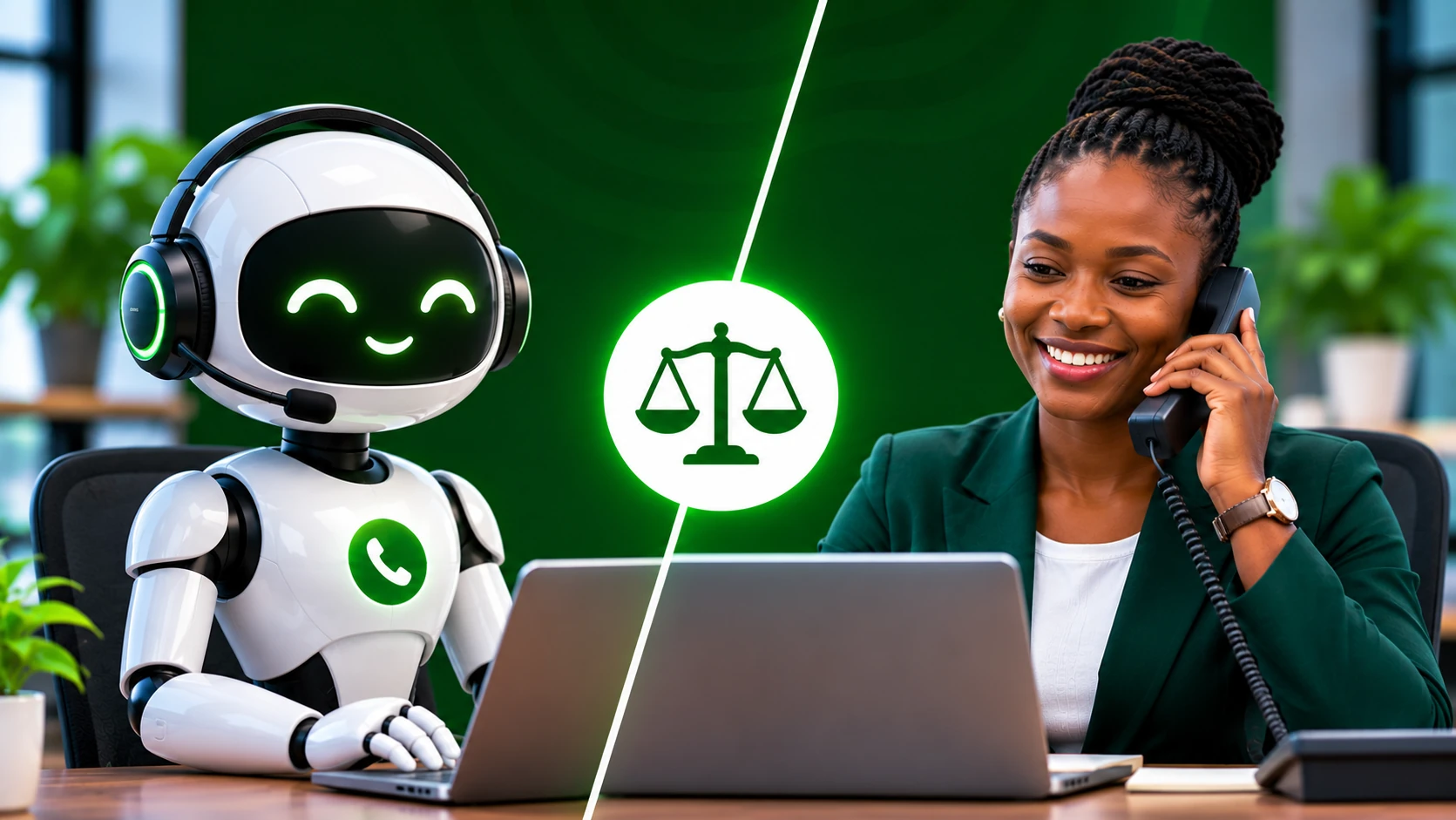
The pattern is clear. The human wins on judgment, warmth and anything physical. The AI wins on hours, volume, speed and consistency. Those strengths barely overlap, which is why the most useful question is not "which one?" but "which calls should each one take?"
A human receptionist costs much more than their salary. An AI receptionist adds a monthly fee to your phone system. For any business that needs calls answered outside office hours, the gap is large.
Start with the salary. Tanzania's private sector minimum wage order sets the lowest legal pay by sector, and employers may pay more, as the Clyde and Co summary of the latest wage order explains. A capable receptionist in Dar es Salaam, Arusha or Mwanza usually earns well above that minimum. Then add the costs that do not appear on the payslip:
Employer social security and workers' compensation contributions
Paid annual leave, plus the cost of covering the desk while they are away
Sick leave and the calls missed on those days
Recruitment and training, repeated each time someone leaves
Airtime, a handset or a desk phone, and their share of office space
The bigger issue is hours. Under the Employment and Labour Relations Act, ordinary hours are capped at nine a day and 45 a week, overtime is paid at one and a half times the normal rate, and night work between 8 pm and 6 am carries extra rules. A week has 168 hours, so one full-time receptionist covers only about a quarter of them. Covering every hour with people means about four full-time staff before leave, which very few small and medium businesses can justify.
An AI receptionist sits on top of a business phone system. With Notify Africa Call Center, plans start at TZS 99,900 a month including VAT, with call minutes and SMS included and a one-time setup fee. The AI receptionist is an optional extra on top, priced with the Notify sales team according to your call volume. You can compare plan limits on the Notify Africa pricing page.
There is no leave, no overtime, no night allowance and no recruitment. Costs rise with the number of calls, not the number of hours you want covered.
Imagine a private clinic that wants every call answered from 6 am to 10 pm, seven days a week. That is 112 hours a week. With people alone, it needs at least three receptionists working shifts, plus cover for leave, which adds up to several million shillings a year once employer costs are included.
With a hybrid setup, the clinic keeps one receptionist on the day shift for patients at the desk and for sensitive calls, and lets the AI receptionist answer early mornings, evenings, Sundays and any call that comes in while the receptionist is busy. The clinic covers more hours, misses fewer calls and spends far less. These figures are illustrative, so run the numbers with your own salaries and call volumes.
Answer Every Call Without Hiring a Night Shift
Get one business number, a Swahili and English call menu and a call-back list for every missed caller.
Get Your Business NumberA human receptionist wins whenever a call needs judgment, empathy or a relationship. These calls are fewer than routine enquiries, but they often matter most to your reputation and revenue.
Complaints and angry callers. A person can apologise sincerely, read the caller's tone and decide on the spot to offer a refund or a manager's call. An AI should hand these calls over quickly.
Sensitive conversations. Health worries, bereavement, school discipline, loan arrears and anything involving a child need a human voice.
Complex or high-value sales. A large order, a group booking or a corporate contract involves negotiation and trust that a person builds better.
Regular and VIP customers. A receptionist who says "Karibu tena, Mama Rehema" builds loyalty that software cannot fake.
Walk-in visitors. Someone has to greet patients, parents and guests at the door, sign for deliveries and keep the visitors' book.
Unusual situations. When something has never happened before, people improvise. An AI can only work from what it has been given.
If your business takes mostly these kinds of calls, a skilled receptionist is worth every shilling, and technology should support them rather than replace them.
An AI receptionist wins whenever the problem is availability, volume or repetition. It solves the calls people physically cannot reach.
After hours, weekends and public holidays. The AI answers at 9 pm on a Sunday as quickly as at 10 am on a Tuesday. Our guide to after hours call answering shows how much business arrives outside the working day.
Busy moments. When three customers call at once during the lunch rush, results season or a promotion, the AI picks up every line instead of leaving callers to ring out.
Repeated questions. "Mnafunguliwa saa ngapi?", "Mko wapi?", "Bei ni shilingi ngapi?" Questions about hours, location, prices and payment can take up most of a receptionist's day. The AI answers them the same way every time.
Both languages. It answers in Swahili or English and copes when callers mix the two, which is how many Tanzanians actually speak.
No bad days. It does not get tired by the 60th call, does not forget the new price list and does not leave for another job after you have trained it.
A record of every call. Each conversation is logged, so you can see what customers ask about most and spot problems early.
The AI's value is not that it is better than your best receptionist. It is that it is there when your best receptionist cannot be.
Both options carry real risks. Knowing them in advance lets you design around them.
Risks of Relying Only on Human Receptionists
The biggest risk is the missed call nobody sees. When the receptionist is on another line, at lunch or off sick, the phone rings out and the caller rarely tries again. Many businesses also end up with staff answering customers on their personal SIM cards. When an employee leaves, their customer contacts and call history leave with them.
Quality also varies. A new receptionist may give wrong prices, forget to pass on messages or sound abrupt under pressure. Without call records, the owner rarely knows until a customer complains. If several staff share phone duties, our guide on how to manage business calls when several staff answer the phone shows how to stop calls falling through the gaps.
An AI receptionist is only as good as its knowledge. If you change a price or your opening hours and forget to update it, it will confidently give the old answer. Some callers, especially older customers, may simply not want to talk to a machine and will need a quick route to a person.
The AI also cannot greet visitors, cannot use judgment in situations it has never seen, and should never be the only option for complaints or sensitive matters. Be open with callers too. Telling them early that they are speaking to a digital assistant builds trust, and hiding it damages trust when they find out.
Most of these risks have the same fix: never let the AI be a dead end. Every call it cannot handle should reach a person, or at least end with a promise of a call back.
Not Sure Which Mix Fits Your Business?
Talk to the Notify Africa team in Dar es Salaam about your call volume, hours and staff.
Book a Free DemoMost businesses do best with a hybrid setup, because the AI and the human cover each other's weak points. The AI takes the hours and volume a person cannot. The person takes the judgment and relationships the AI cannot. Callers get a fast answer every time and a human when it matters.
There are four common hybrid patterns.
Pattern One: People by Day, AI After Hours
Your team answers during working hours. When the office closes, the AI receptionist takes over and answers questions, explains when you open, and makes sure nobody hangs up unheard. This is the simplest starting point and suits most clinics, shops, schools and offices.
Pattern Two: People First, AI as Overflow
Calls ring your staff first. If nobody picks up within a set time, or every line is busy, the AI answers instead. On Notify Africa Call Center, a call nobody answers in 20 seconds can move on rather than ringing out, so the caller is never left waiting.
Pattern Three: Call Menu First, Then the Right Answer
A Swahili and English call menu, also called IVR, lets callers choose. Sales and complaints go to people, and simple information goes to the AI. If you are new to call menus, our guide explaining what IVR is and how it works covers the basics.
Pattern Four: AI First, Person on Request
The AI greets every caller, answers routine questions and hands over the moment a caller asks for a person or needs something it cannot do. This suits businesses with high volumes of repeat questions, such as distributors, solar providers or schools during admissions.
Whichever pattern you choose, the handover is what makes it work. On Notify Africa, the AI Assistant that answers calls is the same agent you can use on WhatsApp and your website. It hands the call to a person when the caller asks or when it cannot help, and whoever picks up sees why the call was passed to them, so the caller does not have to repeat themselves. Missed calls go on a call-back list, and the caller gets an automatic text by bulk SMS so they know you saw the call.
The right choice depends on how many calls you get, when they arrive and how complex they are. Use the examples below as a starting point. They are illustrative, not fixed rules.
By Type of Business
Solo owner or very small shop: one business number with the AI receptionist covering calls you cannot answer while serving customers. A full-time receptionist is rarely worth it at this size.
Private clinic or dental practice: a human receptionist for patients at the desk and for anything involving symptoms, with the AI covering early mornings, evenings, weekends and overflow. Health questions should always reach a person.
Private school or college: staff for parents' concerns and discipline matters, with the AI answering fee, admissions and calendar questions, especially during enrolment and results season, when call volumes spike.
Hotel or tour operator: reception staff for guests on site and for complex bookings, with the AI answering international and late-night enquiries about rates, transfers and availability in English and Swahili.
SACCO or microfinance institution: officers for loan discussions and arrears, with the AI handling questions about branch hours, how to pay and the documents needed for a loan.
Distributor, solar or utility company: the AI handles high volumes of order, delivery and payment questions first, and a person takes faults that need action and any account disputes.
Questions to Ask Before You Decide
How many calls do you miss each week, and at what times?
What share of your calls are the same five or six questions?
Which calls must always reach a person?
Do you need someone physically at the front desk?
Do your customers call in Swahili, English or both?
What would one extra salary cost you this year, compared with a phone system and an AI add-on?
If most missed calls happen out of hours and most questions repeat, start with the AI covering those gaps. If most calls are complex or emotional, invest in your people first and use the AI as a safety net.
Give Every Caller an Answer, Day or Night
Set up your business number, call menu and team ringing in 1 to 2 working days.
Start With Notify AfricaNo Tanzanian law bans businesses from using an AI receptionist, but the rules that already apply to customer calls still apply. This section is general information, not legal advice. Speak to a lawyer about your situation.
The Personal Data Protection Act (Cap. 44) governs how businesses collect and use personal data, including callers' names, phone numbers, call recordings and transcripts. In practice, three habits keep you on the right side of it:
Tell callers early that calls may be recorded and that they may be speaking to a digital assistant.
Collect only the information you need to help the caller, and keep it secure.
Keep recordings only as long as you need them, and know who in your team can access them.
Labour law matters too. If you plan to cover nights with people instead, the Employment and Labour Relations Act sets rules on night work, overtime and rest, which add cost and planning. And telecoms in Tanzania are regulated by the Tanzania Communications Regulatory Authority, so make sure your business number comes from a properly licensed provider rather than an informal arrangement.
Most businesses can move to a hybrid setup in about a week without disrupting their team. Follow these steps.
Measure your missed calls. For one week, note how many calls go unanswered and at what times. This shows where the AI will help most.
List your top questions. Ask your receptionist for the ten questions callers ask most, with the correct answers. This becomes the AI's first knowledge.
Decide which calls must reach a person. Complaints, health, money disputes and anything involving a child should always go to staff.
Choose your pattern. Start with people by day and AI after hours, or people first with AI as overflow. You can change it later.
Tell your team why. Explain that the AI takes the repetitive calls and the 9 pm calls so they can focus on customers who need them. This is support, not replacement.
Test, then go live. Call your own number in Swahili and in English, ask awkward questions and ask for a person. Fix any wrong answers before customers hear them.
For a full walkthrough, see our guide on how to set up an AI receptionist for your business in Tanzania. After launch, review call records weekly for the first month and update the AI's knowledge whenever prices, hours or services change. Where follow-up matters, you can continue the conversation on WhatsApp on the Business and Growth plans.
See the AI Receptionist Handle a Real Call
Book a free demo and hear it answer in Swahili and English, then hand over to your team.
Book Your DemoNeither is better at everything. An AI receptionist is better at availability: it answers instantly, around the clock, takes many calls at once and gives the same answer every time. A human receptionist is better at judgment: complaints, sensitive conversations, complex sales and greeting visitors. Most businesses get the best result by combining them, with people handling the calls that need warmth and judgment and the AI handling nights, weekends, busy moments and repeated questions. The right balance depends on when your calls arrive and how complex they are.
For a very small business with simple, repetitive calls and no front desk, an AI receptionist can cover most calls on its own. For most businesses, full replacement is a mistake. Someone still needs to greet visitors, handle complaints and take over when a caller asks for a person. The better approach is to let the AI take the hours and the volume your receptionist cannot cover, which frees them for the conversations that build loyalty. Think of it as giving your receptionist a colleague who works nights.
The gap depends on how many hours you want covered. One full-time receptionist covers about 45 of the 168 hours in a week, and covering every hour with people takes roughly four employees plus leave cover. An AI receptionist is an add-on to a business phone system. With Notify Africa Call Center, plans start at TZS 99,900 a month including VAT, and the AI receptionist is priced separately by call volume. For extended or 24/7 coverage, the AI costs a small fraction of the salaries it would take to staff the same hours.
Some will, especially if the AI is slow, confusing or pretends to be human. Most callers care more about getting an answer than about who gives it, particularly late at night when the alternative is an unanswered call. To keep callers on the line, introduce the assistant honestly, keep answers short, let callers speak naturally in Swahili or English, and offer a person whenever they ask. A caller who gets a quick, correct answer at 9 pm is usually pleased, not put off.
Yes. Notify Africa's AI receptionist answers in Swahili and English and can follow callers who mix the two in one sentence, which is common in everyday Tanzanian speech. It replies using the knowledge your business provides, such as hours, location, prices and services. Have a native Swahili speaker on your team test it before launch, checking that greetings, prices and time expressions sound natural to your customers.
A well-designed AI receptionist hands the call to a person rather than guessing. On Notify Africa, the AI passes the call to a member of staff when the caller asks or when it cannot help, and the person who picks up sees why the call was handed over. If nobody is available, the call goes on a call-back list and the caller can receive an automatic text so they know you will return the call. The key rule is that the AI should never be a dead end.
Yes, there is no law against using one, but the Personal Data Protection Act still applies to the information callers share, including names, numbers, recordings and transcripts. Good practice is to tell callers early that calls may be recorded and that they may be speaking to a digital assistant, collect only what you need, keep data secure and delete recordings you no longer need. This is general information, not legal advice. Speak to a lawyer for guidance on your business.
Businesses that receive many calls outside working hours, many calls at the same time, or the same questions over and over benefit most. Clinics, schools during admissions and results season, hotels and tour operators taking international enquiries, distributors, solar providers, retailers and SACCOs all fit this pattern. Businesses whose calls are mostly complex, emotional or high-value still benefit, but mainly from using the AI as an after-hours and overflow safety net rather than as the first voice callers hear.
If people visit your premises, yes. Someone needs to greet patients, parents or guests, handle deliveries and manage the front desk. Even without walk-in visitors, you need staff available for the calls the AI hands over, such as complaints, sensitive issues and complex sales. What changes is the receptionist's workload. Instead of answering the same questions all day, they spend their time on the customers who most need a person.
The phone system comes first. A Notify Africa business number is usually ready in 1 to 2 working days, and the Dar es Salaam team helps you record your greeting and call menu and decide who answers. Adding the AI receptionist then mainly means preparing your business knowledge, such as hours, prices, services and the questions callers ask most, and testing it in both languages. Most businesses can go from first call to a working hybrid setup in about a week.
The AI receptionist vs human receptionist debate has a practical answer: use each where it is strongest. A person brings judgment, empathy and a face at the front desk. An AI receptionist brings round-the-clock availability, unlimited simultaneous calls and the same correct answer every time.
One full-time receptionist covers only about a quarter of the hours in a week, and covering the rest with people is expensive.
The AI is best for nights, weekends, busy moments and repeated questions. People are best for complaints, sensitive calls and complex sales.
The handover makes the hybrid work: no caller should ever hit a dead end.
Measure your missed calls first, then choose the pattern that closes the gaps.
Notify Africa Call Center gives you one business number, a Swahili and English call menu, team ringing, a call-back list and an optional AI receptionist, with local support from Dar es Salaam. When you are ready, the team can help you design the mix that suits your callers.

A solution by iPF Softwares, an ISO 27001:2022 certified software development company.