 AI Chatbots
How to Automate Your Business with an AI Assistant in Tanzania
Beatha Beichumila
Last Updated :
27th May 2026
By Fauzia Ibrahim
Product Specialist
Share this article with your friends
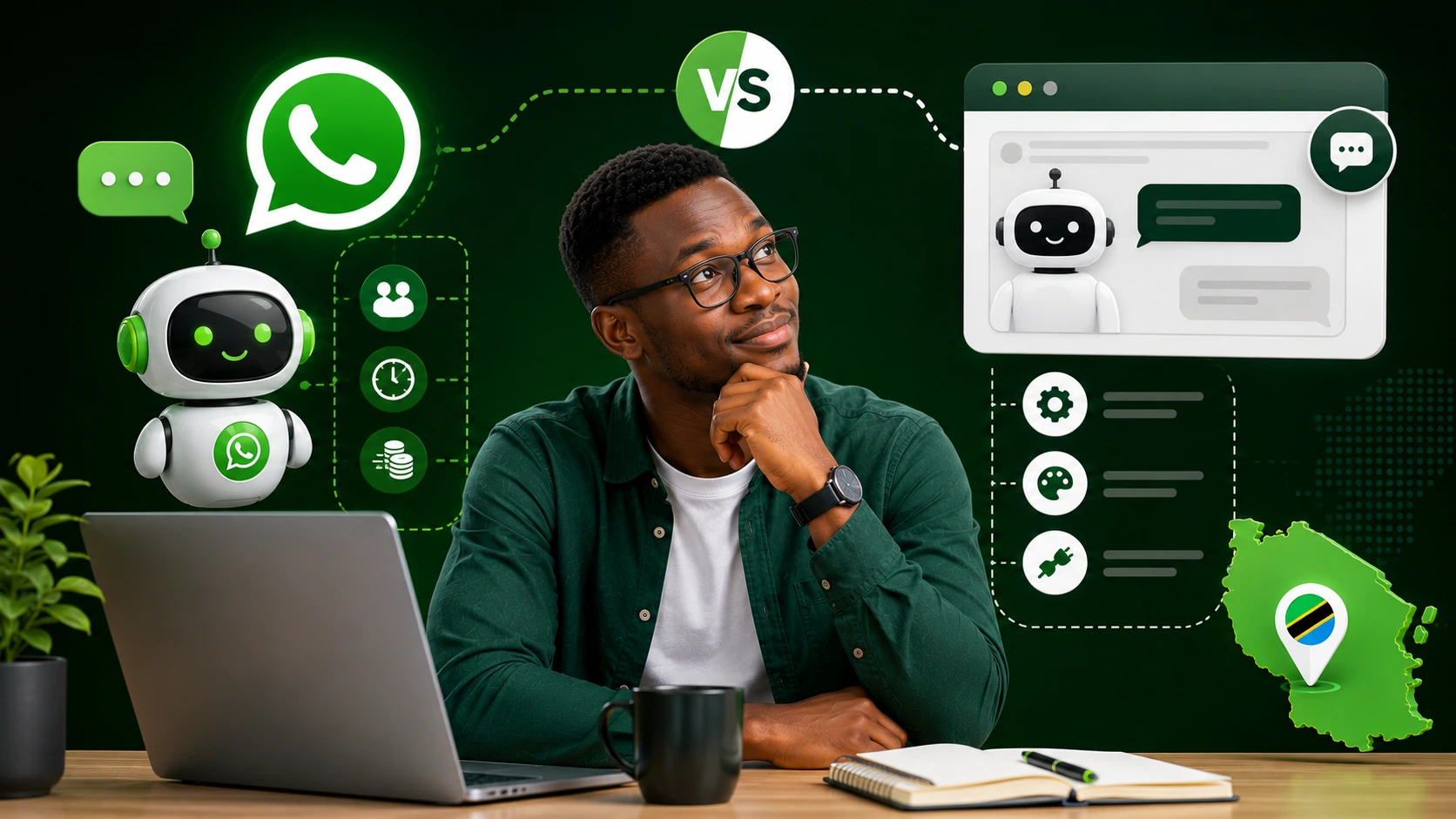
Neither WhatsApp chatbots nor website chatbots are universally "better." WhatsApp chatbots win on reach, open rates, and conversational depth in Tanzania, where WhatsApp adoption sits among the highest in Africa. Website chatbots win on lead capture from organic and paid traffic, anonymous browsing support, and direct purchase flows. The strongest setup for Tanzanian businesses is to deploy both channels under a single AI assistant, so customer context follows the conversation wherever it begins.
If you run a business in Dar es Salaam, Arusha, Mwanza, or Dodoma, you already know two things are true at the same time. Your customers live on WhatsApp. And your customers also Google your products, visit your website, and expect a reply before they leave the page.
This puts every Tanzanian business owner in front of the same decision. Do you put your AI chatbot on WhatsApp, where everyone already chats? Or do you put it on your website, where buying intent is highest? Most "WhatsApp vs website chatbots" comparisons online are written for American or European markets where SMS, email, and Slack still dominate. They miss the reality on the ground here, where WhatsApp is the default inbox, mobile money is the default wallet, and a missed reply at 9pm is a lost sale by morning.
This guide breaks down the real differences between the two channels for Tanzanian SMEs and mid-sized corporates. We cover reach, conversion behaviour, costs, integration, TCRA compliance, and the industries where each one outperforms.
We also show why most growing businesses end up running both, powered by one connected AI assistant. By the end, you'll know exactly which chatbot model fits your business, and how Notify Africa's AI assistants close the gap between the two.
Before comparing the two, it's worth defining each one clearly, because they're often confused.
A WhatsApp chatbot is an AI-powered assistant that runs inside the WhatsApp Business Platform. Customers message your verified business number, and the bot replies in real time, just like a human agent. It can answer questions, send catalogues, take orders, push payment links, send M-Pesa confirmations, and hand off to a live agent when needed.
A website chatbot is an AI assistant that sits inside a chat widget on your website, usually in the bottom-right corner. Visitors click the bubble, type a question, and the bot answers in real time. It can guide visitors to products, qualify leads, book appointments, troubleshoot orders, and capture contact details before the visitor leaves.
Both run on the same underlying technology. According to Gartner, 70% of customer interactions will involve emerging technologies like chatbots and messaging apps by 2026, up from 15% in 2018. What changes is the channel they live on, the audience they reach, and the type of conversation each one is best designed for.
For a deeper view of how AI assistants can sit on top of your messaging infrastructure, see our AI chatbots and assistants overview.
Here is the short version of the comparison most Tanzanian business owners are looking for.
Reach WhatsApp chatbots reach virtually every smartphone user in Tanzania. Website chatbots only reach people who actively visit your site.
Open And Response Rates
WhatsApp messages see open rates above 95%. Website chats only happen when a visitor is on the site and chooses to engage.
Conversation Persistence
WhatsApp conversations stay in the customer's chat history forever. Website chats vanish when the tab closes unless you've integrated a CRM.
Anonymous Engagement Website chatbots can talk to anonymous visitors. WhatsApp chatbots always know the customer's phone number from message one.
Buying Intent Website chatbots catch customers at peak buying intent (they're already on the product page). WhatsApp chatbots catch customers at peak comfort (they're already in a familiar app).
Cost Structure WhatsApp uses Meta's per-message pricing model that rolled out fully on 1 July 2025. Website chatbots are usually flat-rate platform fees with no per-message charge.
Compliance Overhead WhatsApp requires opt-in, business verification, and template approval through Meta. Website chatbots have lighter onboarding but still fall under TCRA's data protection rules for any customer data collected.
Best For WhatsApp wins for support, reorders, payment confirmations, and conversational commerce. Website wins for lead capture, product discovery, demos, and serving anonymous traffic.
Now let's look at each channel in detail.
Website chatbots have a specific superpower that WhatsApp cannot match. They catch buyers in motion.
When someone lands on your pricing page, your service page, or your contact page, they're showing intent. Website chatbots intercept that intent before the visitor leaves. According to chatbot adoption research, 85% of chatbot deployments still start on company websites, which makes sense because that's where most paid traffic and SEO traffic ends.
A website visitor can chat with your bot without sharing their name, phone number, or email. That removes friction at the top of the funnel. People who would never voluntarily WhatsApp a stranger will type a question into a chat widget. Once the bot adds value, capturing the phone number for follow-up becomes easy.
For e-commerce, SaaS, and service businesses, the website chatbot is the closest tool to a salesperson standing next to a customer in a shop. It sees the product page the visitor is viewing, it knows the cart contents, and it can recommend the next step in real time. Strategically deployed AI sales chatbots are reported to lift conversion rates by 23% to 70%.
A website chatbot can hand the visitor a calendar to book a meeting, a form to apply for a loan, a payment button to checkout, or a document to download — all without leaving your domain. Everything stays inside your branded environment.
Website chatbots don't pay Meta per message. They pay a flat platform fee. For a high-traffic site, this can be dramatically cheaper than running every conversation through WhatsApp Business API.
The catch?
Website chatbots are completely dependent on someone visiting your site. No traffic means no conversations. If most of your customers in Tanzania come from word of mouth, WhatsApp groups, or Instagram DMs rather than Google, your website bot will sit quiet for most of the day.
Turn Every Website Visitor Into A Conversation
Deploy a Notify Africa AI assistant on your site and start qualifying leads while you sleep.
Get Started FreeWhatsApp chatbots have a very different superpower. They live where your customers already live.
In Africa, WhatsApp had more than 320 million users in 2025, with Kenya at 97% penetration and South Africa at 96% among internet users. Tanzania sits inside the same band. That means a WhatsApp chatbot can reach a customer on their commute, in a market, in a meeting, or at home in Mbeya — without that customer needing to know your URL, install your app, or remember your business name.
WhatsApp messages open at over 95%. Email hovers around 20%. SMS sits between the two for transactional messages. When a WhatsApp message lands, customers actually see it. That alone makes WhatsApp a serious channel for any business doing remarketing, appointment reminders, or order updates. Combined with our bulk SMS platform, it gives Tanzanian businesses two of the highest-converting outbound channels in one inbox.
A WhatsApp chat is permanent. The customer can scroll up two months later, see your earlier reply, and continue the conversation. That continuity is impossible with a website chat widget that disappears on page close. For Tanzanian businesses doing repeat sales (pharmacies, salons, restaurants, logistics, schools), this persistence is gold.
WhatsApp supports product catalogues, payment buttons, locations, documents, voice notes, and quick replies. Customers can browse, ask, and pay inside the same thread. This is the engine behind conversational commerce, projected to exceed $290 billion globally by 2025 according to Juniper Research, with African markets among the fastest-growing contributors.
For many Tanzanian customers, especially older buyers and rural buyers, WhatsApp is more trusted than an unfamiliar website. There's no fear of "is this a fake site?" The blue verified tick on a WhatsApp Business account does the trust work for you.
The catch? WhatsApp requires a more structured onboarding. You need a verified WhatsApp Business Account, approved message templates for outbound campaigns, and adherence to Meta's per-message pricing model that fully rolled out on 1 July 2025.
You also need to manage the 24-hour customer service window correctly to avoid unnecessary template charges.
This is exactly the layer Notify Africa's WhatsApp Business solution handles for Tanzanian businesses, so you focus on the conversation, not the compliance plumbing.
No channel is perfect. Both have honest weaknesses worth understanding before you commit.
Where Website Chatbots Fall Short
Website chatbots only work when someone is actively on your site. If your traffic is seasonal, low, or concentrated to one referral source, the chatbot is idle most of the time. They also struggle with returning customers because chat history is usually lost between sessions unless your CRM is tightly integrated. Mobile users on slow connections sometimes never see the chat widget load, especially on older Android phones common across upcountry Tanzania.
Where WhatsApp Chatbots Fall Short
WhatsApp chatbots cannot talk to anonymous visitors. The customer has to initiate or accept the chat first. Outbound marketing requires Meta-approved templates, which adds 24 to 72 hours of lag for new campaigns.
WhatsApp also has strict policies on what kind of content can be sent in marketing templates, and a single policy violation can suspend your number. Per-message pricing under the new 2025 model means that high-volume marketing pushes need careful planning, unlike a website chat that's a sunk platform cost.
Where Both Fall Short Without AI
A scripted chatbot using only buttons and decision trees frustrates customers quickly. As of 2025, customers expect conversational intelligence, not "Press 1 for sales, Press 2 for support."
Without modern AI behind the bot, the conversation collapses the moment a customer phrases their question in a way your script didn't expect. This is where a properly trained AI assistant becomes the difference between automation that converts and automation that annoys.
Cost is the conversation every business owner in Tanzania wants to have, so let's be specific.
Most platforms charge a monthly subscription, sometimes tiered by number of conversations or contacts. There's no per-message charge. For Tanzanian businesses with steady website traffic and high session quality, this is often the cheaper option on a per-conversation basis once volume is meaningful.
WhatsApp Business Platform pricing changed significantly on 1 July 2025, when Meta moved from conversation-based to per-message pricing for outbound templates. The headline points for Tanzanian businesses sending messages to "Rest of Africa" rates are:
Service messages (replies inside the 24-hour customer service window) are free Marketing template messages, utility templates, and authentication templates are priced per message Inbound customer messages remain free for the business
This means a chatbot that mostly responds to incoming customer questions costs almost nothing in messaging fees. A chatbot that pushes high-volume marketing campaigns has a direct per-message cost you need to plan for.
Both channels also have a third cost: the AI itself. The chatbot needs to be trained on your products, your tone, and your processes. A poorly built bot wastes traffic on both channels. A well-trained AI assistant earns its keep within weeks, regardless of where it's deployed. That's the layer Notify Africa is built to deliver.
Get A Custom Quote For Your Business
We'll size your AI chatbot setup for Tanzania's WhatsApp and website traffic patterns.
Talk To An ExpertThe clearest way to decide between the two is to map them to actual jobs your customers want done. Here's how the channels split across the most common Tanzanian use cases.
Capturing leads from organic search traffic, qualifying anonymous visitors before they sign up, guiding buyers through a multi-step checkout, booking demos for B2B SaaS, answering pre-purchase product questions, supporting an online application form (loans, insurance, school admissions), and serving visitors who came from Google Ads on a landing page.
Order confirmations and delivery updates, M-Pesa or Mixx by Yas payment receipts, appointment reminders for clinics and salons, customer support for repeat buyers, conversational sales (catalogue browsing inside chat), reordering for restaurants and pharmacies, school fee reminders, microfinance loan repayments, and last-mile logistics updates for drivers and customers.
Most growing Tanzanian businesses need both because their customers move between the two. A first-time visitor lands on your site from Google, asks the website bot a question, then opts to continue on WhatsApp because that's where they live. A returning customer pings you on WhatsApp, but needs to fill in a form that sits on your website. If the two channels are connected by one AI assistant, the customer never repeats themselves. If they're disconnected, you lose the sale to friction.
Reading this far, the verdict should be clear. Asking "WhatsApp or website chatbots, which is better?" is the wrong question for most Tanzanian businesses. The right question is: "How do I make sure my AI assistant follows my customer between WhatsApp and my website without losing context?"
That is exactly what Notify Africa's AI assistant solution is built to do.
The same AI assistant answers on your website and on WhatsApp. It knows your products, your pricing, your delivery zones, your refund policy, and your tone of voice. A customer asking about a product on your site at lunchtime and following up on WhatsApp that evening continues the same conversation without repeating themselves.
Generic chatbots fail in Tanzania because they don't understand "iko wapi" or "lini itafika" or "M-Pesa bado haijafika." Notify Africa's assistants are trained on your actual business data and tuned for bilingual Swahili and English conversations.
The same conversation can trigger an SMS reminder, a WhatsApp follow-up, or a callback request for a human agent. Bulk SMS, WhatsApp Business, and AI assistants all run on one platform with shared customer profiles. For Tanzanian businesses, this means the conversation never breaks because of channel boundaries.
Local Speed Notify Africa's infrastructure is optimised for Vodacom, Airtel, Mix by Yas, and Halotel, with a 98.5% delivery rate, 99.9% uptime, and 24ms average latency. Your AI replies arrive at WhatsApp speed regardless of which Tanzanian network the customer is on. For deeper context on infrastructure choices, see our guide to choosing an SMS gateway in Tanzania.
The entire platform sits on infrastructure delivered by iPF Softwares, an ISO 27001:2022 certified software development company. For banks, microfinance lenders, and any business handling customer financial data, this matters.
Here is the path most Tanzanian businesses take when moving from no automation to a working AI assistant.
Step 1: Define The Two Or Three Conversations You Most Want To Automate
Don't try to automate everything on day one. Pick the highest-volume, most repetitive customer questions. For most businesses, this is order status, pricing, hours, and basic product info. These five conversations alone usually account for 70% of inbound volume.
Step 2: Choose Your Primary Channel
If most of your customers reach you on WhatsApp today, start there. If most of your traffic comes from Google or paid ads, start with the website chatbot. Don't build both at once. Win one channel, then add the other.
Step 3: Train The AI Assistant On Your Business Data
Feed it your product catalogue, your FAQ, your pricing, your return policy. The richer the training data, the better the answers. This is where Notify Africa's onboarding team adds the most value, especially for businesses without internal AI expertise.
Step 4: Set Clear Escalation Rules
The AI should know when to hand off to a human agent. A loan applicant asking about late repayment penalties needs a human. An order tracking question does not.
Step 5: Measure And Refine Weekly
The first month is a learning phase. Watch where the bot fails, what questions it misses, and which conversations convert. Update the training data. Within 60 days, most businesses see automation handling 60% to 80% of routine conversations.
Step 6: Add The Second Channel
Once the first channel is humming, add the second. Now your AI assistant follows the customer everywhere.
Start Your AI Chatbot Setup Today
Free account, Tanzanian onboarding team, ready in days.
Create Free AccountFor most Tanzanian businesses, WhatsApp chatbots reach more customers because WhatsApp penetration is near-universal among smartphone users in the country. However, website chatbots convert better for cold traffic arriving from Google, paid ads, or first-time research, since visitors can engage anonymously. The strongest setup deploys both channels under a single AI assistant so context follows the customer.
Yes. The whole point of a modern AI assistant is that the underlying intelligence is channel-agnostic. Notify Africa's AI assistants are trained once on your business and deployed across both WhatsApp and your website, with shared customer history so a conversation that starts on your site can continue on WhatsApp without repetition.
Yes. The standard WhatsApp Business app supports manual replies and basic automation, but proper chatbot deployment requires the WhatsApp Business Platform. The API enables multi-agent handling, template approval, CRM integration, and AI assistants. Notify Africa handles the API onboarding and verification process for Tanzanian businesses.
Yes, but the experience depends on how the widget is built. Modern chat widgets are designed to be responsive, lightweight, and fast on slow connections, which is critical in upcountry Tanzania where 3G is still common. Notify Africa's website chat widget is optimised for low-bandwidth conditions on Vodacom, Airtel, Mix by Yas, and Halotel networks.
A well-trained AI chatbot can handle 60% to 80% of routine, repetitive conversations, which frees your human team to handle complex sales, complaints, and high-value cases. The goal is augmentation, not replacement. The businesses that report the strongest results from AI chatbots are the ones that combine the bot's speed with a clear handoff to a human agent when the conversation needs judgement.
Final Verdict
The honest answer to "WhatsApp vs website chatbots, which is better?" is that the question itself is outdated. Both channels matter. WhatsApp chatbots win on reach, open rates, and conversational depth in Tanzania. Website chatbots win on lead capture, anonymous engagement, and direct purchase flows. Trying to choose one and ignore the other means leaving sales on the table.
The businesses that grow fastest in Tanzania over the next two years will be the ones running a single AI assistant connected to both. One brain. Two channels. Continuous context. Local network reliability. TCRA compliance built in. That's exactly the model Notify Africa is built to deliver, on infrastructure trusted by SMEs and corporates across Dar es Salaam, Arusha, Mwanza, Dodoma, and beyond.
Key Takeaways
WhatsApp chatbots dominate for reach, repeat customer engagement, and conversational commerce in Tanzania
Website chatbots dominate for lead capture, anonymous traffic, and direct purchase flows
Cost models differ — WhatsApp uses per-message pricing post-July 2025, websites use flat platform fees
Compliance under TCRA and data protection rules applies to both channels
The strongest setup combines both, powered by a single AI assistant trained on your business
If you're ready to deploy an AI assistant that follows your customers across WhatsApp and your website without losing context, the Notify Africa team is ready to scope it with you.
Ready To Win Both Channels?
Set up your WhatsApp and website AI chatbot with Notify Africa today.
Start For Free
A solution by iPF Softwares, an ISO 27001:2022 certified software development company.